By Anna Zhila
Ace Frehley is gone. The Spaceman.
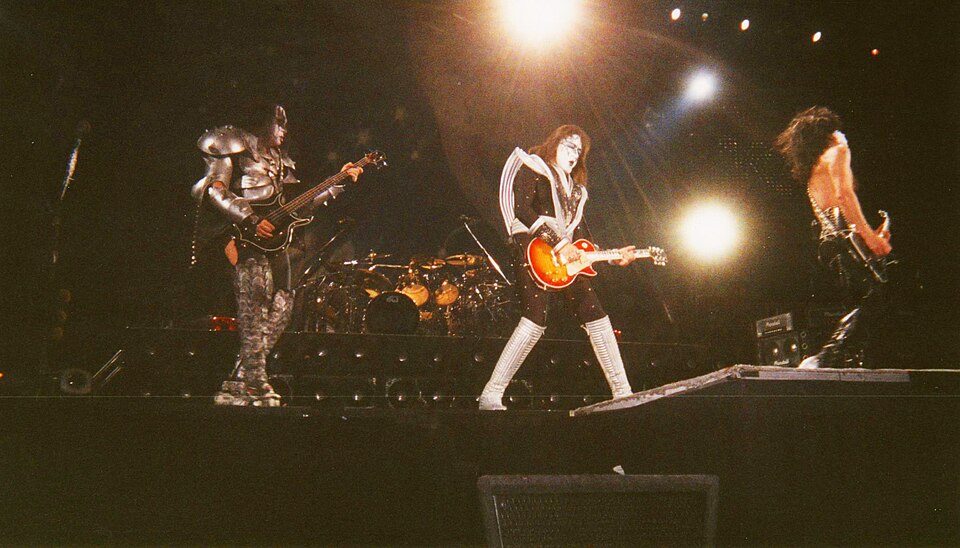
And the first thing you think of, of course, is the makeup. The silver stars, the platform boots, the guitar that shoots rockets. The whole ridiculous, brilliant pantomime of it all. Kiss. It was a cartoon, a brand, a lunchbox, before it was ever really a band.
But that was never the real story, was it?
The real story, the one that actually mattered, was the guy underneath the greasepaint. The kid from a street gang in the Bronx who showed up to his big audition wearing one red trainer and one orange one. You read that and you think, that’s it. That’s the whole story right there. That’s not a brand strategy. That’s not a calculated image. That’s just… a guy. A guy with a guitar and a certain kind of chaotic energy.
They put an ad in the paper, Gene Simmons and Paul Stanley. They were looking for a guitarist “with fire”. And fire is what they got. But the thing about fire is, it’s not particularly interested in your business plan. It just burns.
You have to remember what Kiss became. A corporation. A well-oiled marketing machine. Simmons and Stanley were businessmen, sharp as a tack. They understood logos and licensing and market penetration. They were building an empire. And in the middle of this meticulous construction project was Ace Frehley. The Spaceman. The guy who just wanted to plug in his Les Paul and make a glorious noise.
He was the chaos agent. The necessary grit in the oyster. He designed their famous logo, the one with the lightning-bolt ‘S’s, and then had to spend the rest of his life explaining he wasn’t thinking about the Nazis, he was just thinking about… well, lightning bolts. Of course he was. He was the fire, not the marketing department.
At first, I thought his story was just another rock and roll cliché. The talented but unstable one who couldn’t handle the success. But then I looked closer. It’s not that he couldn’t handle it. It’s that his entire being was at odds with the machine he was helping to build.
It’s like they’d built this perfect, high-performance German car. Every part engineered for maximum efficiency. Simmons and Stanley were the designers, poring over the blueprints. And Ace was the engine. A ridiculously powerful, custom-built, slightly faulty engine that they’d somehow managed to bolt into the chassis. It made the car thrilling, unpredictable, and liable to backfire spectacularly at any given moment. But without it, it was just a very well-made, very boring box.
Think about the key moments. He gets electrocuted on stage in Florida. Nearly dies. A proper, terrifying rock and roll moment. And what does he do? He gets back up, finishes the show, and then goes and writes a song about it. ‘Shock Me’. And it’s one of the best things they ever did. The chaos produces the art. The machine could never have written that song. It took the guy who was dumb enough or brave enough or high enough to nearly die on stage to do it.
And then there’s the solo albums in ‘78. The ultimate marketing gimmick. Four members, four solo records, released on the same day. A display of brand unity. And what happens? The Spaceman, the drunk, the one they were all starting to get tired of, has the only massive hit. A cover of a song he didn’t even want to record. It’s perfect. It was a sign that he had the magic, the groove, the actual connection to the audience that the others were trying to manufacture.
The fall, when it came, was predictable. The booze, the drugs, the car crashes. The fire burns itself out. That’s part of the deal. That’s the price of being the engine, not the engineer. I remember seeing one of the reunion shows in the 90s. He looked a bit lost, a bit sloppy. The machine had been rebuilt around him, but you could still see that spark. The thing you couldn’t fake.
But the most important part of his story isn’t the fall. It’s the getting back up.
And it wasn’t some rock-god moment of clarity on a mountaintop. It was a phone call from his daughter. “Papa, it’s time to stop.” A simple, human moment that cuts through all the smoke bombs and the platform boots. It wasn’t a rock star making a decision. It was a dad. And he did it. He got sober. He started helping other people.
That’s the part of the story that doesn’t fit the cartoon. The quiet strength. The survival.
So what are we left with? A legacy of great guitar riffs, sure. But it’s more than that. Ace Frehley’s story is the story of the battle for the soul of rock and roll. The battle between the art and the industry, the chaos and the control, the fire and the machine. He was the authentic part of a band that became a product. He was the human heartbeat inside the suit of armour.
He was the ghost in the machine. And now the ghost is gone.