By Nicole M. Mayer
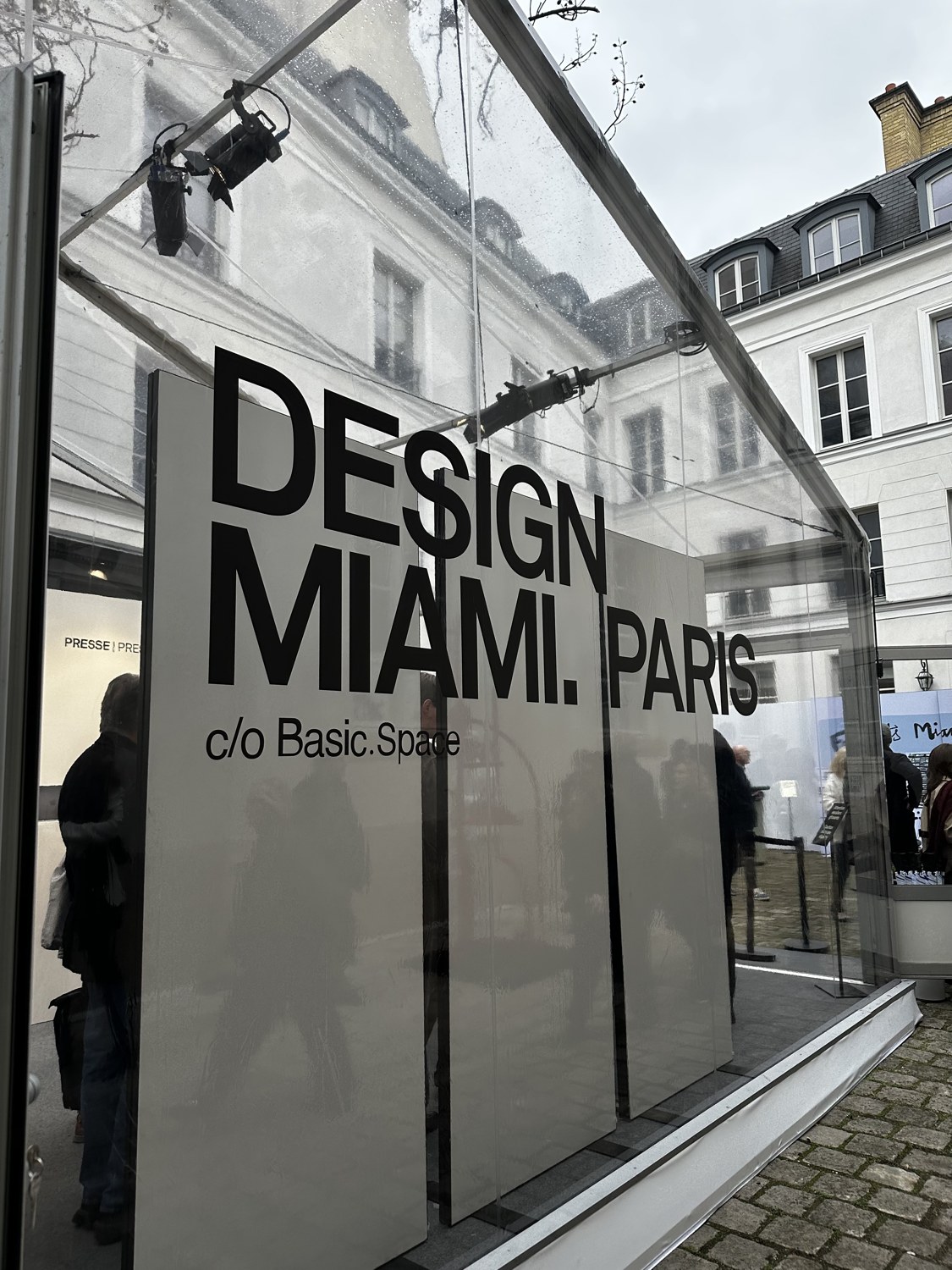
On Tuesday, October 20, the streets of Paris’s Saint-Germain neighbourhood were filled with the international art and design crowd gathered for the city’s annual autumn fairs. At 51 rue de l’Université, visitors passed through the monumental entrance of the Hôtel de Maisons, leaving the rain-soaked street behind for a cobblestoned courtyard and the imposing façade of an 18th-century private residence.

The Hôtel de Maisons is a historical mansion whose past occupants include the Pozzo di Borgo family and, later, Karl Lagerfeld. Design Miami Paris took over for five days, and its historic interiors and grounds brought contemporary collectible design into dialogue with the building’s architectural past.
When I think back on this year’s edition of Design Miami Paris, it is the lighting that stays with me. Among the furniture, sculptural objects and collectible works exhibited throughout the Hôtel de Maisons, I found myself repeatedly returning to the lamps and chandeliers. It was not necessarily the most technically complex or imposing examples that caught my attention, but those that challenged the conventions of lighting design, using illumination as a means of exploring material and form.
Light presents an unusual challenge for the designer. It is something we experience rather than hold, yet its effect depends on the physical properties of the objects through which it travels. Glass tints it, resin can turn a whole surface into colour, fibres break it up. Even materials traditionally considered unsuitable for lighting can become part of its expression. A lamp is therefore never simply a vessel for a light source. Its material determines what we see, what remains hidden and how illumination occupies a space.
Bronze and Glass at Nilufar
At Nilufar, Christian Pellizzari’s Heliconia brought together bronze and Murano glass in an elaborate ceiling lamp. Its branching form gave the piece an almost botanical quality, which was further developed in this year's version through the addition of seashells in place of what were flowers in the previous iterations.
Looking at the lamp, I was struck by the distinct roles played by its two materials. Bronze gives it its framework, while the coloured Murano glass introduces points of colour and changes the character of the light. There is an interesting tension between the solidity of the metal and the delicacy of the glass, which gives the piece much of its appeal.
What I found most appealing was how the lamp held these two qualities together. Illumination becomes one aspect of the piece rather than the sole reason for its existence. Its elaborate construction gives it the presence of a decorative sculpture, even when the light itself is switched off.

Fabric at Pulp Galerie
At Pulp Galerie, I encountered a different approach to lighting in Gaetano Pesce’s Canovacci, a series of glass lighting pieces produced in 1981 in collaboration with the renowned Italian glassmaker Venini. The wall lights grew out of Pesce’s exploration of a familiar domestic gesture: hanging garments from clothes pegs.
Although made from glass, the piece has a surprisingly soft, almost pliable resin-mimicking appearance. Through its irregular shape and texture, the glass takes on qualities more commonly associated with fabric, evoking folds of material suspended from a line. Pesce’s treatment of the glass gives it an unexpected sense of movement, transforming a traditionally rigid material into something that appears almost textile-like.
What struck me was the contrast between the material and the form it was made to suggest. The glass had an irregular, almost crumpled surface, giving it the appearance of fabric caught mid-fold. Suspended from its bronze support, it seemed to hang with a softness that was at odds with the material's inherent rigidity.

Hair at The A/P Room
One of the more unusual material combinations I encountered was at the presentation by Dubai-based gallery The A/P Room. California-based artist Rogan Gregory’s Originform collection paired bronze and alabaster with goat fur and horsehair in a series of sculptural lights.
The use of hair and fur introduces an entirely different relationship with light. Rather than relying on a conventional shade or exposed light source, Gregory allows the fibres to become part of the visual effect, with illumination emerging through and around their strands. The material lends the pieces a softness and irregularity that contrasts with the solidity of the bronze and alabaster.
The biomorphic quality of the pieces is worth examining more closely, too. Their irregular silhouettes and textured surfaces suggested organic forms without quite resembling any recognisable creature. This ambiguity was part of their appeal: although clearly designed as functional lighting, they seemed to occupy an unusual space between domestic object and something almost animate.

Beyond the Functional Object
Looking across these three pieces, what interested me most was not a particular aesthetic or a common design language, but the variety of ways in which material could determine the experience of illumination.
Together, these works demonstrate how much material contributes to the identity of a lighting object. Bronze and glass lend Pellizzari’s lamp its decorative presence, Pesce manipulates glass to mimic textile, while Gregory explores the sculptural possibilities of animal fibres. Each offers a different understanding of what a lamp can be, extending its role beyond illumination.
One limitation of the exhibition was that the works were displayed in rooms already filled with natural and ambient light, filtering in through the Hôtel de Maisons' windows and open doorways. This made it difficult to fully appreciate their lighting performance, particularly how each material transformed the atmosphere of a space in darker conditions. I therefore found myself considering the lamps as much for their sculptural and decorative presence as for their function.
Perhaps this is what makes lighting such a compelling field within collectible design. A lamp must contend with two distinct roles: it is an object with its own material and sculptural identity, but also one that changes the way a space is experienced. At the same time, its surroundings influence how the object itself is perceived. The works at Design Miami Paris offered three different interpretations of that relationship.