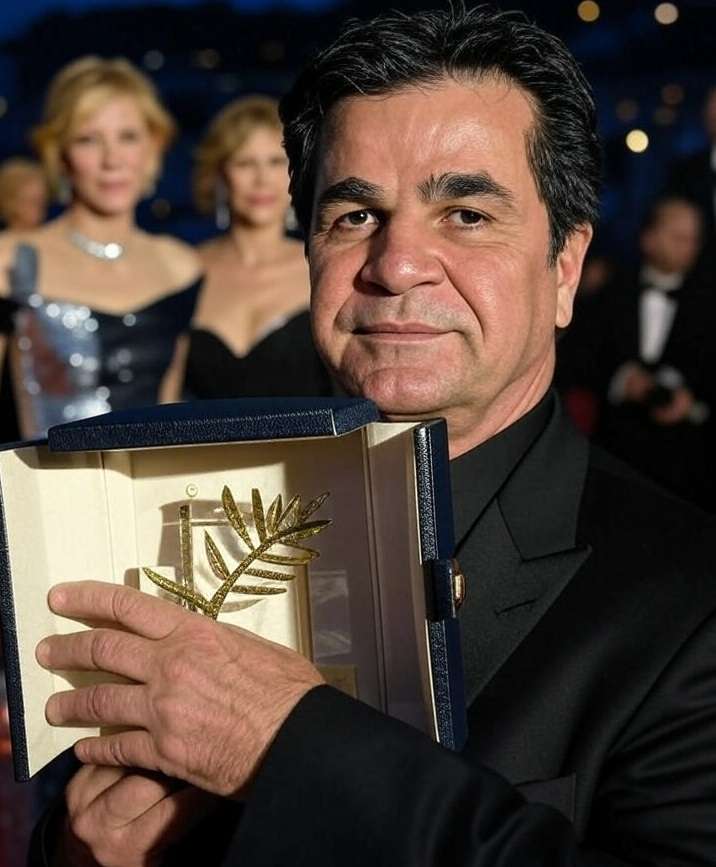
The Riviera's grand theatre, the 78th Cannes Film Festival, concluded its dazzling run not with a gentle dimming of the lights, but amidst an unforeseen maelstrom, yet ultimately delivering a moment of profound artistic justice. The coveted Palme d'Or, that most illustrious of cinematic laurels, was bestowed upon the Iranian auteur Jafar Panahi for his eleventh feature, "It Was Just an Accident." This singular triumph, for a film audaciously crafted in secret within his homeland, resonated with an almost sentient awareness of its own significance, a powerful affirmation of creative indomitability against formidable odds. ArtCulture.UK will tell you about Panahi’s remarkable ascent to this pinnacle, the constellation of other talents recognised, and the extraordinary, often chaotic, circumstances that framed the closing hours of a festival pulsating with political charge and unforgettable cinema.
A resilient artist's voice
Jafar Panahi's journey to this zenith of cinematic recognition is a saga of unwavering artistic courage and profound personal integrity. A filmmaker whose lens has consistently, and often critically, examined Iranian society, Panahi has faced a litany of state-imposed obstacles: imprisonment, debilitating travel bans, and an official prohibition on filmmaking that would have silenced a less tenacious spirit. Yet, through ingenious and courageous circumvention, he has continued to produce an extraordinary body of work, each film a testament to his sharp socio-political insight and his deep empathy for the human condition. His physical presence at Cannes this year, following his release from an Iranian prison in 2023, marked a poignant return after a 22-year enforced absence. To see him accept the Palme d'Or under such circumstances transcends mere cinematic achievement; it stands as a potent symbol of artistic freedom and the unyielding resilience of the creative spirit against oppressive forces. The fact that the jury was presided over by Juliette Binoche, who in 2010 famously held up a sign bearing Panahi's name in solidarity during his then-incarceration, adds a layer of profound, almost fated, significance to this victory.
Accident's moral labyrinth
"It Was Just an Accident," the film that secured Panahi this ultimate honour, is described as a compelling thriller that delves into the complex, often treacherous, terrain of vengeance and mercy. The narrative is reportedly ignited by a seemingly minor road incident – the death of a dog – which unexpectedly propels the protagonist into a confrontation with a man he believes to be his former torturer. This encounter forces him onto a moral precipice, grappling with the immense weight of past physical and psychological trauma and the profound choice between exacting retribution or extending an almost unthinkable clemency. This thematic core, exploring the intricate dance between justice, memory, and forgiveness, undoubtedly draws from Panahi’s own deeply challenging experiences. His Palme d'Or win completes an extraordinary "trifecta" of top awards from the world's most prestigious film festivals, following his Golden Lion at the Venice Film Festival in 2000 for "The Circle" and the Golden Bear at the Berlin International Film Festival in 2015 for "Taxi," cementing his status as one of contemporary cinema's most vital and lauded voices.
Croisette's closing chaos
The festival's denouement was unexpectedly thrown into disarray by an unscripted drama of its own. On the very morning of the closing ceremony, a significant power outage engulfed Cannes and its surrounding areas, affecting an estimated 160,000 households and businesses. The blackout, attributed to a fire at a crucial electrical substation – with disquieting reports of a sawn pylon nearby fuelling suspicions of sabotage – brought an abrupt halt to film screenings, crippled internet connectivity vital for the global press corps, and forced many local establishments into an improvised cash-only economy, made all the more difficult by non-functional ATMs. A city famed for its luminescence was plunged into an unnerving twilight. The iconic Palais des Festivals itself was compelled to switch to backup generators, a logistical feat that allowed the awards ceremony to proceed, albeit under a palpable cloud of tension and uncertainty. This unexpected disruption served as a stark, almost metaphorical, counterpoint to the artistic light the festival strives to shine.
Red carpet resilience
Despite the pervasive uncertainty, as evening descended, the crimson carpet leading into the Palais des Festivals saw a parade of stars, their presence a testament to the festival's enduring magnetic pull and the industry's collective determination. The ensemble cast of Joachim Trier’s highly praised "Sentimental Value," including Renate Reinsve, Elle Fanning, and the distinguished Stellan Skarsgård, graced the event with their customary elegance. Cinematic titans such as Cate Blanchett and Jane Fonda also made their appearances, underscoring the gravitas of the occasion. Naturally, Juliette Binoche, as President of the Main Competition Jury, led her panel of esteemed international film figures – a diverse group including Halle Berry, Alba Rohrwacher, and Jeremy Strong – who had faced the unenviable task of their final deliberations amidst the day's unfolding disruptions. Their composure and commitment ensured the integrity of the awards process.
Jury's diverse acclaim
The awards ceremony, once underway, painted a rich portrait of contemporary global cinema. The prestigious "Golden Camera" for best debut feature was awarded to "A Cake for the President," a poignant narrative by Iraqi director Hassan Hadi, telling the story of a young schoolgirl in 1990s Iraq who undertakes the task of baking a birthday cake for Saddam Hussein. In the realm of short-form cinema, the award for Best Short Film was bestowed upon "It's Good You're Dead Now," a compelling work by Palestinian-French filmmaker Toufik Barhom, exploring the encounter of two brothers with their shadowed past.
The Special Jury Prize recognised the ambitious vision of Chinese director Bi Gan for his experimental, nearly three-hour cinematic tapestry, "Resurrection." The Jury Prize itself was shared between two powerful and stylistically distinct films: "Sirat," from Spanish director Oliver Laxe, a visually arresting odyssey following a father's search for his daughter lost at a rave in the Moroccan desert, and "The Sound of Falling," by German filmmaker Mascha Schilinski, a thoughtful multi-generational drama examining inherited trauma through the prism of four women's lives in 20th-century Germany.
Individual and directorial brilliance
The Belgian masters of social realism, Jean-Pierre and Luc Dardenne, added another laurel to their distinguished careers, receiving the Best Screenplay award for their latest incisive drama, "Young Mothers." Brazilian actor Wagner Moura delivered a performance of significant impact, earning him the Best Actor prize for his role in "The Secret Agent," where he portrays a father compelled to conceal his identity to evade assassination during Brazil's oppressive military dictatorship. The film's director, Kleber Mendonça Filho, was also honoured for his masterful helming, receiving the award for Best Director. "The Secret Agent" has already been acquired by Russian distributors A-One Films, promising its potent narrative will reach audiences there. In a heartening nod to emerging talent, Nadia Melliti, a debutante actress, received the Best Actress award for her compelling portrayal in "The Youngest Sister," a film that explores the life of a young girl from an Algerian immigrant family in Paris.
Trier's grand recognition
The Grand Prix, the festival's esteemed second prize, was awarded to the Norwegian director Joachim Trier for his keenly observed and emotionally resonant film "Sentimental Value." This intricate family drama features Stellan Skarsgård as an ageing, celebrated filmmaker who, in an attempt to mend a fractured relationship with his actress daughter (played by Renate Reinsve), invites her to star in his most deeply personal cinematic endeavour. In his acceptance speech, Trier offered a poignant reflection on the power of art, describing international cinema as a vital "alternative language of unity." "Sentimental Value" is also set for Russian distribution via A-One Films, ensuring Trier's nuanced exploration of human relationships will find a broader international viewership.
A festival of substance
The 78th iteration of the Cannes Film Festival served as a powerful mirror to a world in flux, showcasing a significant number of films that grappled with potent political realities, with narratives emanating not only from Iran but also from Iraq, Gaza, Israel, and Ukraine. The jury's decision to award the Palme d'Or to a film made under conditions of extreme duress, by a director who has so fearlessly championed the cause of artistic freedom, powerfully underscores the festival's enduring commitment to cinema that dares to engage with the urgent social and political questions of our time. Jafar Panahi's victory transcends the realm of artistic achievement; it resonates as a profound symbol of hope, an eloquent testament to the indomitable courage required to speak truth to power through the luminous medium of film.
As the metaphorical, and for a period quite literal, darkness lifted from the Croisette, the enduring glow of Panahi's triumph, alongside the rich tapestry of voices celebrated, ensures that the dialogues ignited at Cannes will reverberate long after the red carpets are rolled away. The remarkable resilience demonstrated by the festival's organisers, its jury, and its attendees in the face of such unexpected adversity further illuminated the unwavering passion and collective spirit that animate this unparalleled cinematic convocation.