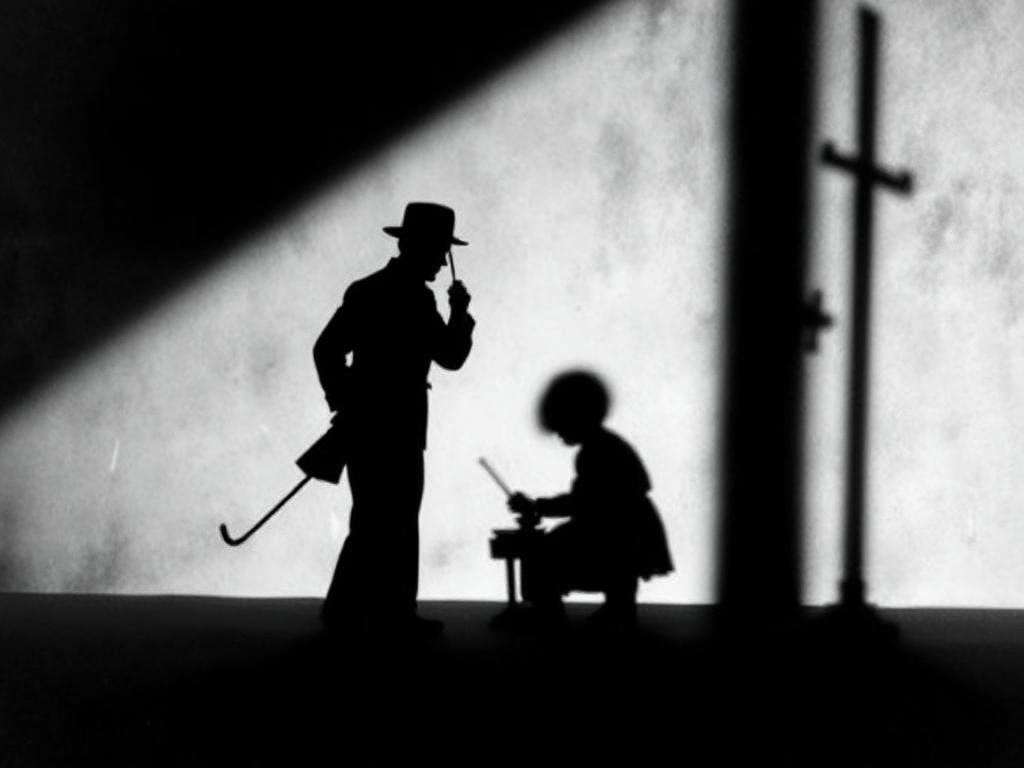
The flickering images of the silver screen, those ghosts of light and shadow, often hold more secrets than they project; indeed, cinema itself possesses a peculiar sentience, an ability to absorb and reflect the hidden currents of its creators' lives. For decades, the silhouette of the Little Tramp has defined not just an era of filmmaking but a universal understanding of comedic genius and poignant humanity. Charlie Chaplin, a titan of cinematic history, remains an endlessly fascinating figure, his work analysed and revered across continents. Yet, even giants cast long shadows, and within those penumbras, stories can lie dormant for generations, awaiting the precise moment of rediscovery. ArtCulture.UK will tell you about a tantalising new claim, emerging from recently unearthed personal papers and scholarly investigation, suggesting a hidden chapter in Chaplin’s later life: the secret mentorship of a young, obscure European filmmaker whose own fleeting work, and potential influence, may carry an unacknowledged, yet profound, Chaplin-esque echo into the intricate tapestry of post-war European arthouse cinema.
A Startling New Claim
The assertion, poised to send ripples through film scholarship and Chaplin aficionado circles, centres on a figure hitherto relegated to the footnotes of Eastern European film archives: one Milosz Novak. According to a meticulously researched, forthcoming monograph, Chaplin's Alpine Apprentice: The Vevey Transcripts, by the respected, albeit sometimes controversial, film historian Dr. Eleanor Vance, Chaplin, during his secluded years at the Manoir de Ban in Corsier-sur-Vevey, Switzerland, engaged in a discreet but deeply influential mentorship of Novak. This relationship, Vance contends, occurring primarily between the late 1950s and mid-1960s, was deliberately kept from public view, its existence only now pieced together through a combination of newly accessible private correspondence and nuanced re-interpretations of Novak’s own sparsely available cinematic output.
Unearthing Lost Correspondence
Dr. Vance’s thesis hinges significantly on a cache of letters and journal fragments recently catalogued from a peripheral section of the Chaplin archives, combined with poignant, almost reverential, diary entries purportedly penned by Novak himself, which surfaced via a distant relative in Prague. "The connection is not overt; it is coded within shared artistic anxieties, philosophical musings on the nature of comedy and tragedy, and strikingly similar, almost allegorical, story concepts," Vance explained in a pre-publication interview. "Chaplin, in his later, more reflective phase, seems to have found in Novak a receptive, albeit melancholic, spirit upon whom he could impress his decades of cinematic wisdom, untainted by the glare of Hollywood or the burdens of his own monumental fame. One journal entry from Chaplin, dated 1961, cryptically refers to 'M.N.' as 'a flickering candle I try to shield from the wind, lest his fragile light be extinguished before its time.'" This discovery potentially recontextualises Chaplin's final years, suggesting an ongoing, deeply personal engagement with the future of his art form.
Who Was Milosz Novak?
Milosz Novak, as pieced together by Vance, was a Polish émigré filmmaker, displaced by the Second World War, who found himself drifting through the artistic undercurrents of post-war Europe. His early life remains shrouded in the mists of wartime upheaval, but he appears to have possessed a raw, untutored talent, a profound sense of visual poetry, and an almost painful sensitivity to the human condition – qualities that might well have resonated with the creator of the Little Tramp. Records indicate Novak directed only three short films and one feature, The Puppeteer’s Requiem (1964), all produced with meagre resources and achieving only limited, local festival screenings before fading into obscurity. "Novak was an enigma," Vance states. "His work, what little survives, is imbued with a tragicomic sensibility, a visual style that marries stark realism with moments of surreal, almost balletic grace. Thematic preoccupations with displacement, the search for meaning in an absurd world, and the bittersweet nature of human connection are recurrent – themes that echo Chaplin’s own oeuvre, albeit filtered through a darker, distinctly Eastern European lens."
A Clandestine Artistic Tutelage
The nature of this purported cinematic mentorship, according to Chaplin's Alpine Apprentice, was less formal instruction and more a Socratic dialogue, a sharing of philosophies and techniques. Vance posits that Novak made several discreet visits to Vevey, under the guise of a distant acquaintance of the family. "The letters suggest Chaplin provided detailed critiques of Novak’s scripts, offered insights into timing, physical comedy, and the crucial balance of sentiment and satire," Vance elaborates. "There's a fascinating passage where Chaplin advises Novak on the 'eloquence of silence' even in sound cinema, a clear nod to his own unparalleled mastery of pantomime and visual storytelling. He wasn’t trying to create another Chaplin, but rather to nurture Novak’s unique voice, using his own experiences as a guiding light." This hidden genius exchange, if verified, would add a remarkable dimension to Chaplin's legacy.
Chaplin's Veiled Motivations
Why would Charlie Chaplin, a figure of such global renown, engage in such a clandestine artistic relationship? Several theories are advanced. Chaplin, particularly after his exile from the United States, was intensely private and wary of media misinterpretation. He may have wished to shield Novak from the potentially crushing weight of association with his own legendary status, allowing the younger artist to develop independently. Furthermore, the Cold War political climate might have made an open association with an Eastern European artist problematic. "Chaplin understood the precarious dance of art and politics," notes Vance. "He himself had been a victim of ideological persecution. It’s plausible he saw in Novak not just a talent, but a kindred spirit navigating a treacherous world, and sought to offer support in the most discreet, protective manner possible." This consideration of the cultural impact of the era adds depth to the narrative.
Novak's Fleeting Cinematic Brilliance
The surviving prints of Novak’s work, primarily housed in a small film preservation unit in Warsaw, are now under intense scrutiny. The Puppeteer’s Requiem, in particular, is cited by Vance as bearing the subtle hallmarks of Chaplin’s influence. "It’s not mimicry," she insists, "but a shared DNA. The film tells the story of an elderly, itinerant puppeteer in a war-ravaged city, whose marionettes seem more alive than the traumatised humans around him. There are sequences of Chaplinesque physical comedy, precise yet imbued with pathos, and a deep empathy for the marginalised. The protagonist, much like the Tramp, is an outsider who exposes the absurdities and cruelties of society through his art." Critics who have seen the restored fragments speak of a unique visual language, a melancholy that never quite extinguishes a fragile hope, a style that, while distinct, seems to converse with Chaplin's silent film techniques translated into a post-war European arthouse idiom.
Echoes in European Auteur Cinema
Could Novak’s work, however obscure, have had a wider, albeit subterranean, influence? Vance speculates that while Novak himself remained largely unknown, his visual ideas and thematic concerns, potentially cross-pollinated through festival circuits or via other filmmakers he encountered, might have subtly permeated the nascent movements of European arthouse cinema. "It’s like a genetic marker," she suggests. "You might not see the direct lineage, but the characteristics – a certain blend of humanism, social critique, and poetic realism – appear in unexpected places. It’s a line of inquiry that demands further film history investigation, looking for these almost intangible artistic inheritances." The search for this unseen influence could redefine aspects of cinematic history.
Reframing Chaplin's Enduring Legacy
If Dr. Vance’s research withstands the inevitable academic debate, it would not diminish Chaplin’s established achievements but rather add a fascinating, deeply human layer to his later years. It would portray him not merely as a lion in winter, tending to his own myth, but as an artist still passionately engaged with the evolution of his medium, generously, if secretly, passing on his profound understanding of cinema to a new generation. This potential expansion of Charlie Chaplin's legacy underscores his commitment to the craft beyond his own performances. The concept of a cinematic heir, even one whose star barely flickered, speaks volumes about Chaplin's enduring belief in the power of film.
The Archives Await Further Scrutiny
The claims presented in Chaplin's Alpine Apprentice are, for now, a tantalising hypothesis, an invitation for further research. Film archives across Europe, private collections, and perhaps even forgotten corners of the Vevey estate itself, may hold further clues to the story of Charlie Chaplin and Milosz Novak. The possibility of a lost Chaplin connection, a secret channel of influence, reminds us that even the most documented lives can retain their mysteries, and that the history of cinema, much like the art form itself, is a story continuously unfolding, revealing new depths and unexpected turns. The full cultural impact of this potential discovery remains to be seen, but it undoubtedly ignites a fresh spark of curiosity around one of cinema’s most iconic figures and the intricate ways artistic influence can manifest.