By Anna Zhila
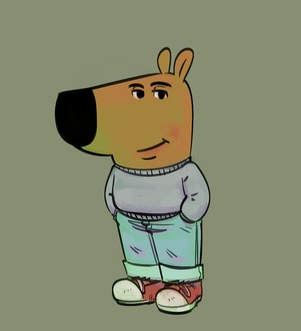
There is a new god in the digital pantheon. He is not a god of thunder, of war, or of wisdom. He is a god of quiet, of stillness, of a kind of radical, unshakeable calm. He takes the form of a simple, almost crudely drawn anthropomorphic dog, sitting in a relaxed, nonchalant posture, a faint, knowing smile on his face. He is known, simply, as the Chill Guy.
He has become an icon of our frenetic age, a soothing, low-resolution balm for our collectively frayed nerves. His image proliferates across the internet, a silent, comforting presence in a landscape saturated with rage, righteousness, and the relentless, screeching demand for our attention. But to see him as merely a symbol of serenity is to misunderstand his true, subversive power. The Chill Guy is not just a call to calm down; he is a quiet, profound, and deeply political argument for a different way of being. He is the patron saint of a new and necessary religion: the gospel of doing nothing.
The Anatomy of a Mood
The power of the Chill Guy lies in his almost aggressive lack of specificity. He is not doing anything. He is not in any particular place. He is simply being. The original illustration, born from the whimsical imagination of an independent artist, is a masterpiece of minimalist expression. The lines are clean, the posture is open, the emotional state is one of complete and total equilibrium. He is a blank canvas onto which we can project our own anxieties and our own longing for peace.
In a sense, he is the antithesis of everything the digital world is built on. The internet is a machine of perpetual motion, an endless scroll of content designed to provoke a reaction: outrage, desire, envy, laughter. It is a space that demands our constant engagement, our clicks, our comments, our shares. The Chill Guy refuses to play this game. He does not demand anything from us. He simply sits, exuding an aura of profound indifference to the chaos that swirls around him.
His posture is a form of visual shorthand for a kind of modern, pixelated Stoicism. He embodies a quiet acceptance of the world as it is, a composure in the face of its unpredictability. He is the visual equivalent of a deep, cleansing breath. He is a pause button for the soul.
The Anti-Hustle
To understand the rise of the Chill Guy, one must understand the fall of the god he has replaced: the hustle-culture influencer. For the better part of the last decade, our feeds were dominated by a very different kind of prophet. They were the manic, relentlessly positive gurus of productivity, the high-energy evangelists of the pre-dawn workout, the side-hustle, and the endlessly optimised life. They preached a gospel of constant, caffeinated striving, a belief that every moment of our lives could, and should, be monetised, leveraged, and turned into content.
The Chill Guy is the quiet, devastating correction to this philosophy. He is the anti-hustle. He offers not a 10-step plan to success, but a silent permission to opt out. His very existence is a refutation of the idea that our value is tied to our productivity. He is not grinding; he is simply sitting. He is not optimising; he is existing.
This shift represents a profound and necessary cultural exhaustion. The relentless pressure to perform, to achieve, to build a personal brand, has led to a collective state of burnout. The Chill Guy is the symbol of that burnout, but he is also its antidote. He represents a return to a more humane and sustainable way of life, one that values rest not as a weakness, but as a necessary and noble act. He is the quiet resistance to a world that wants to turn our very lives into a form of labour.
A Global Sigh
A key to the power of any modern myth is its ability to travel. And the Chill Guy is a seasoned globetrotter. His appeal is not confined to the English-speaking internet. He transcends linguistic and cultural barriers because the feeling he represents - a deep and weary exhaustion with the demands of modern life - is a universal one.
When he arrived in the Russian-speaking internet, for example, he was dubbed “Чилловый парень” (Chillovyy paren’). He was seamlessly integrated into a different cultural context, but his essential meaning remained the same. This global malleability is a testament to a shared human need. From Tokyo to Toronto, from a teenager’s bedroom to an office worker’s cubicle, the Chill Guy speaks a universal language. He is the sound of a collective, global sigh.
He also aligns with the gentle, almost defiant, optimism of the “hopecore” aesthetic, a genre of digital content that pairs serene visuals with soothing music and profound, often philosophical, quotes. In these contexts, the Chill Guy becomes a figure of quiet wisdom, a furry guru for a secular age. He is a cultural touchstone that fosters a sense of collective mindfulness, a shared recognition that in the face of the storm, the most radical act can be to simply find a place to sit down.
The Politics of Apathy
Of course, this gospel of doing nothing is not without its critics. Detractors argue that the Chill Guy risks trivialising serious issues, that he promotes a kind of complacent apathy under the guise of calmness. Is his relaxed demeanour an excuse for avoiding accountability? Is his quiet acceptance of the world a dangerous retreat from the urgent political and social battles that need to be fought?
This is a valid and necessary critique. There is a fine and dangerous line between healthy, restorative disengagement and a wilful, irresponsible ignorance. The commercialisation of the Chill Guy, his transformation from a piece of folk art into a commodified product on t-shirts and mugs, further complicates the issue. The tension between his anti-capitalist spirit and his absorption into the capitalist machine is a paradox that lies at the heart of all modern internet culture.
But to see him as purely a symbol of apathy is to miss the subversive nature of his inaction. In a world that constantly demands we take a side, that we perform our righteousness, that we engage in the endless, exhausting theatre of online debate, the refusal to participate can be, in itself, a powerful political act. The Chill Guy’s silence is not an empty silence. It is a considered, tactical silence. It is a quiet rejection of the terms of a game that he has correctly identified as unwinnable.
In the end, the Chill Guy is more than a meme. He is a mirror. He reflects our deep, collective yearning for a different way of being, for a life that is less about striving and more about arriving. He is a reminder that there is a profound wisdom in stillness, a quiet power in the act of simply being present.
He may have started as a whimsical doodle, a fleeting piece of digital ephemera. But his enduring resonance speaks to a deeper, universal truth. He is the weed growing through a crack in the concrete of our digital lives, a small, stubborn, and beautiful sign of an organic intelligence that refuses to be paved over. In a world that is screaming for our attention, he offers us the most radical and precious gift of all: a moment of peace.