By Anna Zhila, art and music critic
The Girl Who Bit the Apple
There is an image that sits at the very foundation of our stories about women and guilt. It is the image of Eve, her teeth sinking into the forbidden apple. It is a moment loaded with a particular kind of feminine tragedy. To bite the apple is to be set up, to be scapegoated, to have your pleasure and your curiosity forever bound to a sense of shame. As a culture, we have been reproducing this story for centuries, asking women to bend and break themselves to fit into its narrow, punishing logic.
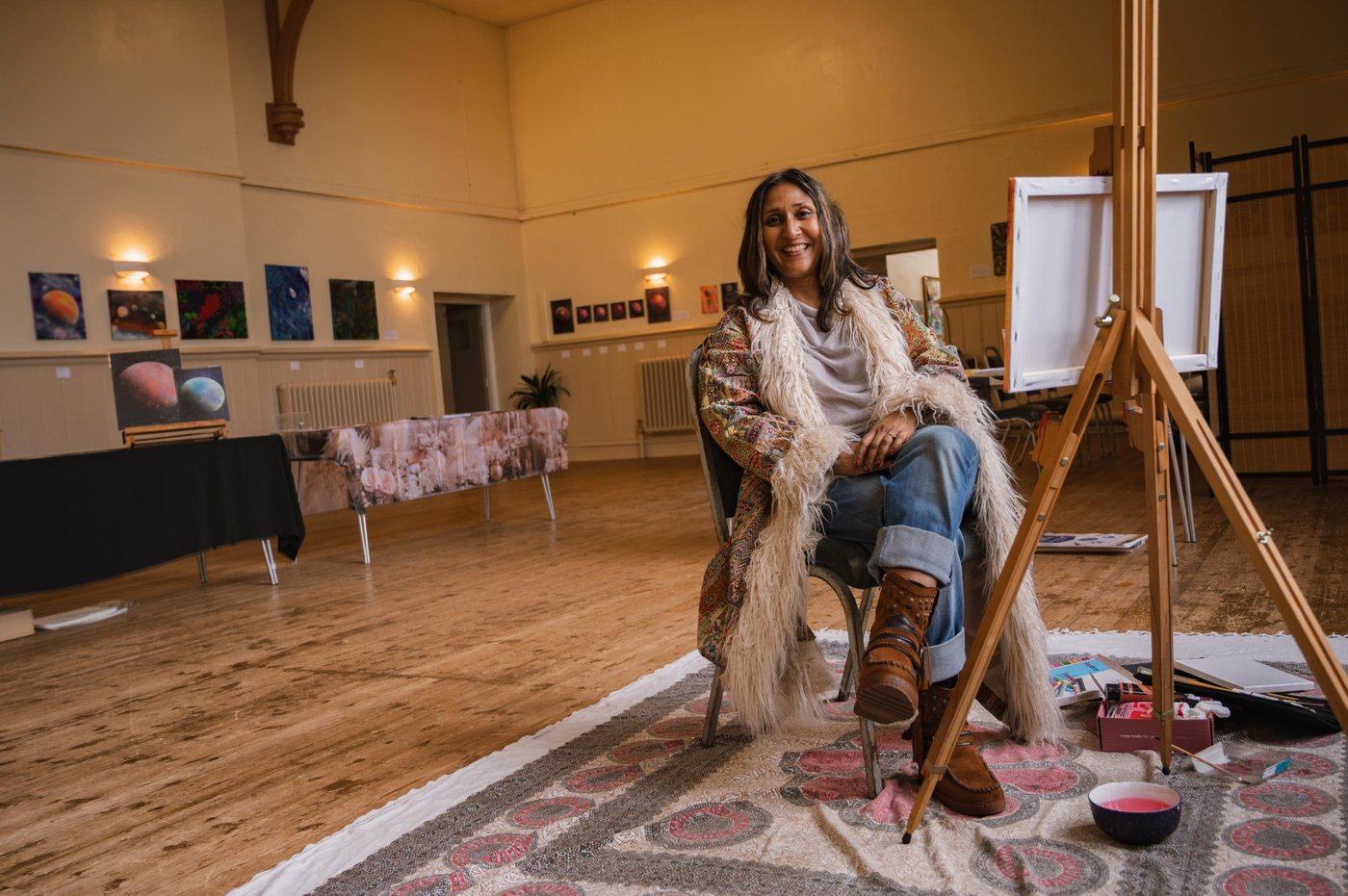
But some people refuse the premise of the story. They bite the apple, feel its juices on their chin, and stare right back at anyone who would dare to judge them. Esther-Rose McGregor is one of those people. As an actor and model who has worked for Miu Miu and Stella McCartney since she was sixteen, she knows what it means to be the object of the gaze. But in her work as a tattooist, an artist, and a young woman navigating the world, she is engaged in a quiet but powerful project: she is taking the apple and owning it. Her art is not about guilt. It is about the radical act of defining pleasure, beauty, and identity on her own terms.
The Daughter in the Mirror
Of course, apples don’t fall far from the tree. And when your father is Ewan McGregor, the world is quick to define you by that proximity. In a recent, wonderfully meta moment, Esther-Rose acted alongside him in Obi-Wan Kenobi, playing a spice runner who tells him, “I was someone’s daughter once, too.” It is a line that resonates with a particular, poignant weight. It is an acknowledgement of her legacy, but also a quiet declaration of her own distinct identity. She is not just someone’s daughter.
This refusal to be easily defined is the thread that runs through all her creative work. She has taken the raw material of her own life - her famous family, her experiences in the fashion industry, her queer identity - and used it not as a narrative to be passively inherited, but as a medium to be actively shaped.
An Argument in Ink
Nowhere is this more apparent than in her practice as a tattoo artist. For many, tattooing might be seen as a form of rebellion, or even as a guilty pleasure. For McGregor, it seems to be something far more profound. It is a space of healing, of collaboration, of building a new kind of power dynamic.
After a particularly belittling experience in a traditional, male-dominated tattoo shop - an experience that left her feeling smaller than she had ever felt - she and a friend, Marissa Munroe, decided to build their own space. They opened Pink Ether, a shop painted entirely pink, filled with butterflies and, as she notes, her own “spooky black things.” The goal was explicit: to create a luxury, safe space for women and the queer community, a place where the act of being tattooed was built on trust and mutual respect, not intimidation.
This is more than just a business model. It is a corrective. It is an argument made in ink. McGregor understands that to tattoo someone is an intimate act. It is to be trusted with their body, their story, their vulnerability. In her practice, the power dynamic between the artist and the subject melts away. It becomes a collaboration. “You’ve got to carry it like it’s the most special baby in the world,” she says of this trust. It is a philosophy that stands in direct opposition to a world that so often treats the female body as public property.
The Meaning of the Rotting Pear
Her personal relationship with her own tattoos reveals an even deeper artistic philosophy. She tells the story of a small, seemingly random tattoo she gave herself of a rotting pear, simply because she liked a drawing she had done. Months later, she found herself in a place that would become deeply special to her, a place with a huge pear tree in the garden, its fruit left to fall and rot on the ground below.
“Life can bring meaning to pieces of art,” she explains. This is a quiet but radical idea. It is a rejection of the notion that art must be infused with a grand, pre-conceived meaning from its creator. Instead, she trusts the process. She trusts that the mundane, the random, the "unhinged" act of eating deli meat from a bag, can eventually accrue a kind of sacred weight. It is an art practice built on faith in the texture of life itself.
The Gaze, Interrupted
This philosophy becomes a form of armour in the world where she is most often seen as an object: the world of fashion. Having modelled since she was a teenager, McGregor is intimately familiar with the mechanics of the male gaze. She speaks with a weary clarity about the expectation that men will always “want that thing from me,” and the way the industry pushes a "femme, hyper-sexualizing image" onto young women.
But she is not a passive victim of this system. She is an active saboteur. She recounts a recent story of being on a shoot where a producer kept demanding, “No, we need more skin! We need more skin!” After years of learning to navigate these spaces, she found her voice. “You know what,” she told him, “no, you don’t need more skin. You didn’t hire me for a piece of my ass.”
This is the girl biting the apple. It is a moment of refusal, a reclaiming of her own image in the very belly of the beast. She understands that the pressure for a certain kind of thinness, a certain kind of beauty, was historically pushed by male designers. And while she acknowledges the immense toll this has taken on her own body image, she is engaged in the difficult, necessary work of "undoing all of that bullshit." This is why she is stepping back from intensive modelling, to focus on the work that feeds her soul: her acting and her tattooing.
She is choosing the spaces where she can be the subject, not the object. Where she can be a collaborator, not a canvas. Her music, which she makes with her band French Thyme, is another example of this. She resists the pressure to turn it into a job, to subject it to deadlines and commercial expectations. It remains a space of pleasure, of therapy, of processing the "internal brain stuff." It is for her.
Esther-Rose McGregor is navigating a world that has tried, from the moment she was born, to tell her who she is. She is the daughter of a star, a model in a demanding industry, a young woman coming into her own queer identity. Any one of these things could have defined her. Instead, she has chosen to define herself. Her work, across all its different forms, is a single, coherent project. It is the art of taking the stories she has been given and writing her own endings. She is not just biting the apple. She is planting a whole new orchard.