By Yulia Tulegenova
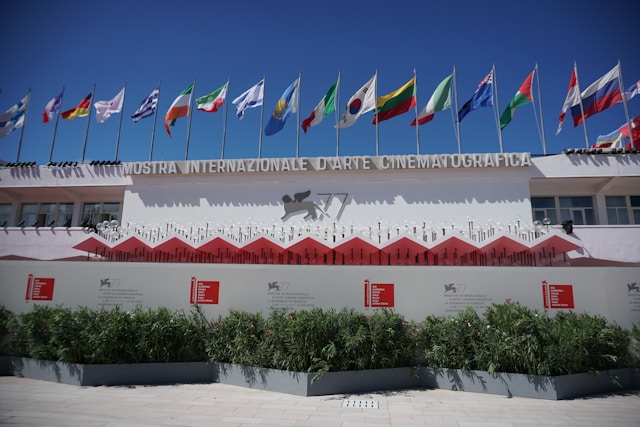
The films, of course, are the official reason. We are here, ostensibly, for the latest offerings from Guillermo Del Toro, Yorgos Lanthimos, and Noah Baumbach. But stand for a few minutes by the edge of the Grand Canal and you will witness a different kind of premiere. As the sleek Riva boats cut through the murky green water, delivering their famous passengers to the red carpets of the Lido, you are watching a parallel festival unfold. This is the unofficial, and arguably more influential, Venice Fashion Biennale.
For ten days every September, the world’s oldest film festival is hijacked. It becomes a floating catwalk, a high-stakes arena where the future of luxury fashion is debated not in a sterile, white-walled showroom, but on the bodies of the world’s most photographed people. This year, more than ever, the red carpet is not just a showcase for expensive dresses; it is a laboratory, a testing ground for new creative directors at some of the most powerful houses in the world. The real drama is not on the screen, but in the seams.
A Game of Thrones, in Silk and Satin
The current landscape of European fashion is one of profound instability. A sweeping generational change has seen a host of new designers installed at the helm of iconic brands. Paris and Milan are braced for a season of high-stakes debuts. But Venice has offered a prequel, a series of calculated leaks that have turned the red carpet into a fascinating game of strategic reveals.
We got our first glimpse of Jonathan Anderson’s vision for Dior, not in Paris, but on the Italian actor Alba Rohrwacher, who wore a custom satin gown in a deep, almost bruised, shade of blue. It was a statement of intent: a move towards a quieter, more sculptural form of elegance. Similarly, Versace’s new designer, Dario Vitale, chose to launch his tenure not with a press release, but with a one-two punch on Julia Roberts and Amanda Seyfried. The dresses hinted at a softening of the house’s famously aggressive glamour, a move towards something more fluid and refined.
The message is clear. A single, perfectly executed red-carpet moment in Venice now carries more weight, and travels further, than an entire runway show. It is a targeted strike, a way of seeding an idea directly into the cultural bloodstream, bypassing the traditional fashion press and speaking directly to a global audience of millions. It is the fashion equivalent of a film trailer, a tantalising glimpse of the world to come.
This phenomenon is not limited to the legacy brands. Louise Trotter’s new Bottega Veneta was previewed on Jacob Elordi and Vicky Krieps, while Matthieu Blazy’s Chanel was given an early outing by Ayo Edebiri. Each appearance was a carefully calibrated piece of messaging, a way of testing the waters and managing expectations before the full collections are revealed. It transforms the actors into something more than just clients; they become co-conspirators, the willing vessels for a new creative vision.
The Return of the Author
But the Venice red carpet is not just a stage for new talent. It is also a platform for established masters to reassert their dominance. An Armani Privé gown on Gemma Chan, luminous and perfectly poised, is a quiet reminder that Giorgio Armani’s vision of timeless elegance remains the industry’s gold standard. Cate Blanchett in Maison Margiela couture is a walking piece of performance art, a testament to the enduring power of conceptual, challenging fashion.
There is a conversation happening here, a dialogue between the old guard and the new. A custom Louis Vuitton gown on Alicia Vikander, with its sculptural bow sleeves, speaks the language of modern, architectural glamour. A silk suit by Saint Laurent on the eternally cool Charlotte Rampling is a masterclass in understated power. Each choice is a move in a complex, unspoken game.
Even the men are part of this new, more expressive era. Andrew Garfield’s artfully undone Dior suit, Jacob Elordi’s double-breasted Bottega Veneta paired with a spectacular Cartier emerald necklace, Oscar Isaac’s polka-dot Celine shirt - these are not safe choices. They are evidence of a new confidence in menswear, a willingness to play with codes and subvert expectations. The black tuxedo, once the unassailable uniform of the male star, now feels like a retreat, a failure of imagination.
The Unspoken Narrative
What makes Venice so uniquely potent as a fashion platform? It is, I think, a matter of context. Unlike the Met Gala, which is an explicit celebration of fashion for its own sake, the clothes in Venice are always in service of something else: the promotion of a film. This gives them a narrative weight, a sense of purpose. An actor is not just wearing a dress; they are embodying a persona, extending the storytelling of their film onto the red carpet.
The city itself plays a crucial role. The sheer, unapologetic romance of Venice, with its decaying palazzos and impossible light, provides a backdrop of unparalleled beauty. A photograph of a star stepping from a water taxi onto the dock of the Hotel Excelsior has a cinematic quality that a street-style shot in Paris can never replicate. The city imbues the clothes with a sense of history, of drama, of art. It elevates them from mere products to cultural artefacts.
Of course, not every look is a masterpiece. For every moment of sublime elegance, there is a misstep, a choice that feels safe, or commercial, or simply wrong. But even these are part of the conversation. The red carpet is a public forum, and the judgment is swift and merciless.
The Future in Plain Sight
As the festival continues, this unofficial fashion week will offer more clues. We will see more experiments, more trial balloons, more calculated risks. The designers and their chosen actors are engaged in a delicate, high-stakes dance, and the world is watching.
The films will be debated, the awards will be given, and the critics will have their say. But long after the Lion d’Or has been handed out, the images from the red carpet will remain. They will be dissected, debated, and disseminated across the globe. They will set the tone for the season to come, and they will offer a fascinating, real-time glimpse into the anxious, exhilarating, and constantly shifting world of modern fashion. Forget the runways of Paris and Milan. The most important show of the season is happening right now, on the waterlogged streets of Venice.