By Maria Bregman, writer, literary and art critic
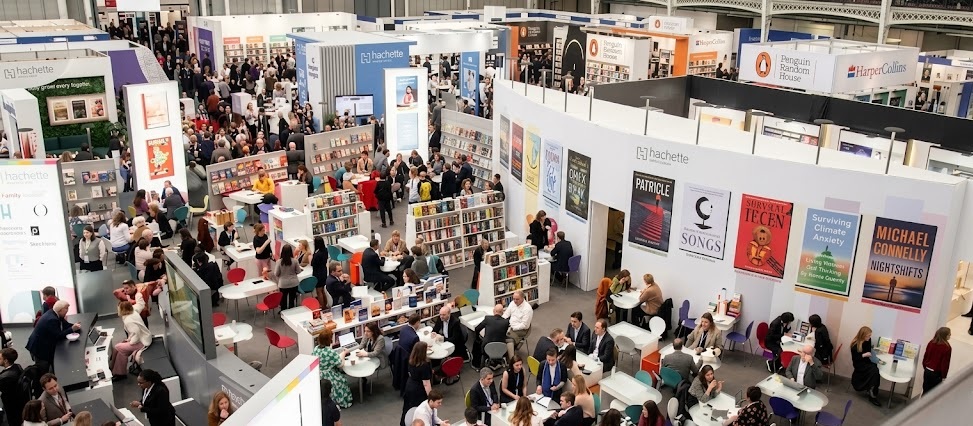
To attend the London Book Fair is to submit to a profound cognitive dissonance. We dedicate our lives to the written word precisely because it offers a solitary, quiet communion between writer and reader. Yet, for three days in the spring, the architecture that delivers this quiet communion is revealed as a sprawling, brutally illuminated bazaar of intellectual property.
The 2026 iteration of the fair carries a distinct nervous frequency, a hum of anxiety that vibrates beneath the aggressively cheerful networking. Walking the aisles, navigating the labyrinth of massive, multi-tiered corporate stands and the modesty of the independent stalls, one is struck by the acute tension between the romance of literature and the algorithmic reality of modern publishing. The industry has always been a commercial enterprise, but the mechanisms of that commerce have grown increasingly cold, driven by data points and risk aversion in a cultural economy that feels entirely unpredictable.
At the heart of this anxiety is the International Rights Centre. Located on the upper mezzanine, it is a vast grid of identical tables where literary agents and foreign rights directors meet in strictly allotted fifteen-minute increments. The noise here is a sustained, frantic roar. To stand on the balcony and look down at the hundreds of simultaneous negotiations is to witness the sheer industrial scale of storytelling. The conversations here are rarely about the beauty of a sentence or the structural elegance of a narrative. They are about global territory rights, audio streaming options, and the desperate, universal hunger for film and television adaptations. The book itself is frequently treated not as the final destination, but as the raw material—the underlying IP—for a more lucrative multimedia franchise.
This year, the contractual negotiations are shadowed by a new, pervasive paranoia. The conversations that were once dominated by royalty percentages and marketing commitments are now fiercely bogged down in the legal minutiae of generative technologies. Agents are fighting tooth and nail to secure clauses that explicitly forbid the use of their authors' manuscripts for the training of large language models. The publishers, caught between their legal departments and their desire to acquire the text, push back. It is a grim, exhausting legal frontier, and it has introduced an element of deep suspicion into relationships that previously relied on a gentleman's agreement of mutual benefit. The text is no longer just vulnerable to piracy; it is vulnerable to being entirely ingested and regurgitated by machines, a reality that haunts every handshake in the hall.
Descending from the Rights Centre to the main exhibition floor, the physical manifestation of algorithmic determinism is impossible to ignore. The hyper-consolidation of the major publishing houses over the past decade has resulted in a visible homogenization of taste. When editorial decisions are increasingly subordinated to the demands of the sales and marketing departments—who in turn are beholden to the metrics of social media engagement—the resulting literature begins to look and sound alarmingly similar.
The visual identicality of the books heavily promoted on the main aisle is striking. We have moved past the bright, blobby vector art of the early 2020s into a new era of aesthetic conformity, dictated entirely by what translates effectively on a five-inch smartphone screen. The covers are designed not to invite contemplation, but to trigger immediate, frictionless consumption. The catalogues are stuffed with variations of whatever succeeded the previous year. The industry remains locked in a desperate cycle of trend-chasing, hunting for the next microscopic sub-genre that might briefly capture the fleeting attention of the digital crowd. The mid-list—the vital, unpredictable books that historically formed the backbone of a healthy literary culture—continues to be ruthlessly hollowed out. If a manuscript cannot be immediately categorised and pitched in a ten-second video hook, it struggles to find an acquiring editor willing to stake their precarious career upon it.
This risk aversion produces a profound lexical fatigue. One wanders past towering displays of celebrity memoirs engineered entirely by committee, and endless rows of genre fiction constructed according to rigid, mathematically proven narrative beats. It is a display of spectacular efficiency, but it leaves the air feeling culturally thin. The major houses are functioning less as curators of culture and more as content logistics companies, managing the supply chain of readable products.
Yet, to write off the entire industry based on the behaviour of its largest conglomerates would be intellectually lazy. The true vitality of the London Book Fair—the genuine oxygen—is found on the physical fringes of Olympia. As one moves away from the sprawling corporate fortresses toward the smaller, modestly dressed stalls of the independent publishers, the atmosphere visibly shifts. The panic recedes, replaced by a stubborn, deeply irrational passion for the physical book.
The independent presses in 2026 are bearing the entire weight of literary risk. They operate on razor-thin margins, entirely excluded from the lucrative bidding wars of the Rights Centre, yet they are the entities publishing the translated fiction, the fragmented essays, the formally inventive novels that will actually endure. Speaking with the editors at these smaller stalls offers a vital corrective to the cynicism of the main floor. They are not talking about IP exploitation or algorithmic reach.