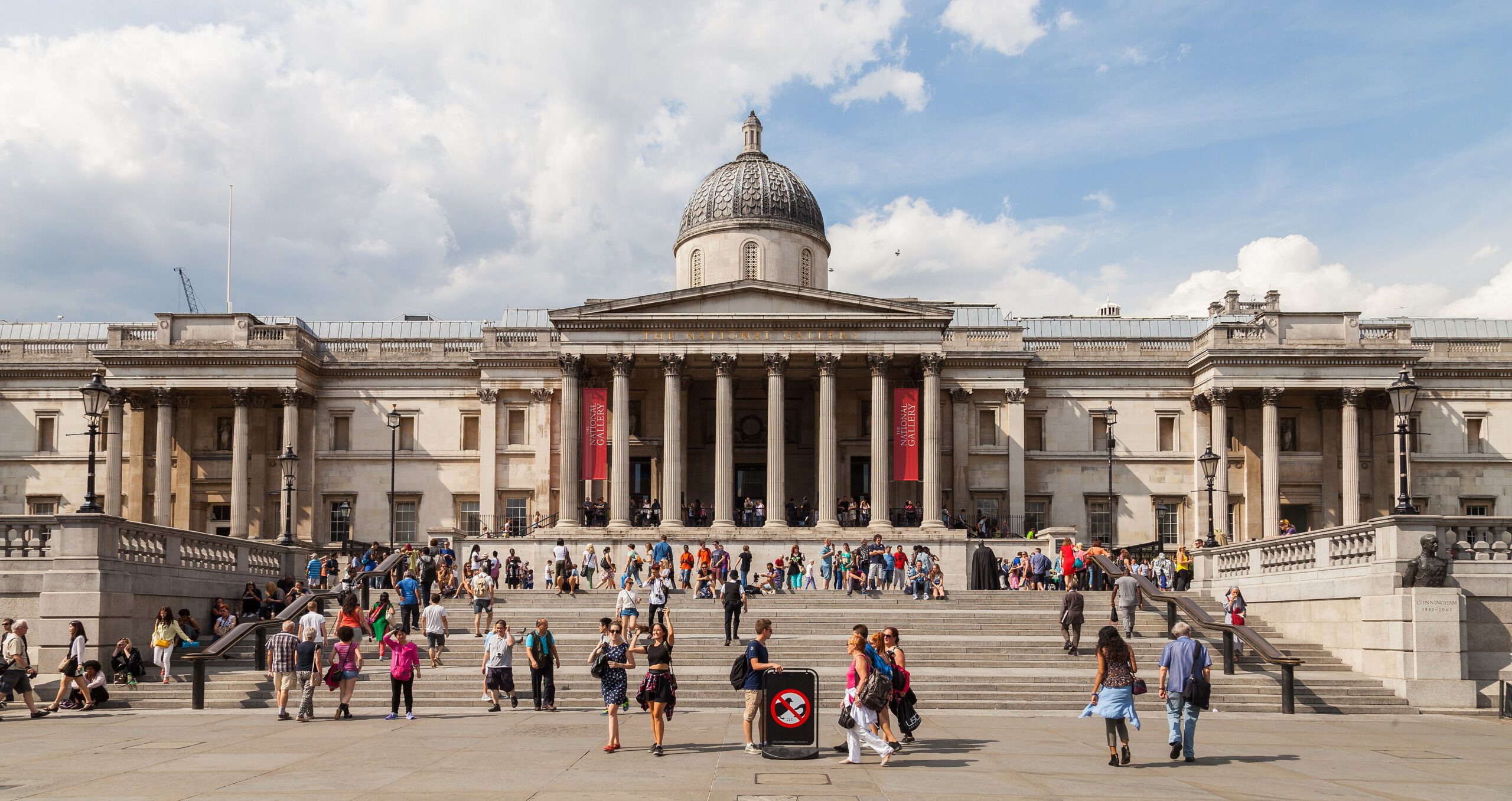
The National Gallery, standing proudly on Trafalgar Square, offers a profound experience. Its vast collection, freely accessible, houses some of humanity's most cherished artistic achievements. While one could spend weeks exploring every room, certain paintings demand a focused journey-a pilgrimage, if you will. These aren't just pictures; they are historical documents, technical marvels, and emotional anchors. To stand before them is to engage with minds across centuries, to witness the evolution of technique and the enduring power of vision.
Jan van Eyck's Microscopic World - The Arnolfini Portrait (1434)
This small panel, painted by Jan van Eyck in 1434, might appear unassuming at first glance. It depicts Giovanni di Nicolao Arnolfini and his wife, perhaps Giovanna Cenami, in their Bruges home. But look closer. Van Eyck was a master of oil paint, pushing its capabilities to unprecedented levels. Notice the individual strands of hair on Arnolfini's head, the way light catches the brass chandelier, each candlewick rendered with meticulous precision. Observe the fur trim on their garments-it practically begs to be touched, so real is its texture, so carefully modelled are its folds. The light filtering through the window illuminates the space with a soft, natural glow, a revolutionary achievement for its time.
The painting's true magic often lies in its reflective surfaces. The convex mirror on the back wall is not just a detail; it's a window into another dimension. Within its tiny, distorted reflection, you can see the backs of Arnolfini and his wife, and two figures standing in the doorway-one of whom is likely Van Eyck himself. Above the mirror, the Latin inscription "Johannes de eyck fuit hic 1434" (Jan van Eyck was here 1434) acts as a signature, but also as a witness's statement, blurring the lines between art and reality, between artist and observer.
Consider the symbolism woven into every element: the dog, perhaps representing loyalty or fidelity; the single lit candle, even in daylight, a symbol of God's omnipresence or a marriage candle; the discarded shoes, indicating sacred ground within the domestic space. The rich colours, built up in translucent layers, give the scene an almost jewel-like intensity. This isn't just a portrait; it's a meticulously crafted document of status, wealth, and potentially a solemn vow, rendered with a level of detail that remains breathtaking almost six centuries later. It exemplifies the early Northern Renaissance's embrace of realism and deep symbolic meaning.
Velázquez's Subversive Gaze - The Rokeby Venus
Diego Velázquez's Rokeby Venus, painted between 1647 and 1651, defies convention. Instead of the typical frontal nude, we are presented with Venus from behind, her back elegantly curved, her skin luminous. This choice was daring for its time, subverting the male gaze by denying direct eye contact with the viewer. What you see is a mastery of flesh-tones-subtle pinks, creams, and greys blending seamlessly to create a living, breathing form, almost palpably soft against the dark drapery. Velázquez's brushwork here is both precise and fluid, capturing the subtle undulations of the body with extraordinary naturalism.
Her face, seen only in the blurred reflection of a mirror held by Cupid, adds an intriguing layer. Is she looking at herself? At us? The ambiguity is part of its enduring appeal. The mirror's reflection, intentionally indistinct, prevents us from truly seeing her face, maintaining her mystique and inviting contemplation rather than direct confrontation. This isn't about explicit sensuality; it's about the beauty of the human form, rendered with an astonishing naturalism that was a hallmark of Velázquez's work as a court painter to Philip IV of Spain.
The painting's history is as compelling as its execution. In 1914, suffragette Mary Richardson attacked the canvas with a meat cleaver, protesting the imprisonment of Emmeline Pankhurst. The scars, visible upon close inspection, serve as a stark reminder of the painting's power to provoke and its place within broader cultural narratives. To stand before it is to confront not just artistic genius, but also the turbulent history of art's reception and its capacity to become a focal point for social commentary.
Turner's Sea of Light and Loss - The Fighting Temeraire (1839)
J.M.W. Turner's The Fighting Temeraire, completed in 1839, is more than a depiction of a ship being towed to its final berth. It's an elegy for an era, a visual poem about transition. The magnificent old warship, a veteran of the Battle of Trafalgar, is shown as a ghostly, pale hulk, its once proud sails replaced by the ignominy of being pulled by a grimy, black steam tug. This juxtaposition is key: the romantic sail against the utilitarian smoke stack, the past yielding to the industrial future, a symbol of technological progress and nostalgic loss.
Look at the sky. Turner, often called the "painter of light," captures a sunset of extraordinary drama. The sun, a blazing orb of yellow and orange, melts into the water, creating reflections that shimmer with an almost liquid quality. The colours are incredibly vibrant, yet there's a melancholic air, a sense of fading glory. The sky alone tells a story of the relentless march of time and the beauty that accompanies endings. The moon, a faint sliver, rises on the opposite side, hinting at the coming night and a new cycle.
Observe the brushwork. It's loose, almost abstract in places, especially in the sky and water, where colours blend and merge. This isn't about precise detail but about capturing atmosphere, emotion, and the transient effects of light. Turner was revolutionary in his approach, anticipating later movements like Impressionism. The Temeraire itself, though fading, retains a certain dignity, its masts piercing the glowing sky, a silent farewell. To experience this painting is to witness a master's meditation on mortality, technological change, and the enduring beauty of the world, even as it transforms.
Van Gogh's Burst of Colour - Sunflowers
Vincent van Gogh's Sunflowers, specifically the 1888 version from Arles, is an explosion of pure, unadulterated joy and struggle. Van Gogh painted several versions of sunflowers, but this one, with its vibrant yellows and oranges, stands out. When you approach it, the first thing that strikes you is the sheer intensity of the colour. He used chrome yellow straight from the tube, celebrating the sun-drenched landscape of Provence, pushing the boundaries of what colour could convey.
Then, notice the texture. Van Gogh applied paint with a vigour that borders on sculptural. The impasto-the thick application of paint-makes the sunflowers almost three-dimensional. You can see the individual strokes, the way he built up the petals and stems, giving each flower a distinct personality. Some are fresh and vibrant, standing tall; others are wilting, their heads bowed, hinting at the cycle of life and decay. The brushstrokes themselves become an integral part of the composition, conveying movement and vitality.
This isn't just a still life; it's a self-portrait of Van Gogh's emotional state. He was trying to create a "studio of the south" in Arles, envisioning a community of artists, and the sunflowers were meant to decorate the room of his friend, Paul Gauguin. The painting radiates an almost palpable energy, a restless vitality that mirrors Van Gogh's own fervent spirit. It highlights his unique vision and his profound connection to nature, rendered with an intensity that continues to captivate and move viewers worldwide, a powerful expression of his inner world.
Holbein's Enigmatic Masterpiece - The Ambassadors
Hans Holbein the Younger's The Ambassadors, painted in 1533, is a feast for the intellect and the eye. It depicts two wealthy, educated Frenchmen: Jean de Dinteville, the ambassador to England, and Georges de Selve, Bishop of Lavaur. On a two-tiered side table between them, a collection of objects speaks volumes about their world. Holbein's meticulous realism renders each object with astonishing clarity, making them almost tangible.
At the upper level, instruments related to the heavens-a celestial globe, a torquetum, sundials-represent the celestial and theoretical sciences, reflecting their intellectual pursuits and the Renaissance era's scientific advancements. Below, terrestrial instruments-a terrestrial globe, a lute, a hymn book, compasses-point to earthly concerns, music, and practical knowledge. Each object carries symbolic weight, reflecting the Renaissance fascination with knowledge, exploration, and the arts. The broken string on the lute, for example, might symbolise discord or religious schism, perhaps hinting at the Protestant Reformation then sweeping Europe.
But the most striking element, and the one that demands a shift in perspective, is the distorted, elongated shape stretching across the floor in the foreground. This is an anamorphic skull. To view it correctly, you must stand to the right of the painting, almost parallel to it, and look upwards. Suddenly, the strange smudge resolves into a perfectly rendered human skull-a stark memento mori, a reminder of death's inevitability, lurking beneath all earthly achievements and intellectual pursuits. It's a brilliant visual trick, a philosophical statement, and a chilling surprise all in one.
Finally, look closely in the upper left corner, almost hidden behind the green curtain. There, a small, silver crucifix is partially visible, offering a spiritual counterpoint to the worldly pursuits displayed. Holbein's genius lies in weaving together these layers of meaning-worldly power, intellectual curiosity, artistic skill, and the stark reality of mortality-into a single, compelling image, prompting viewers to consider their own ephemeral existence.
A Journey Through Time and Vision
These five paintings represent just a fraction of the treasures held within the National Gallery, but they offer a concentrated dose of artistic evolution and human insight. From Van Eyck's microscopic detail to Turner's atmospheric grandeur, from Velázquez's daring composition to Van Gogh's emotional impasto, and Holbein's intellectual puzzles-each canvas provides a unique window into its creator's mind and its era's spirit. A visit here is not merely a passive viewing; it's an active engagement, an opportunity to connect with history, beauty, and the enduring power of human creativity. Remember, entry is free, and the journey awaits you on Trafalgar Square.