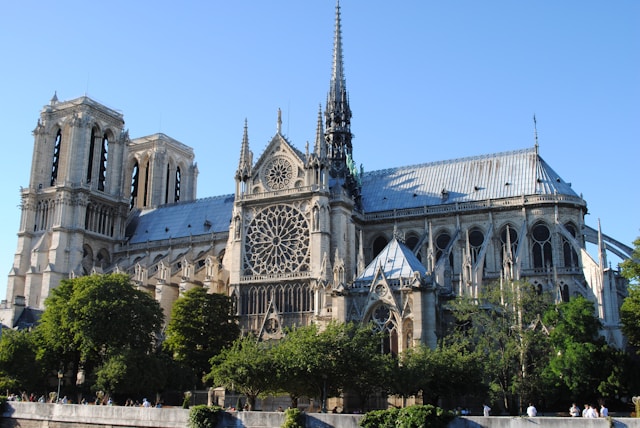
The reopening of Notre Dame de Paris in December 2024, five years after the devastating fire that destroyed its roof and spire, represents one of the most significant architectural and cultural events of the twenty-first century. The restoration of the cathedral - a project that mobilised extraordinary resources, expertise, and public investment - illuminates the relationship between architecture, memory, and national identity.
The Fire
On 15 April 2019, a fire broke out in the roof space of Notre Dame de Paris, destroying the cathedral’s eight-hundred-year-old oak roof and causing the collapse of the nineteenth-century spire designed by Eugène Viollet-le-Duc. The fire was watched in real time by millions of people around the world, and its emotional impact was immediate and profound.
Notre Dame is not merely a building; it is a symbol - a structure that embodies France’s history, culture, and identity. Its destruction was experienced as a collective loss that transcended national and cultural boundaries.
The Restoration
The restoration project that followed the fire was characterised by ambition, controversy, and extraordinary craftsmanship. President Emmanuel Macron’s decision to restore the cathedral “more beautiful than before” set an aspiration that required both technical innovation and respect for historical authenticity.
The restoration involved thousands of craftspeople - carpenters, stonemasons, glassmakers, metalworkers - who employed both traditional techniques and contemporary technology. The oak roof structure was recreated using timber from forests across France, and the spire was reconstructed according to Viollet-le-Duc’s original design.
The speed of the restoration - completed in five years, a fraction of the time that many experts predicted - reflected both the mobilisation of national resources and the determination to demonstrate France’s capacity for large-scale cultural projects.
The Controversy
The restoration was not without controversy. Proposals to modernise the cathedral’s interior - to add contemporary lighting, to create a museum space, or to redesign the entrance - provoked fierce debate about the appropriate balance between restoration and innovation.
The controversy reflected deeper questions about the relationship between heritage and modernity. Should a restored cathedral be a faithful reproduction of its historical appearance, or should it incorporate contemporary elements that reflect the present as well as the past? The answers to these questions have implications not only for Notre Dame but for the broader practice of architectural conservation.
The Significance
Notre Dame’s reopening represents several significant achievements:
Technical accomplishment. The restoration demonstrated that traditional craft techniques, combined with contemporary engineering and technology, can produce results that rival the original construction.
National mobilisation. The project showed that France could mobilise the resources, expertise, and political will necessary to undertake a large-scale cultural project - a demonstration of national capacity that has implications beyond the architectural sphere.
Cultural continuity. The restoration ensured that Notre Dame will continue to serve as a site of worship, tourism, and cultural identity for future generations - a continuity that connects the present with the medieval past.
For readers interested in the broader history of architectural conservation, our analysis of the philosophy of restoration provides additional context. Those exploring Notre Dame’s specific history may also appreciate our feature on Gothic architecture in medieval France.