By Yulia Tulegenova
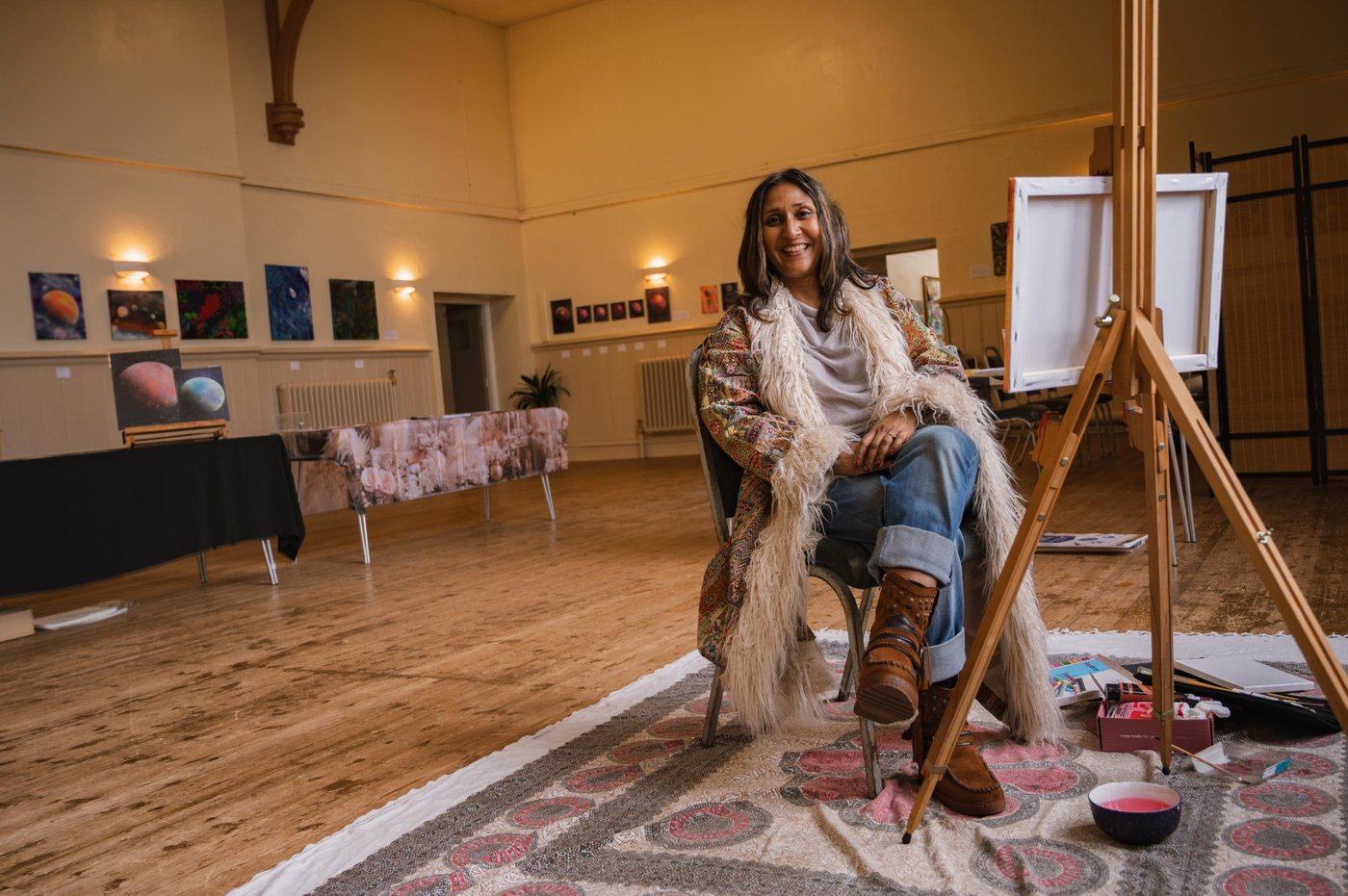
The first thing you notice in a London studio is the light. It isn’t the sharp, unforgiving sun of the Middle East or the vast, heavy light of a Russian winter. It’s a softer, more mutable thing; a pearlescent, shifting grey that filters through the glass and seems to understand the complexions of skin. It’s a painter’s light. And for me, it has become the silent collaborator in a process that began thousands of miles away, a lifetime ago.
My journey to this specific quality of light was not a straight line. It was a triptych, three distinct panels of geography and experience that define who I am and what I paint. The first panel is Russia. It’s the formidable weight of the academic tradition, the rigorous, almost punishing, training in form at the Moscow School of Arts. There, you learn the rules before you can even dream of breaking them. You draw from casts, then from life, hour after hour, until the human form is no longer a mystery but a language you speak fluently. It is a world of discipline, of cold studios and the ghosts of the great Russian masters peering over your shoulder.
The second panel is Israel. A sharp, sun-drenched contrast. Here, the light bleached the subtlety from shadows and the air hummed with a different kind of intensity. At the Art cources, the focus was not on inheriting a tradition but on finding a personal voice, on conceptual rigour. The questions shifted from ‘How do you paint this?’ to ‘Why do you paint this?’ It was a necessary disruption. It forced me to dismantle the scaffolding of my classical training and inspect the pieces. Which parts were truly mine, and which were simply the echo of my teachers?
And now, the third panel: London. A city that is, in itself, a collage of histories and identities. It is here, in this specific confluence of cultures and that unique, painterly light, that the two earlier parts of my life have found a way to speak to each other. The Russian discipline and the Israeli inquiry have synthesized into a practice that is entirely my own.
The Figure as a Landscape
I have always been drawn to the human figure. It is, for me, the ultimate landscape. We speak of a body of work, but I think of my work as being about the work of the body. The way it holds memory, the way tension settles in the shoulders, the subtle narrative told by the posture of a hand. In an age of fleeting digital avatars and curated online personas, the physical, vulnerable, and unapologetically present human body feels like a radical subject.
My process is one of excavation. A painting doesn’t begin with a clear image for me. It begins with a presence, a feeling. The canvas is a space of encounter. I build up layers of paint, and then I scrape them away. It is a physical, sometimes aggressive, act. I add, I subtract. I search for the form within the chaos of the material, much like a sculptor finds the figure in a block of marble. This process is a dialogue. The paint resists, it surprises, and the image that emerges is often not the one I set out to create. It’s the one that needed to be found.
Of course, the people I paint are not mere subjects. They are collaborators. The hours spent in the studio are a form of intense, non-verbal communication. As I observe, I am also being observed. There is a transfer of energy, a shared intimacy in that quiet space. The goal is never to create a mere likeness, a simple portrait. The goal is to capture the internal weather, the psychological architecture of the person sitting before me. The finished painting should feel less like a depiction and more like a presence.
Colour, Memory, and the Unseen
Colour, for me, is inseparable from emotion and memory. The palette is often subdued, earthy - ochres, umbers, siennas, offset by stark whites and deep, resonant blacks. These are not the colours of spectacle, but the colours of introspection. They are the colours of soil, of old walls, of flesh and bone. They speak of history, of the weight of time.
Sometimes a specific colour will assert itself, a sharp cadmium red or a deep cobalt blue. These moments are intuitive. They are not planned. They feel like a memory breaking through the surface, a flash of some forgotten intensity. The application of colour is, in a way, like the work of a geologist. Each layer is a stratum of time, a record of a decision, a feeling, a moment of doubt or a moment of certainty. The final surface of the painting is a geological map of its own creation.
Perhaps the most striking thing is how this process of layering and excavation mirrors the way we experience our own identities. We are not monolithic. We are composed of layers of experience, of past selves, of memories both clear and faded. We carry our histories within us, in the way we stand, in the lines on our faces. To paint a person is to acknowledge this complexity, to attempt to render the unseen layers visible.
Beyond the Likeness
In the end, what am I searching for? It is not beauty in the conventional sense. It is a kind of truth. A truth that is not literal, but emotional. A truth that resides in the imperfections, in the asymmetries, in the moments of vulnerability.
My figures often exist in undefined spaces. The backgrounds are ambiguous, stripped of anecdotal detail. This is intentional. I want to remove them from a specific time and place, to allow them to exist in a purely psychological space. They are not defined by their surroundings, but by their own internal state. This forces a more direct confrontation between the viewer and the painted figure. There is nowhere to look but into their eyes, at the turn of their head, at the tension in their form.
The work is finished not when it looks ‘right’, but when it feels right. When it has its own life, its own breath. When it looks back at me with an intensity that is independent of my own. My hope is that the viewer experiences a similar sense of encounter. That they do not simply see a painting of a person, but that they feel the presence of a person. That they are reminded of the profound, complex, and often contradictory business of being human. And that, in the quiet contemplation of a painted surface, they might recognise something of themselves. That, for me, is the entire point.