On May 1, 1840, the United Kingdom unleashed a quiet, bloodless revolution. It did not arrive with the roar of a steam engine or the clattering looms of the industrial north, but rather in the form of a small, adhesive square of paper measuring scarcely an inch across. The Penny Black, universally recognised as the world’s first prepaid postage stamp, was an unassuming artefact that fundamentally reshaped human interaction. Valid for public use from May 6 of that year, it transformed a convoluted, prohibitively expensive postal network into a public utility accessible to the working classes. In an era where information and correspondence were privileges tightly controlled by wealth and geography, the Penny Black democratised the written word.
To appreciate the seismic impact of this small, glutinous square, one must examine the archaic, sprawling system it replaced. Prior to 1840, the Royal Mail functioned less as a public service and more as a revenue-generating tax on communication. Postage was rarely paid by the sender; instead, the financial burden fell entirely upon the recipient upon delivery. The calculation of these fees was notoriously complex, extortionate, and fiercely protective of the status quo. Costs were not determined by weight, but by the number of individual sheets of paper enclosed and the precise mileage the letter travelled. A simple, two-sheet correspondence traversing a few counties could cost a working-class individual several days' wages.
This draconian pricing structure encouraged widespread evasion and necessitated bizarre communicative practices. To minimise the number of sheets, correspondents developed the art of "cross-writing," where a page would be filled with text in one direction, and then turned ninety degrees to be written over again, creating a dense, often illegible grid of ink. Senders also resorted to complex ciphers scribbled on the outside of folded sheets; the recipient would examine the exterior to decode the message, only to hand the letter back to the courier, refusing to pay the extortionate fee. Meanwhile, Members of Parliament and the nobility freely exploited the 'frank' - a privilege allowing them to send unlimited mail free of charge simply by signing the envelope. The general public languished in communicative isolation, and the postal service was haemorrhaging money, plagued by administrative inefficiency and stifling both commerce and personal connection.
The catalyst for destroying this archaic framework was Sir Rowland Hill, a visionary schoolmaster, inventor, and social reformer. In 1837, Hill published a revolutionary pamphlet entitled Post Office Reform: Its Importance and Practicability. He passionately argued that the exorbitant cost of postage was a regressive tax on education, scientific exchange, and human affection. His proposal was radical in its egalitarian simplicity: a uniform rate of one penny for any letter weighing up to half an ounce, regardless of the distance it travelled within the borders of the United Kingdom.
Crucially, Hill insisted that postage must be prepaid by the sender. This would entirely eliminate the enormous administrative costs and delays of postal clerks attempting to collect shillings and pence from reluctant recipients on doorsteps across the empire. To achieve this prepayment, Hill proposed an ingenious, tactile solution. As he famously wrote in his 1837 pamphlet, the prepayment could be proven by "...a bit of paper just large enough to bear the stamp, and covered at the back with a glutinous wash."
This simple sentence laid the conceptual groundwork for the modern adhesive postage stamp. Unsurprisingly, Hill’s proposals met with ferocious opposition from the postal establishment. The Postmaster General, Lord Lichfield, famously dismissed Hill's idea as "the most extraordinary of all the wild and visionary schemes." However, supported by prominent figures like Robert Wallace MP and championed by a public desperate for change, Hill’s reforms captured the national imagination. The campaign culminated in the passing of the Penny Postage Act in 1839, paving the way for the launch of the uniform penny post.
Once the concept of a prepaid adhesive label was enshrined in law, the immense challenge of its design emerged. The Treasury held an open competition in 1839, inviting the public and artists to submit designs for the new stamp. Over 2,600 entries flooded in, but Hill and the Treasury ultimately rejected them all, deeming none secure enough to prevent counterfeiting. Hill understood that the stamp required an image that was instantly recognisable, universally respected, and extraordinarily difficult to forge. He found his definitive muse in the youthful monarch, Queen Victoria, who had ascended the throne just a few years prior.
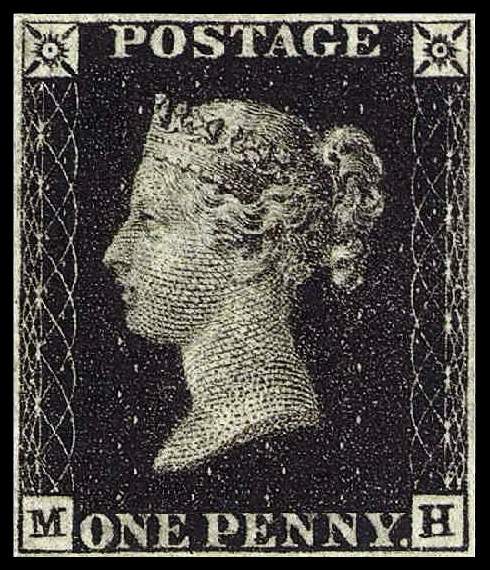
The image chosen for the Penny Black was not commissioned from scratch, but adapted from a celebrated piece of numismatic art. It was based on a portrait by William Wyon, the Chief Engraver at the Royal Mint. Wyon had initially created this profile of the fifteen-year-old Princess Victoria for a medal commemorating her 1837 visit to the City of London. The artwork was widely revered for its elegant neoclassical purity and authoritative grace. To translate the sculpted, three-dimensional relief of Wyon’s medal into a flat, two-dimensional stamp, the chosen printing firm commissioned the artist Henry Corbould to produce a highly detailed drawing. This drawing was then meticulously hand-engraved onto a steel die by Charles Heath and his son, Frederick. The resulting aesthetic was austere yet strikingly beautiful, featuring the Queen’s profile set against a finely textured dark background, flanked simply by the word "POSTAGE" at the top and the denomination "ONE PENNY" at the bottom. The monarch's face became the ultimate guarantee of the stamp's fiscal value.
The physical production of the Penny Black was as much a triumph of Victorian engineering as it was of graphic art. The monumental contract was awarded to Perkins, Bacon & Petch, a leading security printing firm renowned globally for their expertise in producing forgery-proof banknotes. The firm had been founded by Jacob Perkins, an American inventor who pioneered the use of hardened soft-steel plates. This innovation allowed for unparalleled precision, enabling the printers to create exceptionally fine, durable plates capable of producing millions of identical impressions without degradation.
To further thwart the efforts of counterfeiters, the firm employed a highly sophisticated technique known as "engine-turning." This involved using a complex, geometric rose engine lathe to engrave an intricate, machine-generated background pattern of looping arcs behind the Queen's portrait. The mathematical complexity of this lattice-work was utterly impossible to replicate reliably by the human hand, ensuring the integrity of the Crown's postal revenue.
Additionally, an ingenious security feature ensured that every single stamp on a sheet of 240 was entirely unique. The printers hand-punched check letters into the bottom two corners of the design. The left corner letter indicated the horizontal row (running from A to T), while the right corner letter indicated the vertical column (running from A to L). A full sheet of 240 stamps cost exactly 240 pence, equating to one pound sterling. Because of the unique letter combinations, a forger could not simply engrave one passable stamp and use it to mass-produce a sheet; they would be forced to recreate all 240 distinct letter combinations, a task of insurmountable difficulty. The stamps were printed on specialised paper featuring a small "Crown" watermark for an additional layer of security.
Despite its iconic status and near-perfect execution, the Penny Black had a remarkably brief operational reign. The stamp, as its name suggests, was printed using an intense black ink. This meant that post office clerks had to cancel the stamp to mark it as used - typically using a striking red ink applied with a handstamp known as the Maltese Cross cancellation. However, postal authorities and the Treasury quickly discovered a fatal, unforeseen flaw. The red cancellation ink was not particularly fast; it could be relatively easily washed or bleached off the black background by unscrupulous individuals, allowing the stamps to be fraudulently reused.
Within months of the May 1840 launch, the Treasury recognised that the black ink/red cancellation combination was a vulnerability that threatened the revenue of the entire system. By early 1841, a solution was implemented: the Penny Black was replaced by the Penny Red. The new stamp used the identical design and plates but was printed in red ink, allowing clerks to cancel it with a heavy, permanent black ink that was virtually impossible to remove without destroying the paper. Consequently, the Penny Black was in active production for barely a year, yet in that short window, an astonishing 68 million individual stamps were printed.
The introduction of the Penny Black and the uniform postal rate achieved everything Rowland Hill had promised and more. It triggered an immediate and staggering explosion in correspondence; the volume of mail traversing the UK doubled within a single year. It sparked a communication revolution that rippled across the globe, as nations worldwide rapidly adopted Hill's model of prepaid adhesive postage.
Beyond its logistical triumph, the Penny Black drove profound societal change. It fostered literacy, as the working classes suddenly had an affordable incentive to read and write. It stimulated trade by allowing businesses to send catalogues, invoices, and correspondence cheaply across the country. It even birthed entirely new industries, such as the mass production of Valentine's Day cards and Christmas greetings. Most poignantly, it allowed families separated by the massive migrations of the Industrial Revolution to maintain their familial bonds, bridging the gap between the rural shires and the sprawling new metropolises.
Today, the Penny Black stands as a masterpiece of Victorian ingenuity - a seamless convergence of sweeping social reform, exquisite culture and artistry, and cutting-edge technological innovation. It remains an enduring symbol of a moment when the world suddenly became a little smaller, a lot more connected, and undeniably more democratic.