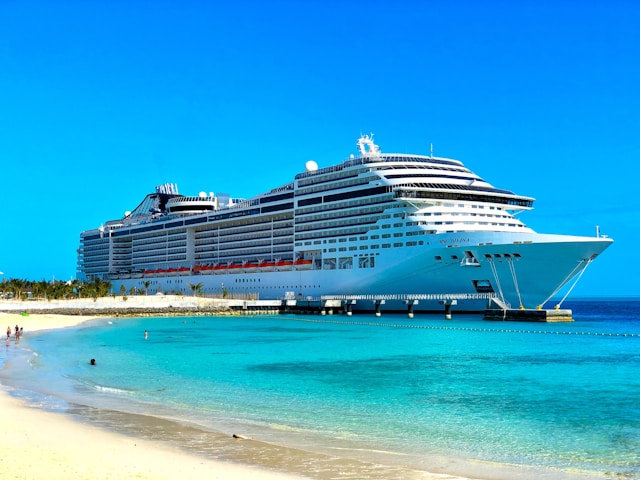
There is a new dream being sold to the restless and the retired, a fantasy of perpetual horizons and a life unbound by the dreary anchor of a fixed address. ArtCulture.UK will tell you about the ultimate escape, a magnificent, terrifying, and distinctly modern form of self-imposed exile. It is the story of Sharon Lane, a Californian pensioner who, after liquidating her entire existence - every book, every photograph, every piece of furniture that held a memory - stepped aboard the cruise ship Villa Vie Odyssey with a ticket for the next fifteen years of her life. This is not a holiday. It is an untethering. A radical reimagining of what it means to grow old, and perhaps, what it means to be home.
The concept is seductively simple. For a one-time fee, starting at a surprisingly attainable $129,000, and a monthly stipend of around $3,000, one can purchase a life at sea. A permanent cabin, food, drink, Wi-Fi, medical check-ups, and a world that changes outside your window every few days. The Odyssey is a floating village, a self-contained bubble of comfort that promises to circumnavigate the globe once every three-and-a-half years, a slow, stately dance with the planet. It is a life curated to eliminate friction, a world where the only decision is which shore excursion to take. But what are we to make of this grand experiment in placelessness? Is it the apotheosis of freedom, or a gilded cage floating on an endless ocean?
A dream nearly shipwrecked
Sharon Lane’s journey to this floating utopia was almost scuppered before it began. Her story is a crucial cautionary tale in the burgeoning market of residential cruising. She had initially invested her savings and her hopes in a similar venture, a start-up called Life at Sea, which promised a three-year voyage. She sold her possessions, prepared for departure, only for the entire enterprise to collapse in a spectacular, humiliating failure. The company never even managed to procure a ship. The dream dissolved, leaving its would-be passengers, Lane included, adrift in a sea of broken promises and financial loss.
She found herself, crushingly, in a retirement home in California, the very antithesis of the adventurous life she had planned. The walls of her new reality were closing in. Then, a newspaper article, a lifeline. She learned of Villa Vie Residences, a competitor with a seemingly more robust business model and, most importantly, an actual ship. With a resolve forged in disappointment, she called them immediately, transferred the funds, and reclaimed her dream from the wreckage. This backstory is not just colour; it is fundamental. It highlights the desperation and the sheer force of will driving people like Lane towards this unconventional existence. It is a dream so potent, it can survive a complete shipwreck.
The calculus of contentment
On the surface, the logic is impeccable. For many, the cost of the Odyssey is comparable to, or even less than, the expense of assisted living facilities or maintaining a home in an expensive city. The monthly fee covers nearly everything: meals, alcohol with dinner, medical services, laundry, and a constant stream of entertainment. It is a life of managed ease, a perfectly bundled product that removes the messy unpredictability of shoreside existence. There are no property taxes, no utility bills, no leaking roofs to fix. It is the ultimate downsizing, a shedding of not just possessions, but of responsibilities.
The ship itself is a microcosm of a comfortable Western town. It has restaurants, bars, a library, a gym, a golf simulator. It is a world designed to prevent boredom, a hermetically sealed environment of pleasant distractions. The company organises cultural events with local artists in the various ports, offering a taste of the world outside, a curated glimpse of authenticity before the gangway is raised and the ship glides back into the sterile comfort of international waters. It is a compelling proposition: all the adventure of global travel, with none of the discomfort.
The tyranny of placelessness
But beneath the glamour, a more complex and unsettling picture emerges. What does it mean to be a resident of nowhere? To have your community defined not by shared history or geography, but by a shared payment plan? The endless cruise offers a life of perpetual observation, turning the entire world into a spectacle to be viewed from a balcony. The residents are not participants in the cultures they visit; they are consumers of them. They are ghosts who glide into a port for a day or two, absorb the local colour, and then vanish, leaving only foreign currency behind.
There is a profound difference between travel as an act of discovery and travel as a lifestyle choice designed to insulate oneself from the world. The former is about engagement, immersion, and often, discomfort. The latter is about creating a frictionless existence. The residents of the Odyssey are not citizens of the world; they are citizens of the ship. Their allegiance is to the vessel that feeds them, houses them, and keeps them safe from the beautiful, chaotic, and often difficult reality of the places it visits. It is a life lived in a state of permanent liminality, always arriving but never truly belonging.
A new social experiment
And what of the community on board? A ship populated by hundreds of people, living in close quarters for years on end, is a fascinating social experiment. It is a self-selecting community of individuals who are, by definition, seeking to escape something. They are wealthy enough to afford it, healthy enough to enjoy it, and untethered enough to commit to it. Friendships will form, romances will blossom, and petty rivalries will undoubtedly fester. It is a high school reunion, a retirement village, and a UN summit all rolled into one, floating on the ocean.
Villa Vie touts the sense of community as one of its main selling points. But it is a community founded on a commercial transaction. What happens when the novelty wears off? When the endless horizon begins to feel like a wall rather than a promise? The dream of escaping the mundanity of everyday life might well be replaced by the unique mundanity of ship life - the same faces, the same restaurants, the same rhythm of arrival and departure. It is a radical bet on the idea that a constantly changing backdrop can sustain a human soul that craves not just novelty, but also roots, purpose, and a genuine sense of belonging.
The story of Sharon Lane and the Villa Vie Odyssey is a powerful parable for our times. It speaks to a deep-seated desire for freedom, for a shedding of the burdens of modern life. It is a testament to the human capacity for hope and the relentless pursuit of a dream. But it also holds up a mirror to a society where the ultimate luxury might be to disconnect entirely, to curate a life of pleasant, placeless observation. It is a magnificent, seductive, and terrifying vision of the future, a life of endless horizons that might, in the end, feel very small indeed.