By Yulia Tulegenova
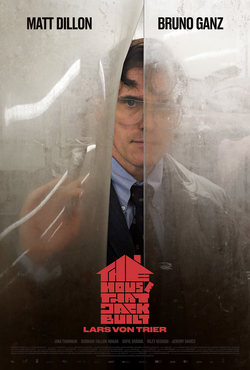
Another Lars von Trier film lands. And, as always, it doesn’t so much land as crash, leaving a crater. This one’s called The House That Jack Built.
On the surface, it’s a film about a serial killer. We’ve all seen films about serial killers. The genre is exhausted. At first, you think, here we go again. Another edgy, violent film designed to get a reaction, to make the headlines, to get people walking out of the cinema at Cannes.
But what is it, really?
The story follows a man named Jack, played by Matt Dillon. He’s an engineer who wants to be an architect. And he’s a serial killer who thinks his murders are a form of high art. The whole thing is framed as a confession, a conversation between Jack and an unseen man he calls Verge. Short for Virgil, of course. Because this isn’t just a story about murder. It’s a dissertation. A lecture. Jack is taking us on a guided tour of his own personal hell, and he’s brought a very extensive reading list.
And the lectures. My god, the lectures. Jack doesn’t just kill people. He philosophises. He goes on these long, rambling monologues, illustrated with diagrams and historical footnotes, about architecture, about the divine properties of Gothic cathedrals, about the moral weight of a Stuka dive bomber, about the will of the material. He’s trying to justify his own horrific material – the bodies – as a kind of building block for art.
The entire film is like watching a man try to build a piece of furniture from a kit with half the instructions missing and a bag full of the wrong screws. He keeps building, taking it apart, starting again. The house he’s trying to build is his masterpiece, his soul, his justification. And it’s a complete shambles.
The name-dropping is relentless. Glenn Gould on the piano, the poetry of Blake, paintings by Botticelli and Klimt. It’s all part of the same desperate, intellectual scaffolding he’s building around his own monstrosity. He’s trying to argue that great art is worth any price. That destruction can be a creative act. It’s not a new idea, but von Trier pushes it to a grotesque, almost comical extreme.
And then, of course, there’s the Nazism bit. Jack muses on the artistic merits of totalitarianism. Which is, naturally, von Trier poking the bear, reminding everyone of the disastrous press conference in 2011 that got him banned from Cannes. He knows exactly what he’s doing. He’s laying all his cards, all his ugliest thoughts, on the table.
But where does the film really click into place? Where does it stop being a lecture and start being something else?
It’s in the details. The small things. Jack suffers from obsessive-compulsive disorder. The sequence after the first murder, where he keeps going back into the house to clean a spot of blood he might have missed, is played for laughs, almost. A long, farcical set-piece. But then you remember. Von Trier himself has talked endlessly about his own OCD, his own catalogue of phobias and anxieties.
So is this just a portrait of a killer? A very well-read, architecturally ambitious killer?
No. Actually, scrap that. The film isn’t about Jack at all, is it?
It’s about Lars von Trier.
I've watched his films for years, and you always feel him there, just off-camera, pulling the strings, torturing his characters (usually women, let’s be honest). But here, he’s finally put himself in front of the camera. Jack is his avatar. This isn’t a character study. It’s a self-portrait. A monstrous, bloated, almost unbearably self-indulgent self-portrait.
He is Jack, the artist who believes his own dark impulses are a form of creative genius. The perfectionist who is never satisfied, who has to keep tearing everything down and starting again. The man crippled by anxieties, who can only achieve a sense of control through acts of extreme cruelty.
And he is also Verge, the guide and interrogator. The voice of reason, of judgment, who listens to this catalogue of horrors with a mixture of weariness and dry wit. Von Trier is having an argument with himself, and he’s made us pay to watch.
The film even includes a montage of clips from his previous work. Dancer in the Dark, Dogville, Melancholia. It’s him, laying out his own body of work, his own trail of beautiful corpses, and asking: was it art? Was it worth it?
This is the key to the whole thing. It’s not a horror film. It’s not a thriller. It’s an apologia. A confession. An unbearable, two-and-a-half-hour therapy session he’s decided to film and charge us to watch. He’s taking us through every circle of his own personal and creative hell, pointing out his sins, his obsessions, his grand theories, his pathetic little compulsions.
For anyone else, it would be an act of unforgivable self-indulgence. A work of staggering ego. But because it’s Lars von Trier… well, that’s just what you get. It’s infuriating, brilliant, boring, and utterly unforgettable, all at the same time. He has built the house. It’s a monument to himself. And it is a truly terrible place to be.