By Anna Zhila
There is a certain quality of light in the curated world of social media. It is a soft, golden, early-morning light, the kind that streams through the floor-to-ceiling windows of a minimalist kitchen, illuminating a single, artfully placed cup of coffee, still steaming. This is the native light of the Porsche Pilates Mom, a new and fascinating archetype that has emerged from the digital ether, a figure who glides through a life of serene, understated luxury, and in doing so, holds up a mirror to our own, more chaotic, realities.
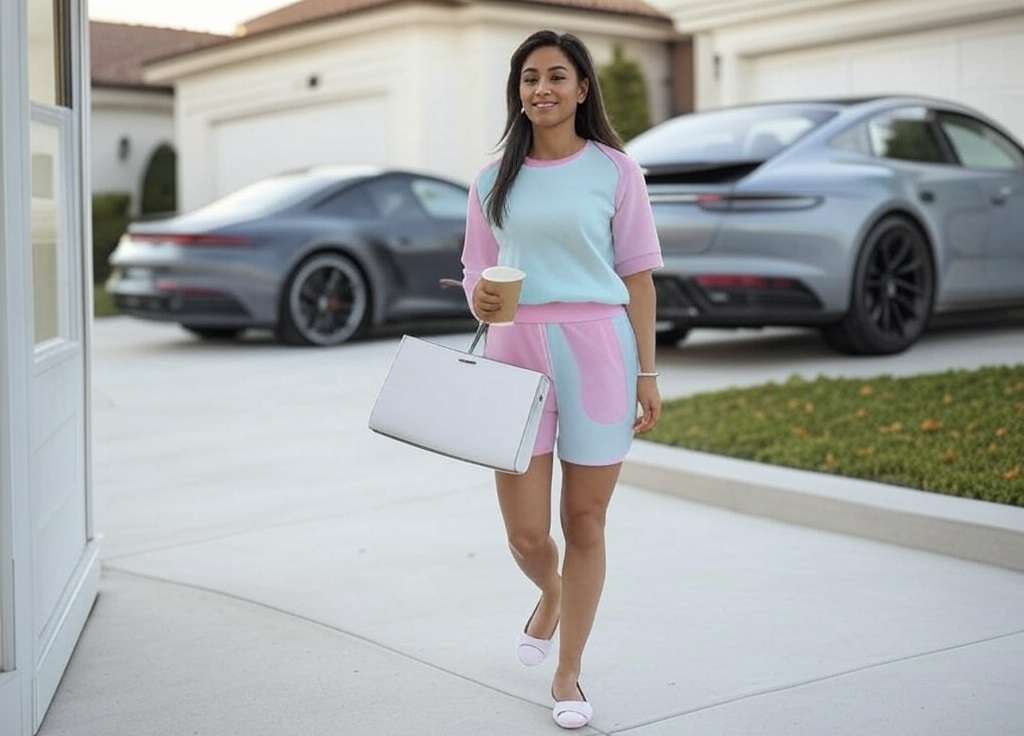
She is a creature of immense and mesmerising power. Her mornings are not a frantic ballet of burnt toast and lost school shoes. They are calm, centred affairs. Her children, when they appear, are well-behaved and impeccably dressed, existing less as demanding, sticky-fingered humans and more as beautifully appointed accessories. Her body is toned and lithe from boutique fitness classes. Her car, naturally, is a Porsche. She has become a focal point for a potent cocktail of fascination, envy, and a quiet, simmering rage. But to dismiss her as just another out-of-touch influencer is to miss the point entirely. The Porsche Pilates Mom is not a person; she is a dream. And the dream she is selling is the most seductive, and perhaps the most dangerous, of all: the dream of the outsourced life.
The Anatomy of an Aspiration
The Porsche Pilates Mom, or PPM, is a meticulously constructed fantasy of modern womanhood. At its core, it is a vision of a life where the messy, inconvenient, and laborious aspects of existence have been rendered invisible, delegated to a silent, efficient army of nannies, housekeepers, and personal assistants. She is the beneficiary of a comprehensive support system that frees her to pursue a life of self-care, personal growth, and effortless elegance.
This is a crucial distinction. She is not the “tradwife,” the archetype who finds fulfilment in the traditional, hands-on work of domesticity. The PPM does not bake the bread; she eats a single, artisanal slice of it at a fashionable brunch spot. Her domain is not the nursery, but the Pilates studio. Her labour is not the scrubbing of floors, but the maintenance of her own, flawless facade.
The details of this fantasy are specific and instantly recognisable. The Chanel ballet flats. The discreet Hermes handbag. The green juice. The air of unhurried calm. It is a lifestyle built on a foundation of immense, unspoken wealth, a wealth that allows for the ultimate luxury: the complete and total erasure of drudgery.
The Universal Longing
The widespread fascination with this archetype extends far beyond the realm of actual mothers. Childfree individuals, young professionals, people of all genders find themselves captivated by the apparent ease of her existence. This is because the dream of the PPM is not, fundamentally, about motherhood. It is about a universal, and deeply human, longing for a life without friction.
She represents an escape from the relentless, grinding pressures of modern life: financial anxiety, professional burnout, the endless, unpaid “second shift” of domestic labour. She is a vision of a life where all the practicalities have been solved, leaving an abundance of time and energy for the pursuit of personal well-being and refined pleasures. In a sense, she is the ultimate post-work fantasy. She has achieved a state of serene, post-productive grace. The envy she inspires is not just about the car or the handbag. It is about the time. It is about the quiet. It is about the freedom from the tyranny of the to-do list.
A Utopian Motherhood
The online discourse around motherhood is a notorious minefield. Women who share the joyful, picture-perfect moments are accused of setting unrealistic standards. Those who voice the struggles of sleepless nights and toddler tantrums are labelled as complainers. It is a space of intense judgment, a digital panopticon where every parenting choice is subject to scrutiny and critique.
The PPM narrative elegantly sidesteps this binary. It presents a romanticised, almost utopian, vision of motherhood, where the "hard parts" have been neatly edited out of the frame. The children are always happy, the house is always clean, the mother is always calm. It is a fantasy that offers an appealing, if entirely unattainable, alternative to the often-polarising realities of online parenting forums. It is a form of escapism, a beautifully shot, fictional account of a life without the mess.
The association of public figures like Rosie Huntington-Whiteley with this archetype is crucial to its power. Her carefully curated public persona - the understated elegance, the successful career, the high-profile partner, the glimpses of a serene family life - provides a tangible, if illusory, embodiment of the ideal. She becomes a visual touchstone, lending the fantasy an air of aspirational, if distant, attainability.
The Price of the Dream
Of course, this dream has its critics. The PPM ideal is, by its very nature, an exclusionary fantasy, accessible only to a tiny, ultra-privileged elite. For the vast majority of women, who are navigating the hands-on, often overwhelming, realities of motherhood without a household staff, this vision can be profoundly alienating, another stick with which to beat themselves.
It also raises uncomfortable questions about the invisible labour that underpins this seemingly effortless existence. The PPM’s serenity is bought and paid for by the work of other, less privileged, women. The nanny who soothes the crying child, the housekeeper who cleans the minimalist kitchen - they are the unseen gears in this beautiful, frictionless machine. To celebrate the PPM without acknowledging the labour that makes her lifestyle possible is to participate in a form of wilful blindness.
Furthermore, there is a critique to be made of the inherent consumerism of the ideal. The luxury brands, the exclusive fitness classes, the organic food delivery services - these are not just accessories; they are the very substance of this life. It is an existence defined not by what you do, but by what you can afford to buy.
In the end, the Porsche Pilates Mom is less a person and more a piece of cultural weather. She is a beautifully polished mirror, reflecting our own, often contradictory, desires and anxieties. She is a symbol of a deep and widespread yearning for a life of peace, of time, of a kind of elegant, unburdened grace.
The specific trappings of her life may be unattainable for most. But the underlying fantasy - the dream of a life where the dull, repetitive, and exhausting work of maintenance has been magically taken care of, leaving us free to become the best, most serene versions of ourselves - is a fantasy that is deeply, and dangerously, seductive. She is a modern goddess, the patron saint of the outsourced soul. And in the soft, golden light of our Instagram feeds, we continue to worship at her altar, hoping that a little of her impossible magic might rub off on us.