By Yulia Tulegenova
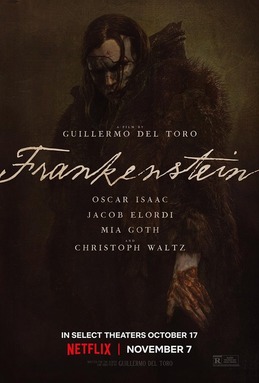
Another Frankenstein is upon us. Guillermo del Toro’s version this time, which means it will be beautiful, and sad, and full of empathy for the monster. Which is a good thing. A necessary corrective, even.
Because for two hundred years, we’ve been telling ourselves the wrong story about Frankenstein.
The word itself has become a shorthand, hasn’t it? A prefix you can attach to anything that feels a bit scientifically dodgy. Frankenfood, Franken-babies. It’s become a lazy synonym for ‘science gone wrong’. The story of the arrogant, mad scientist who plays God and unleashes a monster on the world.
But is that really what the book is about?
At first, you think, of course it is. The story is a parable about the dangers of unchecked ambition, of meddling in things man was not meant to know. And it is. Mary Shelley was writing at a time of huge scientific anxiety. People were experimenting with galvanism, running electric currents through dead frogs to make their legs twitch. The line between life and death suddenly seemed… blurry. She tapped into that fear, brilliantly.
But then you go back and actually read the book. And you realise that’s only half of it. And it’s not even the most interesting half.
The thing is, the real monster in Frankenstein isn’t the creature. It’s Victor.
The creature, when he is first ‘born’, is not a monster. He’s a child. An eight-foot-tall, yellow-skinned, hideously ugly child, but a child nonetheless. He is innocent. He is curious. He learns to speak by watching a family in a cottage, he learns to read, he learns about love and kindness. And what does he want? He wants what we all want. A bit of companionship. A friend. Someone to not run away screaming the moment they see him.
The whole thing is a bit like watching one of those heartbreaking nature documentaries where a baby animal is rejected by its mother. A tiny, clumsy thing, stumbling around, trying to make sense of the world, and the one creature that is supposed to protect it just walks away in disgust. Victor Frankenstein doesn't just create a life. He immediately, and completely, abandons it. He is the original deadbeat dad.
And that’s the tragedy that sits at the heart of the book, the one that the movies, for the most part, have completely ignored. The creature is not born evil. He is made evil. He becomes a monster because he is treated like one. He is driven to murder and revenge by the relentless, universal cruelty of a world that cannot see past his hideous exterior. “I was benevolent and good,” he says. “Misery made me a fiend.”
It’s the most devastating line in the book. And it’s a line that most film adaptations have simply erased, by turning the creature into a grunting, mute, inarticulate brute.
I remember watching the James Whale film from 1931, with Boris Karloff. It’s a masterpiece of horror cinema, of course. The flat head, the bolts in the neck, the lumbering walk… it created the definitive image of the monster. But in doing so, it also lobotomised him. It took away his voice. It took away his mind. It took away his argument.
And that’s the version that has stuck. The misunderstood monster, yes. But a monster nonetheless. A thing to be pitied, but also feared. A problem to be solved, usually with fire and pitchforks.
Actually, scrap that. The interesting thing isn’t that the films got it wrong. The interesting thing is why.
Why were we, and are we still, so much more comfortable with the story of a mad scientist than we are with the story of an abandoned child?
Because the first story is easy. It has a clear villain. Dr. Frankenstein is the one who transgresses, who goes too far. He’s the problem. The second story is much more uncomfortable. Because if the creature is made into a monster by society’s rejection, by our cruelty, by our inability to show him a scrap of kindness… well, then who’s the villain? We are. All of us.
And that’s a much harder story to tell. And a much harder one to watch.
So we cling to the myth of the mad scientist. It’s a get-out-of-jail-free card. It allows us to feel a bit of sympathy for the monster, while still reassuring ourselves that he is, fundamentally, other. That his violence is a product of his monstrous nature, not of our own failings.
Del Toro seems to get it. He’s said his version is about “the lineage of familial pain,” with Victor as an abusive father. He’s always been on the side of the monsters. He understands that they are so often a reflection of our own ugliness.
But will his be the version that sticks? I doubt it. The image of Karloff is too powerful, too deeply lodged in our cultural memory.
So we will continue to misunderstand Frankenstein. We will continue to use it as a lazy metaphor for scientific hubris, while ignoring its much deeper, much more painful message about parental responsibility, about compassion, about our duty to the outcasts and the unloved. We will keep focusing on the spark of life, and ignoring what happens in the crucial, terrible moments that follow. The moments when a creator looks at his creation, and walks away in disgust. Because that, in the end, is the real horror story.