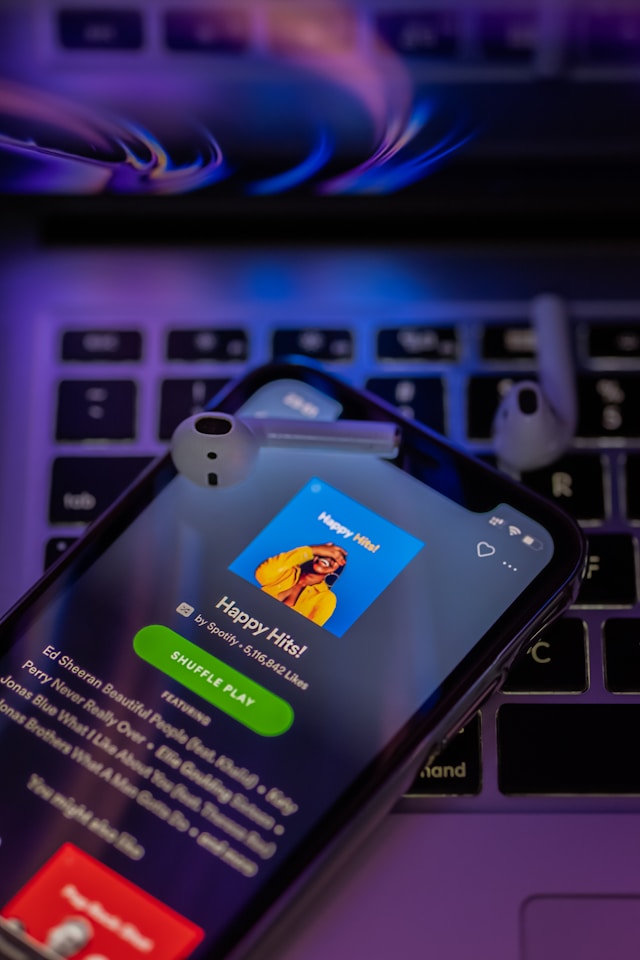
It must have been the winter of 2018. I remember the weak afternoon light, the specific chill of a room that is never quite warm enough, and the discovery of a feature on Spotify called ‘Organise Liked Songs’. For the next four hours, I did not move. I plunged into the digital viscera of my own taste, meticulously sorting thousands of tracks into an obsessively granular system of playlists: ‘Driving North at Night’, ‘Sunday Morning Coffee, No-one Home’, ‘Post-Punk for Argumentative Cooking’. The satisfaction I felt was profound, almost devotional. It was also, by any sane measure, utterly pointless. It produced nothing, earned nothing, taught me nothing I did not already know. And yet, the pleasure was unmistakably intellectual. It was the joy of imposing order on chaos, of crafting a small, perfect system from the sprawling mess of my own history.
This small, strange episode comes to mind whenever I encounter the prevailing cultural diagnosis of our age: that we have traded the deep, rewarding toil of genuine cognition for the cheap, fleeting sugar-rush of digital gratification. The argument, now a familiar sermon, is that rationality in the digital sphere has been re-engineered to serve immediate emotional appeasement. We seek not knowledge, but the feeling of being knowledgeable; not connection, but the palliative of being seen. We are, the story goes, junkies for the algorithm’s drip, our capacity for delayed gratification, for the slow-burn pleasure of solving a truly hard problem, eroded with every swipe and click.
There is, of course, a counter-narrative. It comes from the engine room of the digital age itself. The computer scientists Maurice Herlihy and Nir Shavit, in their work on concurrent programming, speak of the profound intellectual pleasure inherent in their discipline. The joy of simplifying complexity, of understanding the crystalline logic of an algorithm, of building something that elegantly works. Here, rationality is not the servant of fickle emotion, but a tool for mastery and creation. It is the architect’s satisfaction, the logician’s delight. These two poles - the coder’s deep focus and the consumer’s shallow distraction - are typically presented as the central conflict of modern intellectual life. The cathedral of considered thought versus the endless, glittering bazaar of the feed.
But what if this is a false dichotomy? What if these are not opposing forces at all, but two dialects of the same language? Perhaps I’m mistaken, but it seems to me that both the programmer hunched over her code and the teenager lost in the TikTok scroll are, at a fundamental psychological level, seeking the very same thing: a refuge from the unbearable ambiguity of the real. They are both, in their own ways, running from a world that offers no easy answers, no clean resolutions, and taking shelter in systems that do.
The Cathedral and the Feed
Consider the pleasure of the coder, the data scientist, the systems architect. What is its true nature? Yes, it involves problem-solving, but this is a very specific species of problem. It is a problem that, by definition, has a solution. The work is a process of navigating a world of fixed rules and logical constraints to arrive at a state of correctness. It is a retreat into a state of what one might call ‘known unknowns’, a carefully curated garden of problems where the weeds of genuine, terrifying, existential contingency cannot grow. It feels good. It feels safe. The pleasure derived is not just from ‘solving’ something; it is the deeper, more primal comfort of operating within a closed, knowable universe.
This is not a uniquely digital phenomenon. It is the same impulse that drives the master watchmaker, assembling her intricate universe of gears and springs, or the chess grandmaster, exploring the finite but vast territory of the 64 squares. It is the search for a neat little box in a world that is anything but. The digital realm, however, has democratised this search. It has made it possible for millions to experience the solace of the solvable problem, to build and manipulate tiny, self-contained worlds of pure logic. This is the intellectual pleasure of ratio, of reason, but it is a reason walled off from the messy, unpredictable business of being human amongst other humans.
Now, look again at the endless scroll. On the surface, it is chaos. A firehose of disconnected images, sounds, and sentiments. But psychologically, it functions as the polar opposite. Each fifteen-second video, each meme, each tweet is its own perfectly contained narrative unit. It presents a tiny premise and, within moments, offers a resolution - a punchline, a satisfying visual, a hit of outrage, a jolt of recognition. There is no ambiguity. No loose ends. The cognitive demand is minuscule, but so is the cognitive risk. We swipe, and a tiny story begins and ends. We swipe again. Another. It is a continuous stream of cognitive closure, intellectual pleasure atomised into its smallest, most digestible form. It is the cathedral’s stained-glass window shattered into a million pieces, each one still catching the light.
One could argue, with some justification, that this comparison is a category error. Building a complex algorithm is an act of supreme active creation, whilst scrolling a feed is an act of supreme passive consumption. One wrestles with chaos to impose order; the other simply receives a pre-ordered sequence of stimuli. This is true, but it misses the shared psychological motive. The underlying drive is not towards creativity or passivity, but away from uncertainty. The programmer actively builds a predictable system to escape the world’s unpredictability; the scroller passively consumes a stream of predictable resolutions to escape the very same thing. Both are modes of anxiety management. Both are a flight into the tidy mind.
An Escape from the Real
This, then, might be the great trade-off we have made. It is not that we have become less intelligent, but that we have redirected our intelligence towards the pursuit of certainty above all else. We have mistaken the satisfaction of the solved puzzle for the altogether more difficult, more ambiguous, and ultimately more rewarding pursuit of wisdom. Wisdom, after all, is not about having the right answers; it is about learning to live with the right questions. It is about navigating contingency, tolerating doubt, and finding meaning within the irresolvable mess of human affairs.
And I confess, it’s a tempting trade. The real world is a place of intractable political problems, of relationships that defy easy analysis, of ethical dilemmas with no clean solution, of our own baffling and contradictory natures. It offers very little of the clean, satisfying closure of a debugged line of code or the instant narrative resolution of a viral video. Faced with that relentless complexity, who wouldn't be tempted by a holiday in a world where things just add up? The appeal is not hedonistic; it is therapeutic.
Perhaps I’m overstating the case. Perhaps it's simpler than that - we're just wired for novelty and the algorithm is a better drug dealer than the library. And yet, I can’t shake the feeling that we are outsourcing our tolerance for ambiguity. We are training our minds to expect and demand a kind of epistemological tidiness that life itself simply does not provide. The ultimate consequence is not a loss of intelligence, but a loss of resilience. A mind accustomed to the neatness of the system, whether it is one it builds or one it consumes, is a mind ill-equipped for the beautiful, maddening chaos of everything else. It is a mind that has traded the capacity for wisdom for a constant supply of answers.
The four hours I spent organising my music that winter afternoon were not wasted. They were a respite, a quiet act of creating a small, ordered corner in a disorderly world. It was a pleasant, harmless vacation for the mind. The question that lingers, though, is what happens when we never want to come back from the holiday. What do we become when our intellectual lives cease to be an engagement with the world as it is, and become instead a full-time project of curating a world as we wish it would be: finite, solvable, and blessedly, addictively, neat.