By Anna Zhila
A festival is a set of choices, and the most revealing ones are not the headline premieres. They are the rules nobody reads: who picks the films, which prizes exist, and who is allowed to win them. The Cambridge Film Festival, which opens its 45th edition on 22 October 2026, has changed those rules more in the last seven years than in the previous forty.
Forty years of one taste
For most of its life the festival was the work of one programmer's sensibility. It was founded in 1977 at the Arts Cinema in Market Passage, with David Jakes as its first programmer. The opening programme set the tone: Akira Kurosawa's Dodes'ka-den and Luchino Visconti's Conversation Piece. The next year a Satyajit Ray retrospective began a strand the festival still treats as part of its identity.
From 1981 to 2019 the festival director was Tony Jones, and his festival had a recognisable character: serious, European-leaning, generous to retrospectives and alert to what was coming out of the major festivals. Its record of UK premieres shows it. In 1992 Cambridge audiences saw Reservoir Dogs and Bille August's The Best Intentions before the rest of the country. In 1994 the Three Colours trilogy came with what the festival describes as the first full Kieślowski retrospective. In 2003 there were around 50 UK premieres, Spirited Away among them.
This is how many British festivals of that generation worked. A director with long relationships with distributors and sales agents builds a programme that is, in effect, an argument about what matters in cinema. Its strength is coherence. Its risk is that the argument stops changing when its author does.
From author to panel
When Jones stepped down after the 2019 festival, he received the festival's first Outstanding Contribution to Cinema Award. The festival did not appoint a single successor. It formed a programming panel. Today the festival lists a Programming Panel Lead, Savina Petkova, several programmers including a specialist in Catalan film, a dedicated short film programmer and a curator for the Outstanding Contribution Award.
This is a larger shift than it looks. A panel does not have a single taste. It negotiates one. The obvious cost is coherence: a panel programme is harder to read as one sensibility. The gain is range. Several people bring several networks, and the programme is less likely to have blind spots that match one person's history. The visible results in the current festival point that way: more than half of the 2026 line-up is directed by women, marked with the F-Rating the festival has adopted, and the programme spans more than 25 countries.
What the prizes say
Prizes are a festival's statement of values, and Cambridge's prizes favour discovery over consecration.
The jury prize is the Golden Punt for Best Discovery Feature. It does not go to the best film in the programme. It goes to a discovery, which in practice means a new or little-known voice. The 2025 winner was Guillermo Galoe's Sleepless City (Ciudad sin sueño); in 2024 it was Tereza Kotyk's Nebelkind - The End of Silence. Neither is a name the British audience already knew.
The Audience Awards carry a stricter condition: only films having their UK premiere at the festival can win. This is a quiet but consequential rule. It gives the audience a role as first responders, not as the last word on films already reviewed elsewhere. It also gives the festival a reason to compete for premieres, since the prize the public votes for depends on them.
The Youth Lab Jury Award, voted by members of the festival's programme for 16 to 24-year-olds, adds a third perspective. A festival that lets young viewers judge films is building its future audience and admitting that its present one does not see everything.
Only one prize looks backwards: the Outstanding Contribution to Cinema Award, recently given to Emma Thompson, Asif Kapadia and Daniel Kaluuya. It is the one place where the festival still honours reputation. It is also the award most likely to bring a famous face to the city, and every festival needs a few of those.
The numbers behind "45th"
The festival is now in its 45th edition, not its 50th, although 2027 will mark fifty years since the first one. The reason is a break: after the 20th festival in 1996 there was no festival for several years, and it returned in 2001 as the 21st. Some organisations would quietly renumber. Cambridge counts the editions it actually held, a small honesty that says something about the institution.
What to watch for this year
The 2026 programme will be published on 30 September. The organisers have promised Palme d'Or and Cannes prize-winners, new British films, documentaries and films for younger audiences. The interesting question is not which Cannes titles arrive. Most British festivals will show some of them. It is what the panel places around them: which discovery features it backs for the Golden Punt, which UK premieres it secures for the audience vote, and whether the retrospective strand, one of its oldest traditions, finds a subject that speaks to 2026.
The festival runs from 22 October to 1 November at the Cambridge Arts Picturehouse and other venues in the city. It is a BAFTA- and BIFA-qualifying festival, run by the Cambridge Film Trust, a registered charity.
Sources: Cambridge Film Festival website (history, awards, team and submissions pages) and the festival's 2026 announcement, checked 11 September 2026.
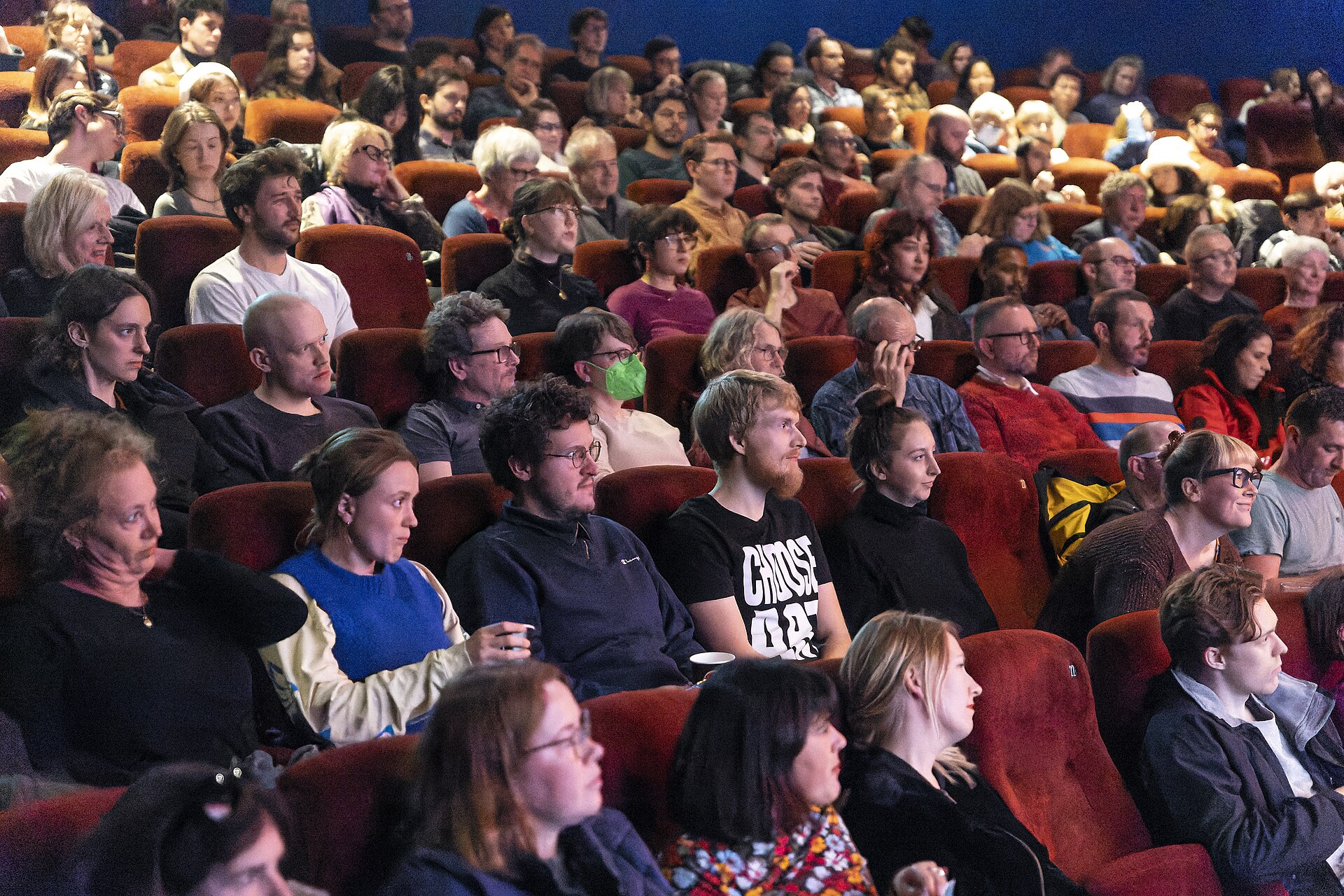
Image: the audience at a Cambridge Film Festival screening of Triangle of Sadness, October 2022. Photo: Kitsonian / Wikimedia Commons, CC BY-SA 4.0.