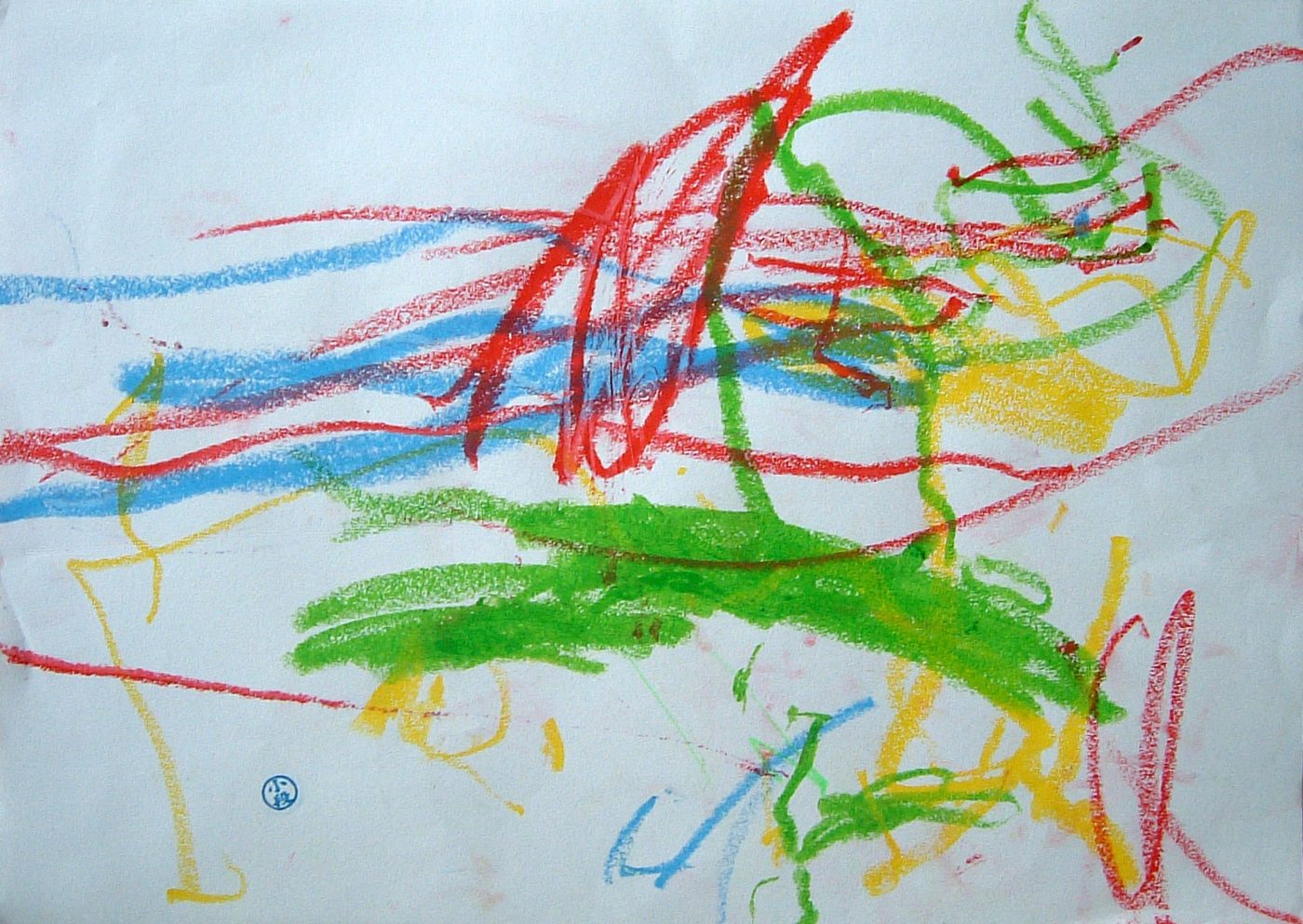
I used to think that I had stopped being an artist. Not because I had made a conscious decision to give up art, but because I had gradually accepted a practical idea: an artist cannot make a living. There was work to do, responsibilities to take care of, and painting became something I would perhaps return to one day. Then, one day, my daughter and I were sitting together with nothing particular to do. I took a piece of paper and made a few random marks. I suggested that we look at them and see what we could find. We discovered fish, balloons, bears, and other things that neither of us had planned to draw. It was a simple game, born out of boredom. But I remember the pleasure of it. Something appeared where there had been nothing recognisable before.
I began doing this more often. Whenever I had no idea what I wanted to do, or simply wanted to shift my attention, I would make a scribble and look for something inside it. Sometimes I found an object almost immediately. Sometimes I found nothing. The difference between those two experiences became increasingly important to me. When I recognise something in a random arrangement of lines, it feels like a reward. I have not deliberately drawn that object. I have discovered it. And the pleasure of that discovery makes me want to continue. One association leads to another; I start telling myself little stories about what I see, and those stories seem to create new possibilities in the image. Looking, thinking and imagining begin to move together.
This was also how my painting series, The Familiar, began. I had canvases in my studio that I had bought years earlier and left untouched, waiting for some future moment. One day I simply tried. It turned out that I wanted to paint after all.
The beginning of a creative session does not always feel the same. Sometimes I arrive with enthusiasm and the first marks come naturally. At other times I want to draw, but I have no inspiration at all. Then I have to push myself. I make a scribble and wait to see whether anything catches my attention. For me, the first two or three seconds can be surprisingly important. If I recognise something, I usually want to follow it. The process opens up and my creativity seems to grow as I work. If I do not see anything, I can become bored and impatient. I may stop altogether, or continue almost on autopilot, inventing objects that I have not actually found in the lines. The drawing still develops, but the experience is different. If I abandon it, I am often left feeling dissatisfied. I am not sure that every session needs to be rescued.
I have been thinking more about inspiration lately, about personal development and the idea of following what feels right. I have become more willing to accept that, if I do not want to paint on a particular day, perhaps I simply should not. But I also know that sometimes the desire is there and something else is missing: the first connection that makes me want to stay.
There is another thing I have begun to notice, although I do not yet know how to explain it. My emotional state seems to affect what I see. When I am calm, I tend to recognise objects in the marks. When I am carrying a strong emotion, I often see the drawing more abstractly. It is as if I bring what is happening inside me into the image. My problem becomes entangled with the scribble, and the lines seem to fill with shapes rather than separate, familiar objects. I find it much harder to direct my attention towards something outside myself. I cannot say why this happens, or whether it happens to other people in the same way. It is simply something I have begun to observe in my own work. The drawing has not changed. I have.
When I cannot find anything by looking at the individual lines, I try to change the way I look. Instead of searching for an object inside the scribble, I look at its overall outline. I take in the whole shape and its atmosphere. Sometimes an impression of the whole appears first, and individual objects emerge from it afterwards. The order is reversed: from the whole to the parts, rather than from the parts to the whole. This has made me less dependent on one way of seeing. I used to think that I had to find something within the lines. Now I know I can step back and look at the entire composition. There are several ways into the image, and I do not have to force myself to use only one.
I often imagine myself as someone pushing a heavy stone uphill. I tell myself: just a little further, just one more object, and I will reach the top. Once the stone passes the highest point, it will roll on its own. I will no longer have to push. It is not always that easy, of course. Sometimes I have to decide to continue. The decision does not simply arrive by itself; I have to help it happen. But knowing that I have more than one way to approach the image makes the first step less difficult. I no longer need to wait helplessly for an association. I can change my position, look at the whole, look at a detail, or make another mark.
With practice, this process has become easier. At the beginning, connecting the shapes and associations felt difficult. Now the movement between seeing, thinking and imagining feels more natural. I notice something, associate it with something else, tell myself a story, and that story gives me another reason to look. I have also become more disciplined. I do not always wait for an idea to appear before I act. I have learned that sometimes the ideas come after I begin.
I would not say that I have discovered a formula for creativity. I still have days when I do not see anything, when I am distracted, or when I decide to stop. But I have come to understand that the first impulse does not always need to be strong or complete. Sometimes it needs a little help. Maybe continuing is not simply a matter of having inspiration. Perhaps it is also a matter of knowing what to do when inspiration is absent, when the first attempt does not work, or when the image refuses to offer anything familiar. My advice to myself has become quite simple: follow the impulse, but give it a small push when it gets stuck. You do not always have to know what you are looking for. Sometimes you only have to make the first mark, look again, and give yourself a chance to see something you did not expect.
So the real question is not why we lose inspiration, but how many possibilities we leave unexplored simply because we stop looking too soon. What might happen if, instead of waiting for the right moment or the right idea, we allowed ourselves to begin again?
Dilyana Teneva is an independent researcher and visual artist. Her ongoing painting series is The Familiar: poznatoto.online.