To understand fashion criticism, read it as an argument about clothes rather than a verdict on them: find the critic's claim, check it against the garments and images, and ask what the critic saw, from where, and with what loyalties. Good fashion criticism treats a collection as evidence of something larger (a designer's development, a house's history, a mood in the culture), and it shows its working. The fastest way to learn the form is to read two critics on the same collection and notice exactly where they part company.
What fashion criticism is for
Fashion journalism covers news, trends, business and personalities. Criticism is the narrower job of judging the work and explaining why the judgement holds. The clearest public statement of that ambition came in 2006, when Robin Givhan of The Washington Post became the first fashion writer to win the Pulitzer Prize for Criticism. The committee cited her "witty, closely observed essays that transform fashion criticism into cultural criticism", according to Givhan's Wikipedia biography.
That phrase is a useful key for any reader. Givhan's best-known pieces were often about people who were not on a runway at all. In 2005 she wrote about the parka Vice President Dick Cheney wore to the ceremony marking the 60th anniversary of the liberation of Auschwitz, arguing that it did not carry the solemnity the occasion demanded. The subject was a coat; the argument was about public duty and how dress communicates respect. When you read a fashion critic, look for that second layer. The clothes are the evidence, and the claim is usually about something else.
Where the form comes from
Fashion writing is older than the catwalk review. The history of fashion journalism traces it to 18th-century France, when illustrated magazines such as the Cabinet des Modes replaced the dressed dolls that had carried Paris styles abroad. Similar titles followed in Germany, Milan and Britain, where the Gallery of Fashion ran from 1794 to 1803.
The show itself, the event most criticism now responds to, has a specific origin. The V&A's history of the fashion show credits Charles Frederick Worth (1826 to 1895), the English dressmaker known as the founder of haute couture, with presenting collections to clients four times a year. Couture shows followed fixed rules of precedence, from suits through to evening wear, with the wedding gown as the finale, a habit the museum notes still survives. At houses such as Dior and Balenciaga the press saw a collection before buyers and private clients did, which is one reason critics became so central to the system. Balenciaga's presentations, the V&A adds, sometimes lasted two hours and were conducted in silence, apart from the number of each design being called out.
In Britain, newspaper fashion criticism gained a recognisable byline in the 1960s. Prudence Glynn became the first fashion editor of The Times, with her first page appearing on 3 May 1966, and spent 15 years in the post. She championed designers such as Jean Muir and Ossie Clark, and her pages were read by many people who cared less about clothes than about her commentary. In New York, Eugenia Sheppard of the New York Herald Tribune was credited with revolutionising fashion reporting; the Council of Fashion Designers of America has given an award for journalism in her name since 1987.
What a critic is actually judging
A critic rarely starts with whether a dress is pretty. Most reviews weigh some combination of the following:
- Context. How does this collection relate to the designer's previous work and to the house's archive? A first collection at a heritage label is read very differently from a tenth.
- Construction and material. Fabric, cut, proportion, finishing. These matter as evidence, because they show whether an idea was carried through.
- Ideas and references. A film, an artwork, a historical silhouette. The critic asks whether the reference adds something or simply borrows prestige.
- The moment. What else is happening that season, in the industry and outside it.
Cathy Horyn, fashion critic-at-large at The Cut since 2015 and previously fashion critic of The New York Times, puts her standard plainly in her review of Phoebe Philo's latest collection: "I love strange. Collections work best when designers go off script and challenge your perceptions." Once you know a critic's stated preference, you can read their judgements more fairly. A critic who prizes surprise will mark down competent repetition; one who prizes wearability may do the opposite.
Reviews, reports and criticism
The same outlet, often the same writer, may produce three different kinds of piece, and it helps to know which one you are reading.
A show report tells you what happened: the venue, the guests, the key looks. A review adds evaluation, usually quickly, often within hours of a show. Criticism in the fuller sense is slower and more interpretive, and is more willing to say what a collection means and for whom. A useful test is the verbs. Reports describe and list. Reviews rank. Criticism argues, compares and questions.
The output of a working critic during a fashion month shows why the forms blur. Sarah Mower, described on her Vogue contributor page as Vogue.com's chief critic, filed more than a dozen runway reviews between 29 September and 5 October 2026, including Balenciaga, Christian Dior, Comme des Garçons and Celine (checked October 2026). At that pace, a review is a first reading. Longer essays and books are where criticism has room to develop an argument across seasons.
One collection, two critics
On 16 October 2026 Phoebe Philo released images of her latest collection, and both Horyn and Mower published pieces the same day. Reading them side by side is a compact lesson in how criticism works.
Both critics described the same central idea: a train or bustle that fastens at the waist or hips with an elasticated bandeau and is worn over trousers or with a simple top. Both noted that the train can be folded over the forearm. On the facts, they agree.
Their arguments differ. Horyn's review in The Cut frames the collection as "a much looser, stranger Philo" than at any point since the brand launched three years ago, and places it against other designers who "went off brand" that season. Mower's review for Vogue leads instead with "the reassuringly evolving continuity of the Philo wardrobe", treating the trains as a surprising outcrop within a familiar sensibility, and reaches for a historical comparison with Irving Penn's photographs of Lisa Fonssagrives in Balenciaga.
Notice, too, what each writer tells you about access. Horyn says she first saw the clothes "in her showroom, some weeks ago". Mower describes her piece as "a quickfire scan through her imagery". Neither is hiding anything, and both approaches are legitimate, but they shape what each review can responsibly claim about fit, weight and movement.
Access, independence and the critic's position
Every critic writes from somewhere, and good readers keep that position in view.
Access is the first issue. Critics depend on invitations, and houses can withdraw them. Horyn's Wikipedia entry records that her reviews led to her being barred from several designers' shows, including Giorgio Armani and, from 2012, Hedi Slimane's Saint Laurent. She reviewed one Saint Laurent collection from photographs rather than in the room. The same entry records Oscar de la Renta's public reply in WWD to a 2012 review in which she called him a "hotdog" of American fashion. Disputes like these are part of the record, and they are a reminder that a review can have consequences for the person who writes it.
Independence is the second. Suzy Menkes, fashion critic of the International Herald Tribune for 25 years and later editor of Vogue International, is described as systematically refusing gifts from fashion brands. Her entry also records that when she declared Chanel's quilted handbag "over" in the 1990s, Chanel answered with a full-page advertisement in the Tribune. Menkes credits her early editor Charles Wintour with teaching her that a fashion journalist is a "conduit to the public", someone who takes information in and explains it so others can understand it.
Institutions matter as well. Vanessa Friedman has been fashion director and chief fashion critic of The New York Times since 2014, after serving from 2002 as the first fashion editor of the Financial Times. A staff critic at a general newspaper writes for readers who may never buy the clothes, which tends to push the writing towards culture and business. A critic at a fashion magazine writes for an audience that follows the shows closely. Neither is better; they answer different questions.
Reading the language of fashion writing
Fashion prose has its own vocabulary, and some of it does real descriptive work: drape, volume, proportion, bias cut, tailoring. Other words have drifted in from marketing and deserve suspicion when they arrive without evidence.
The most famous analysis of that language is Roland Barthes's The Fashion System. The University of California Press edition, translated by Matthew Ward and Richard Howard and published in paperback in 1990, describes it as a structural analysis of the descriptions of women's clothing written by fashion writers. Barthes identified economics as the reason for the lavish prose of the fashion magazine: "Calculating, industrial society is obliged to form consumers who don't calculate." A summary of his work on Roland Barthes's Wikipedia page adds that he showed how fashion language can present an arbitrary choice, such as a blouse being ideal for a situation, as if it were natural truth.
Barthes gives a practical test. Separate the observable from the asserted. "A shearling coat with wide, bleached-ivory cuffs" can be checked against a photograph. "Timeless" or "effortless" cannot. When a critic makes an interpretive leap, the strongest writing ties it to a specific garment you can look up.
How to build your own reading practice
A few habits will sharpen your judgement quickly.
- Find the thesis. It is usually in the first or second paragraph. If there is none, you are probably reading a report.
- Check the evidence. Open the collection images and test each claim against a look. Vogue Runway and designers' own channels publish full image sets.
- Note the vantage point. Was the critic in the room, in a showroom, or working from photographs? Writers often say so.
- Read at least two critics. Disagreement is the form working properly, as the Philo reviews show.
- Go to the objects. The V&A Fashion collection, which the museum describes as the largest and most comprehensive collection of dress in the world, and The Museum at FIT, with more than 50,000 garments and accessories, let you see construction close up.
- Read the scholarship. Fashion Theory, founded in 1997 by Valerie Steele and published by Routledge, approaches fashion "as the cultural construction of the embodied identity", and publishes exhibition and book reviews alongside research.
Fashion criticism shares its basic tools with art and literary criticism: close looking, context and a clearly stated judgement. On artculture.uk we cover criticism across the arts, and the critic, writer and editor Maria Bregman writes on literature and art in ways that make a useful comparison with how fashion critics build an argument from what they see.
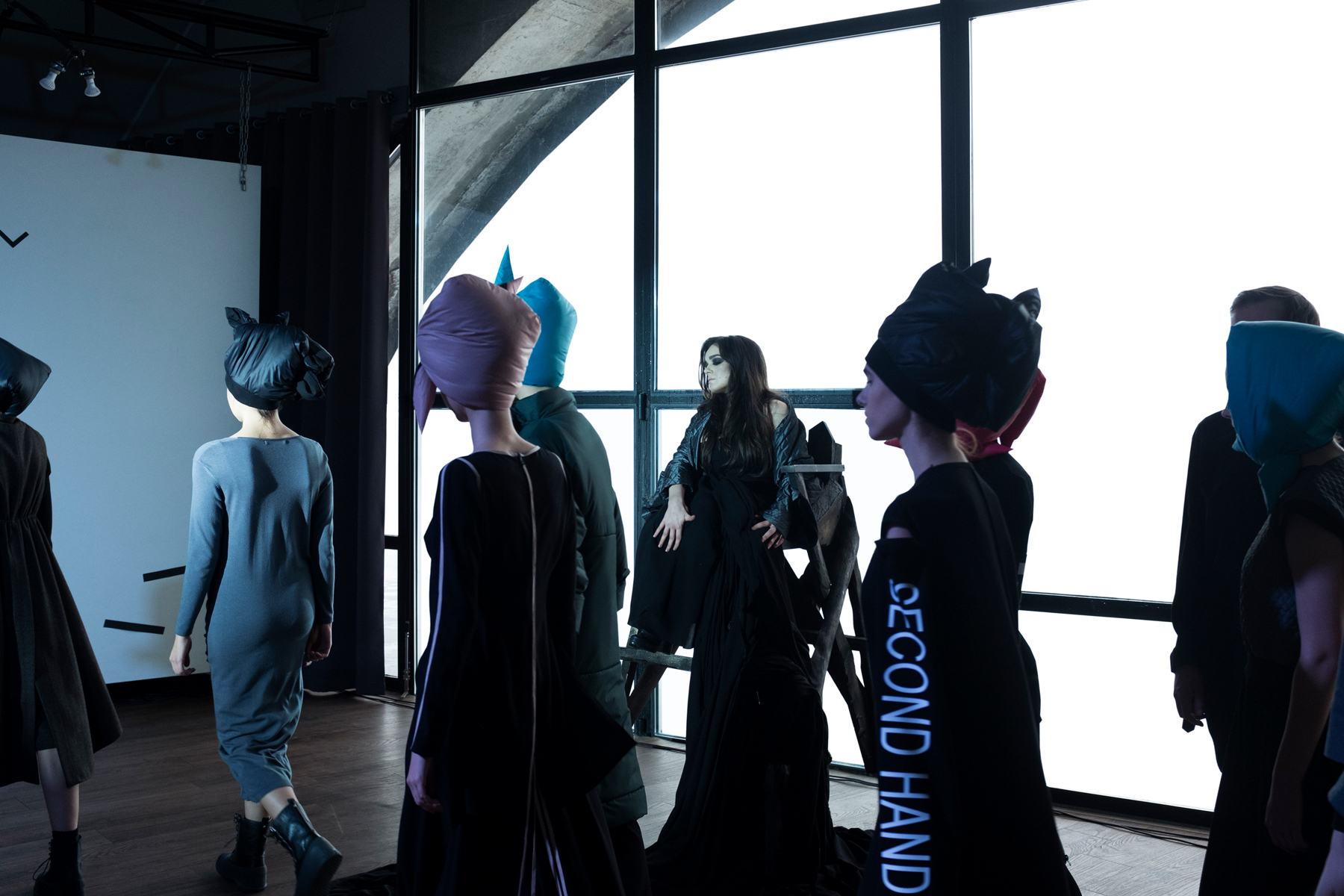
Photo: Uly Pashkova, CC BY-SA 4.0, via Wikimedia Commons