By Joseph Jenkinson
Black & White does something unusual: it sets a deeply personal story about trauma, guilt and identity in the underground world of professional wrestling. The film follows Michael, a Deaf man whose past continues to haunt him as he tries to find a place in a world from which he feels increasingly disconnected.
Written by Brian Duffy, who also stars as the troubled protagonist, and directed by Bim Ajadi, the film explores Michael's estrangement from the Deaf community, his relationship with wrestling and the psychological consequences of a tragedy that continues to shape his life. Its journey to the screen, however, was almost as complicated as its protagonist's.
Asked about the title, Duffy points to the diversity of experience within the Deaf community: "There's not one type of deaf person; there are many different types of deaf people." That complexity is reflected in Michael, who is estranged from the community and struggles with his own sense of belonging.
Duffy traces this to his own encounters with other Deaf people: "When I met people that were Deaf, they would see me sign, and they assumed that I had a Deaf family, and or that I went to a Deaf school, but I didn't do either."
"And then their attitude would change a little bit," he continues. "They're like, oh, interesting. As a teenager, you're like, oh, I'm better than you, we're different, we're not the same."
"I did, myself, look down on other Deaf people as a teenager," he admits. "I needed to grow up about it and be honest."
That willingness to acknowledge his own shortcomings matters in Black & White, a film that deliberately avoids presenting identity and community as straightforward. Its characters occupy complicated positions, sometimes struggling to reconcile their own perceptions with the expectations of those around them.
From Deaf Club to the ring
Speaking through interpreter Kat Wright, Duffy explained that his original screenplay followed a Deaf son whose mother is killed in a car accident on her way home after dropping him off at Deaf Club. The son blames himself for her death and eventually turns to wrestling as a way of punishing himself.
The idea came from Duffy's own childhood. Growing up in a hearing family in Glasgow, he relied on his mother to take him to Deaf Club every Wednesday evening.
It was an ambitious concept, but turning it into a short film presented several challenges. The original story had many layers, and discussions with LumoTV, the film's commissioner, eventually led to a significant change of direction. "They were a bit unsure about it, that it was quite a complicated story to explain, lots of layers," Duffy recalls. "We couldn't afford a car to crash. And we wouldn't want to use AI to show it either."
Duffy says LumoTV, known as BSL Zone when it took on the script, initially wanted a simpler, more upbeat story. He wanted to write something less conventional: "I don't want to write something like that. I want to write something angry…"
After several discussions and revisions, the team turned to a later part of Duffy's life: his career as a professional wrestler. The change allowed the filmmakers to explore a different set of emotional themes.

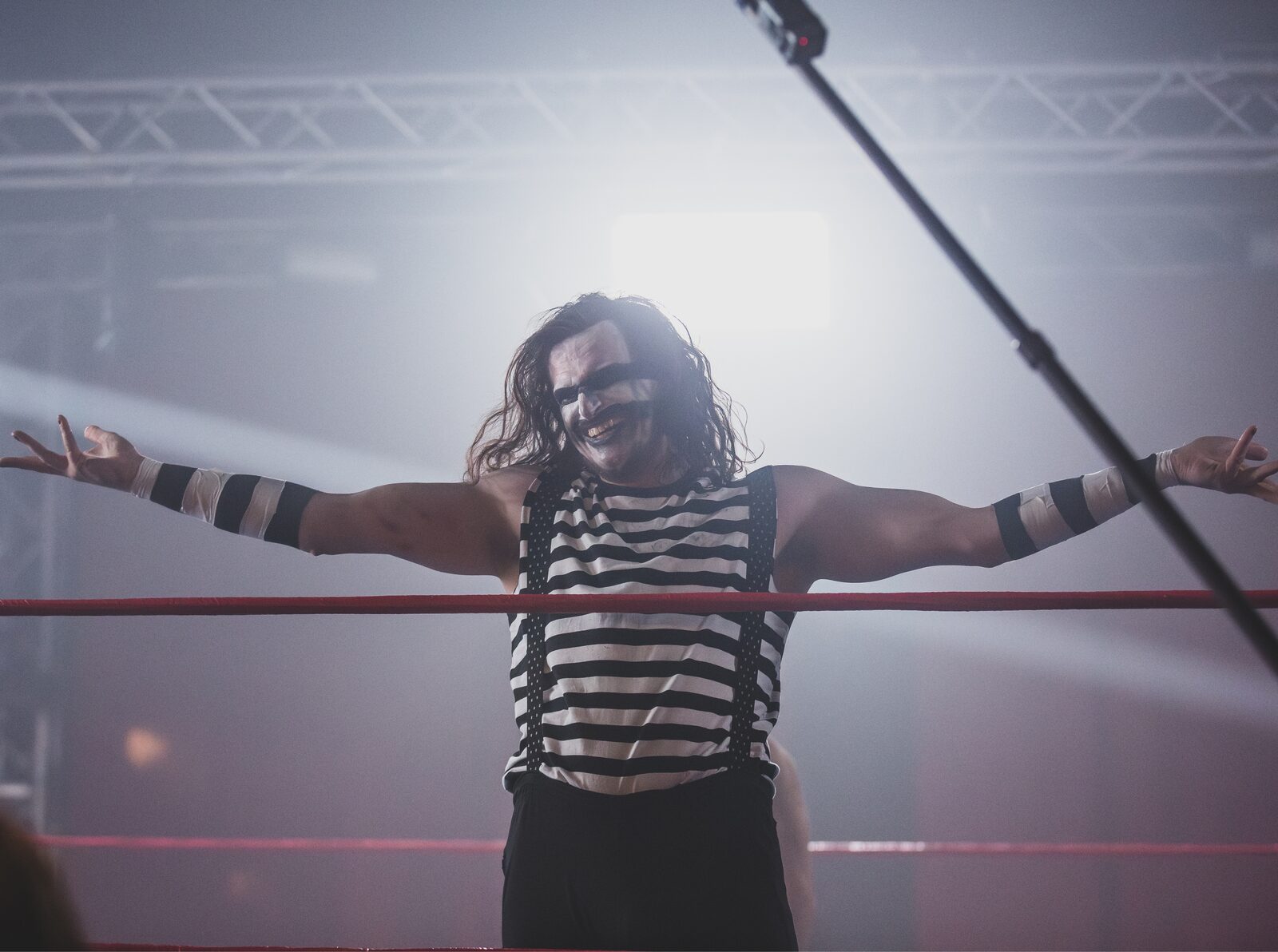
Duffy's wrestling persona was a mime, inspired by a Swiss mime artist whose dark, theatrical performances used disturbing imagery. That persona passes to Michael, who uses the character to communicate through his performances, turning the ring into a space where he can briefly exercise some control over his identity.
Duffy grew up on WWF and WWE wrestling and was also inspired by Darren Aronofsky's The Wrestler (2008), the sombre Oscar-nominated drama starring Mickey Rourke. "I love that film," he says. Like Rourke's ageing fighter, Michael uses the ring as an escape. "I thought wrestling would be a good part of [the story], because my character can't speak. He can't hear."
Duffy sees a connection between wrestling and the Deaf community through visual expression. Unable to rely on spoken language, he found ways to express himself through his wrestling character's mannerisms, and these are channelled into Michael and his need for solace.
A director who knows the sport
For Ajadi, the combination of a major sport and deafness was one of the script's strongest attractions. Having played semi-professional football, he knew what it was to compete in predominantly hearing environments and to meet assumptions about what Deaf people can do.
"When I read it, I thought it was really good to have a bit of empowerment for Deaf people in this mainstream sport," he explains. Ajadi recalls being judged during his own sporting career, with some people questioning whether his deafness would stop him reaching the same level as hearing players. "I could empathise with him [Michael], particularly his determination to improve and achieve more in his chosen sport."
Ajadi was also drawn to the film's treatment of PTSD. Trauma, he says, can come from many experiences, including bullying and discrimination, yet the ways people cope with it are rarely discussed openly.
"People don't talk about the trauma that they go through," he explains, "and to be fair, a high percentage of Deaf people have traumatized moments throughout their lives, in various circumstances: they could have been bullied at school, they've been oppressed by the hearing community, however that plays out in their life. So, there are elements of trauma that we as a community go through, and then we don't really talk about how they deal with it, so it's not really talked about."
"So, I think," he continues, "the story really helps to open that up to people, and those discussions should be had: you know, how do we cope with trauma?"
Michael copes through wrestling. Ajadi adds that "his [Michael's] trauma is not being involved in the Deaf community at all, and being in denial of that he's a member of the deaf community. So, the things that happened to Michael have happened to many, many, many Deaf people in similar situations, you know?"
Twenty people and a camera
The shift to a wrestling story also made the film easier to shoot on its budget. The production hoped for around 100 spectators for the wrestling scenes but managed to gather about 20 to 30. To make up for it, the crew filmed from different angles and moved spectators between takes; with changes of clothing, hairstyle and seating, they created the impression of a much larger crowd.
The whole film was shot in six days, two of them devoted to wrestling, which left the team with about eight hours of wrestling footage. Duffy had plenty of ideas for further choreographed sequences, but Ajadi was wary of losing the story's emotional focus. "There is a danger there of the story then becoming a wrestling story, which it isn't, actually. It's about human stories that people can relate to, and the wrestling is a tool to add to that storytelling."

The film is visually compelling too. Its non-linear structure asks the audience to piece together Michael's hidden trauma like a mystery, until we finally understand him. "I want the audience to think and work things out," Ajadi explains. "I don't want to spoon-feed the audience."
At the same time, Ajadi wanted the film to stay realistic and personal, so that audiences could understand the perspective of a Deaf person in a sport as intense and physically demanding as wrestling. Michael's matches are filmed in a close, claustrophobic style, with cinematographer Adam Lyons drawing on The Wrestler and The Crow (1994), two films grounded in a grim, truthful picture of ordinary people struggling to get by.
Those references shaped the darker atmosphere and the contrast between Michael's different worlds. "I'm a big fan of authenticity," Ajadi says. "I don't want to over-stylise things, Hollywood style. I want it to feel very grounded."
For Ajadi, that balance between realism and style is also about not underestimating Deaf audiences. Deaf viewers, he points out, regularly watch complex mainstream films and streaming dramas, and should be offered the same range of cinematic experiences. "We need to push the level of Deaf filmmaking up," he says. "Let's not play things too safe. I want us to take risks when we're making films and tell different stories."
No simple redemption
For all its wrestling sequences, dark imagery and unconventional structure, Black & White returns to a remarkably human story. Michael's experiences raise difficult questions about guilt, trauma and what happens when a person loses their sense of belonging. His wrestling persona offers an escape, but it cannot entirely protect him from the past.
For Duffy and Ajadi, a Deaf-led production was a chance to move beyond familiar representations and take on subjects that rarely get enough attention. Their ambition goes beyond putting more Deaf characters on screen: they want Deaf filmmakers to have the creative freedom to experiment, take risks and tell stories that are not necessarily comfortable or predictable.
Michael's story offers no simple route to redemption. Wrestling gives him a place to express himself, but it cannot erase the guilt and isolation he carries. For Duffy, the character grew from personal experience; for Ajadi, the challenge was to shape that material into a film that trusts its audience and resists easy answers. Black & White is not meant to stand for every Deaf person. It is one complicated, individual story, and a reminder that Deaf-led filmmaking should have room for stories as unsettling, ambiguous and unconventional as any other.
Black & White, directed by Bim Ajadi and written by Brian Duffy, streams on LumoTV from 27 November 2026 and airs on TogetherTV on 30 November 2026.
Joseph Jenkinson is a freelance film and entertainment writer whose work has appeared in Screen Rant, The Indiependent, Flickering Myth and Flickside.