
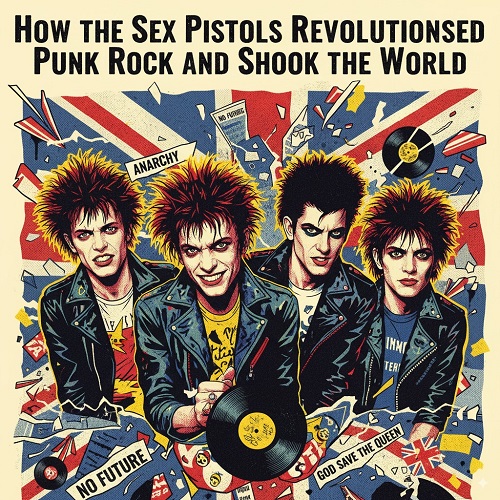
By Anna Zhila
It all came down to a few minutes of television. On the first of December 1976, the Sex Pistols were ushered into a London studio as a last-minute replacement for another band. The host, Bill Grundy, was a man steeped in the cosy, self-satisfied traditions of light entertainment. He goaded them, patronised them, and flirted with the band’s female entourage. In return, the band gave him exactly what he was asking for. They swore.
The outrage was immediate and magnificent. Newspapers frothed with indignation. The nation, it seemed, was clutching its pearls in unison. But the broadcast was not a mistake. It was a detonation. It was the moment a carefully constructed art project, designed in a King’s Road boutique and fuelled by working-class rage, escaped the laboratory and went viral. The Sex Pistols were never just a band. They were a cultural weapon, and the Grundy interview was the moment they pulled the pin.
To understand the Sex Pistols is to understand that their music was, in many ways, the least important thing about them. They were an idea first, a sound second. They were a calculated assault on a culture that felt bloated, self-important, and disconnected from the grim reality of 1970s Britain - a country of power cuts, three-day weeks, and the lingering smell of decay.
The Architects of Anarchy
The band’s genesis was not in a garage, but in the mind of Malcolm McLaren. He was not a traditional music manager; he was a situationist, an art-school provocateur who understood that the real power was not in creating products, but in engineering spectacles. His shop, SEX, was a laboratory for his ideas, selling a kind of anti-fashion that was less about clothing and more about attitude. The Sex Pistols were simply the next logical step: a human embodiment of his theories.
He assembled the parts with a kind of cynical genius. In Steve Jones and Paul Cook, he had a rhythm section that was pure, brute force - a muscular, rock-and-roll engine stripped of all finesse. In Glen Matlock, he had a surprisingly adept songwriter with a knack for a pop hook. But the final, crucial component was John Lydon, a young man with rotten teeth and a stare that could curdle milk.
Lydon, rechristened Johnny Rotten, was the project's soul, or perhaps its anti-soul. He was not a singer in any conventional sense. He was a vessel for contempt. His voice, a high, nasal sneer, was the perfect instrument to articulate the boredom, disgust, and nihilistic fury that simmered beneath the surface of British society. He was authentic in a way McLaren could never be, and it was this collision of art-school theory and genuine, street-level rage that gave the band its explosive power.
The Sound of Collapse
When their only studio album, Never Mind the Bollocks, Here’s the Sex Pistols, was unleashed in 1977, it was not so much a collection of songs as it was an act of sonic vandalism. It sounded like a building being torn down. Steve Jones’s guitar, layered into a monstrous wall of noise, was a chainsaw cutting through the bloated corpse of progressive rock and stadium pomp. The rhythm section was a jackhammer.
And over it all, there was Rotten. He didn't sing about love or fantasy; he spat out headlines from a world on fire. “Anarchy in the U.K.” was not a political manifesto; it was a gleeful celebration of chaos, a two-fingered salute to the very idea of a future. “God Save the Queen” was even more potent. Timed for release during the Silver Jubilee, it was a direct assault on the nation’s most sacred cow, equating the monarchy with a “fascist regime.” It was blunt, crude, and utterly effective.
Of course, it was all theatre. But it was brilliant theatre. The ripped clothes, the safety pins, the spiky hair - it was a visual language of dissent, a way of making oneself an eyesore to the establishment. It was a rejection not just of mainstream fashion, but of the very idea of aspiration. It was a style that said, “I have no future, so I will make myself a collage from the wreckage of the present.”
The Human Sacrifice
The project’s internal logic, however, was always self-destructive. It was an experiment designed to burn out, not fade away. The embodiment of this tragic trajectory was Sid Vicious.
When Glen Matlock, the band’s most musically competent member, was jettisoned, his replacement was a fan with the right look and the wrong everything else. Sid Vicious could not play the bass. He was not a musician. He was a symbol, a cartoon character of punk nihilism brought to life. He was everything the media wanted punk to be: violent, stupid, and doomed.
His addition to the band was McLaren’s masterstroke and his greatest sin. Vicious turned the spectacle into a blood sport. The band became more chaotic, more dangerous, and less about the music. He was the human sacrifice the project demanded, a walking, talking embodiment of the "no future" mantra. His descent into heroin addiction and his violent, squalid end in a New York hotel room was not a surprise. It was the story’s inevitable, grim conclusion. It was the point at which the art project started to claim real lives.
“Ever Get the Feeling You’ve Been Cheated?”
The end came, fittingly, on an American stage. In January 1978, at the Winterland Ballroom in San Francisco, a broken and exhausted Johnny Rotten slumped over his microphone after the final encore. He looked out at the crowd, a mixture of die-hard fans and curious onlookers, and posed a question that has echoed through the decades: “Ever get the feeling you’ve been cheated?”
It was the perfect epitaph. But who had cheated whom? Had the band cheated the fans by imploding? Had McLaren cheated the band by using them as pawns in his cultural game? Or was the swindle something bigger?
Perhaps the cheat was the nihilism itself. The promise of anarchy and destruction is, ultimately, a hollow one. Burning everything down is easy. The difficult part is building something new in its place. The Sex Pistols offered no solutions. They were a year zero, a cultural reset button, but they had no idea what to do after the reset was complete.
Their true legacy is not in the three-chord riffs or the ripped t-shirts. It is in the permission they gave. They demonstrated that you didn't need to be a virtuoso to make a statement. You didn't need to wait for permission from the gatekeepers. All you needed was a guitar, an attitude, and something to say. The explosion of creativity that followed in their wake - the entire post-punk movement, the rise of independent labels, the DIY ethos - was built on the ground they had cleared. The Clash, Joy Division, The Fall, and countless others took the energy of punk and channelled it into something more complex, more durable, and more artistically ambitious.
In a sense, the Sex Pistols were like a controlled demolition. They were a blunt instrument used to bring down a condemned structure. The process was ugly, loud, and dangerous. But it was necessary. It created a space for new things to grow. And while they themselves may have been a magnificent, beautiful swindle, the revolution they inadvertently started was very real indeed.





Leave a Reply
You must be logged in to post a comment.