She was born on 31 July 1965, which makes today her sixty-first birthday and, by a coincidence she wrote into the books, her most famous character's too. The story attached to that date has been told so often that it has worn smooth: unemployed single mother writes in an Edinburgh café, becomes richer than the Queen. Most of it is true. What gets lost in the retelling is how small the numbers were at the start, and how much of the fortune was made after the writing stopped being the point.
What the benefits years actually looked like
The idea arrived in 1990 on a delayed train from Manchester to London. Rowling had no pen, so she sat and thought for four hours, and by the end of the journey a boy who did not know he was a wizard existed in outline.
Then her mother died of multiple sclerosis that December, at forty-five. Rowling left for Portugal, taught English, married, had a daughter, and came back to Edinburgh in late 1993 with three chapters and a marriage behind her.
The next two years are the part that gets compressed into a sentence. She was on income support of roughly seventy pounds a week, being treated for clinical depression, and describing herself later as poor "as it is possible to be in modern Britain without being homeless." She wrote in cafés partly because a baby fell asleep more easily when pushed there, and partly because a café is heated.
She finished the manuscript on a manual typewriter and typed the whole thing out a second time, because photocopying the full text cost more than she had.
Twelve rejections and an eight-year-old
Her agent, Christopher Little, sent the book to twelve publishers. All twelve declined it. Children's books of that length were considered unsaleable, and the market for boarding-school fantasy was not obviously crying out for another entry.
Bloomsbury said yes because Alice Newton, the eight-year-old daughter of the chairman, was handed the first chapter to read and came back demanding the rest. The advance was a reported £1,500. The initial print run was 500 copies, of which around 300 went to libraries. Those library copies now change hands for tens of thousands of pounds each, which is the only part of this story that everybody already knows.
She was also advised to publish under initials rather than a first name, on the theory that boys would not pick up a book by a woman. She has no middle name; the K was borrowed from a grandmother.
In 1997 the Scottish Arts Council gave her a grant of eight thousand pounds to keep writing. Later that year Scholastic paid a hundred and five thousand dollars for the American rights at auction. That was the moment the arithmetic changed, and it happened four months after publication, not on the day of it.
The fortune was not built by the books alone
Six hundred million copies in eighty-five languages is an extraordinary number, and it is not where most of the money is. Film, theatre, licensing, a theme park division and a games franchise turned a series of novels into a durable rights business, and Rowling retained an unusual degree of control over it for an author.
Forbes named her a dollar billionaire in 2004. In 2012 it took her off the list, citing her charitable giving and British tax rates, which is a rare way to lose a title. The Sunday Times Rich List now puts her at around £975 million, still short of a sterling billion, still comfortably the wealthiest author alive.
Some of the giving is specific and traceable. She has put twenty-five million pounds into the Edinburgh clinic named after her mother, which researches the disease that killed her.
The experiment she ran on herself
In 2013 she published a detective novel called The Cuckoo's Calling under the name Robert Galbraith. It was reviewed well and sold around fifteen hundred copies before a leak revealed the author, at which point it went to number one within days.
That is the most honest data point in the whole story. A good book by an unknown writer sells fifteen hundred copies. The same book by a famous one sells a hundred times that in a week. Rowling has said she found the anonymous version liberating. It also demonstrated, at her own expense, that the market she conquered runs on names.
Why the origin story keeps being retold
Since 2020 Rowling has been one of the most argued-over public figures in Britain, and readers now come to her biography already holding a position. That is not what this piece is about, but it explains why the café-and-benefits story is invoked so constantly by both sides: it is the one part of her life everyone still finds usable.
The version worth keeping is less triumphant and more useful. A book that twelve professional judges rejected was rescued by a child. An advance of fifteen hundred pounds and a grant of eight thousand bought the time to write the second volume. Nobody in the chain, including the author, knew what they were holding.
At sixty-one she is a rights-holder, a litigant, a philanthropist and an argument. She was, for about two years in the mid-nineties, a woman with a pram, a typewriter and no money, and that is the part the market could not have predicted and still cannot reproduce.
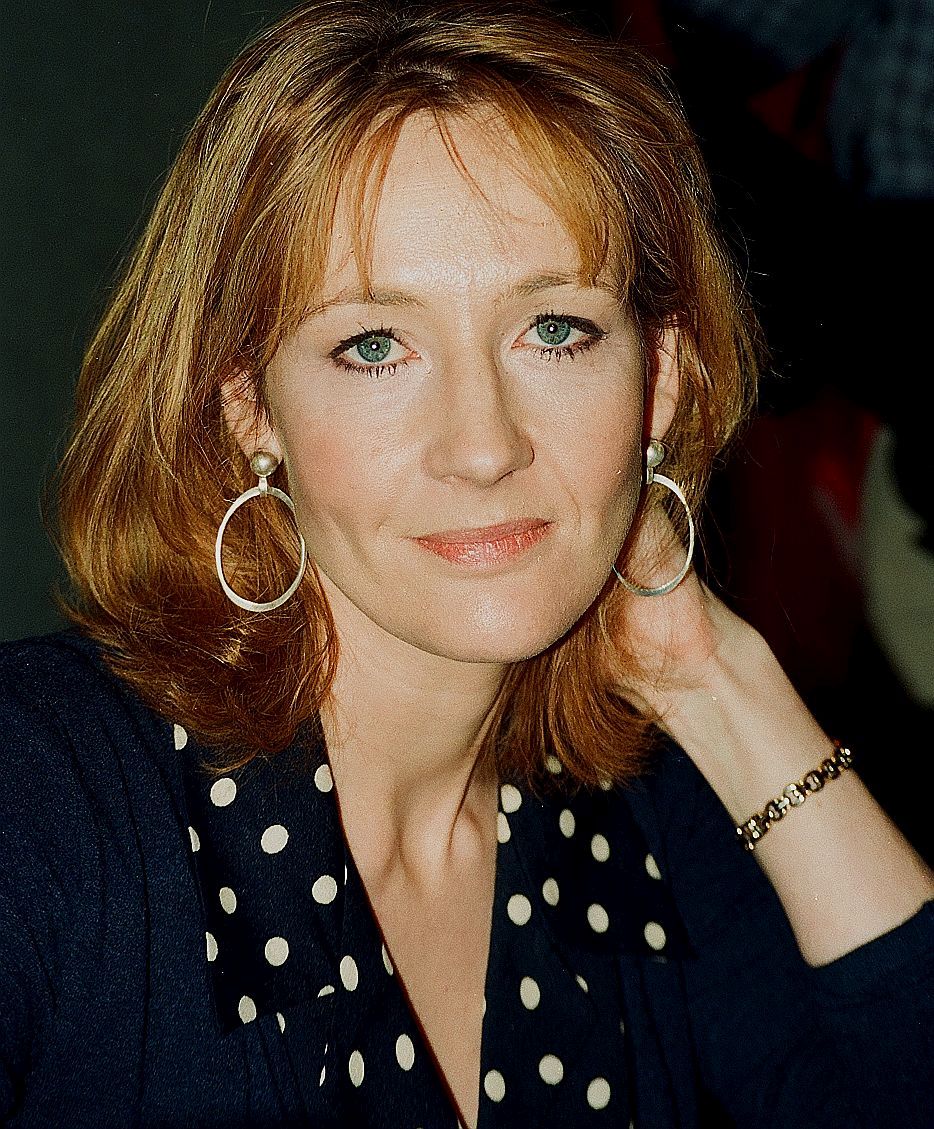
Photograph: J.K. Rowling at the National Press Club, Washington DC, 1999. John Mathew Smith & www.celebrity-photos.com, CC BY-SA 2.0, via Wikimedia Commons.