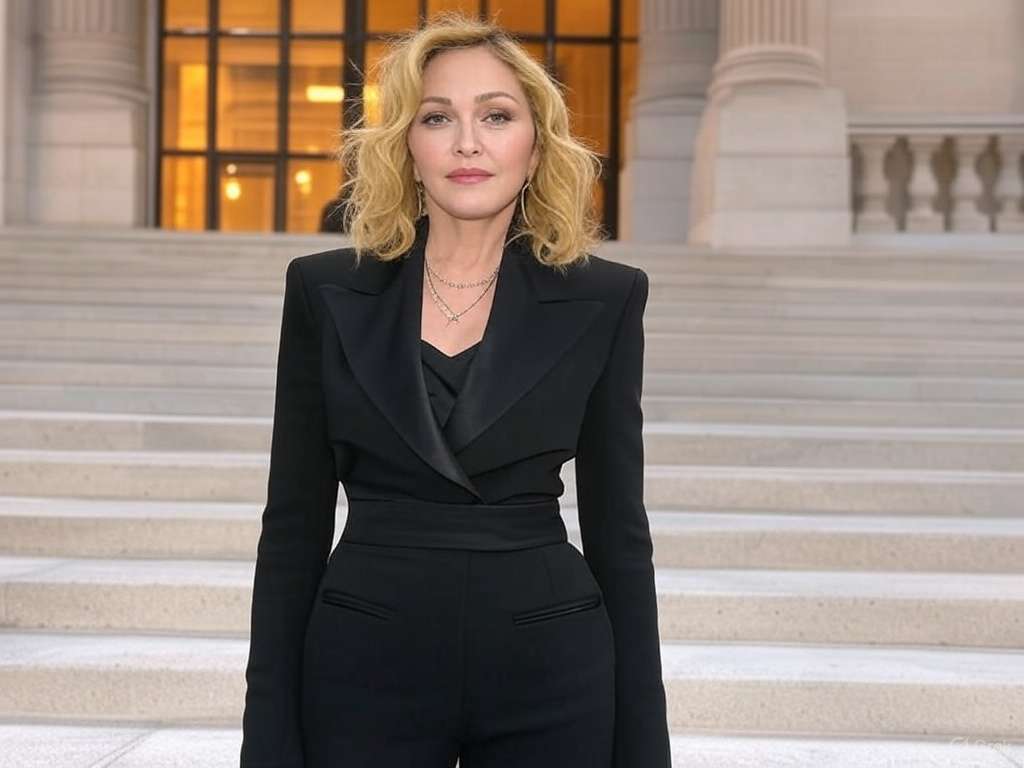
The Met Gala, fashion's most scrutinised annual spectacle, is as much a stage for audacious reinvention as it is for sartorial splendour. When an icon of Madonna's magnitude, a woman who has spent decades meticulously crafting and recrafting her public image, appears with a noticeably less filtered, more natural visage, a distinct sentience permeates the event. It’s a moment that commands attention, not for flamboyant defiance, but for a quiet, yet profound, shift in self-presentation. ArtCulture.UK will tell you about this compelling evolution, exploring how the Queen of Pop's embrace of a more unvarnished aesthetic at such a high-profile event signals a broader cultural conversation about ageing, authenticity, and the enduring power of self-acceptance in the relentless glare of the celebrity spotlight.
The Calculated Reveal
For years, Madonna's relationship with her image has been a masterclass in control, utilising every tool available, from rigorous physical discipline to, reportedly, cosmetic enhancements and, undeniably, digital alteration in her social media presence. Her appearance at a future Met Gala, therefore, would be freighted with expectation. Imagine her arrival, not in an overtly provocative ensemble designed to shock, but in a surprisingly elegant Tom Ford suit, perhaps designed by Haider Ackermann, arm-in-arm with the designer himself. Such a choice, aligning perfectly with a hypothetical "Black Dandyism" Met Gala theme, would already be noteworthy for its sophisticated restraint. This adherence to red carpet fashion norms by an artist known for breaking them would be the first clue that something different is afoot.
Beauty Unveiled
The true talking point, however, would not be the outfit itself, but Madonna's beauty look. After a period where her public appearances and social media posts have fuelled considerable discussion about cosmetic procedures, a shift towards a more natural appearance would be striking. This hypothetical scenario posits that, having perhaps acknowledged a period of over-correction, she has undergone procedures to restore a degree of naturalness. The previous reliance on veils or heavily filtered images would give way to a more open, less concealed presentation. At the Met Gala, this might manifest as significantly lighter make-up, allowing her natural skin texture and features to be more visible than they have been in years. This seemingly simple choice, in the context of her history, becomes a powerful Madonna beauty statement, a veritable manifesto of self-reclamation. Even if her social media posts of the event later receive a touch of Photoshop, the initial, unfiltered public appearance speaks volumes.
The "Naked Face" Trend
This move would align with a burgeoning trend amongst mature female celebrities, famously championed by figures like Pamela Anderson, who have embraced a "naked face" or minimal make-up look on red carpets and at high-profile events. This isn't about neglecting self-care; these women often invest significantly in high-end skincare and professional treatments. Rather, it's a conscious decision to eschew heavy, transformative make-up, signalling a newfound comfort in their own skin and a weariness with the relentless pressure to conform to youthful beauty ideals. This shift represents a significant departure from an era where dense foundation and elaborate make-up were de rigueur for public appearances. The rise of ageing gracefully as a desirable, even fashionable, aesthetic is a powerful counter-narrative to the pervasive cult of eternal youth. For icons like Madonna and Anderson, who have spent decades under intense scrutiny and have little left to prove, this embrace of authenticity feels particularly potent.
Beyond Superficial Changes
The reasons behind such a shift are likely multifaceted. It could represent a genuine personal evolution, a desire to move beyond the pursuit of an unattainable ideal and find peace with her current appearance. After decades of pushing boundaries and reinventing herself, this embrace of a more natural look could be the ultimate act of Madonna's evolution, a quiet assertion of self-acceptance. It’s a powerful message, suggesting that true confidence doesn't always require elaborate artifice. This celebrity image transformation would resonate deeply, challenging conventional notions of beauty and ageing in the public eye.
Alternatively, or perhaps concurrently, external factors might play a role. The public discourse around cosmetic surgery and extreme beauty interventions has become increasingly critical. A move towards a more natural aesthetic could be a savvy response to this changing cultural climate. Furthermore, personal happiness and fulfilment can profoundly impact one's self-perception. If Madonna is, as rumoured, finding joy in her personal life, perhaps with a younger partner like footballer Akim Morris, this contentment could translate into a more relaxed and confident approach to her public image, diminishing the perceived need for extensive cosmetic interventions or heavy digital filtering. The narrative of finding youthfulness not through surgery but through personal happiness offers a compelling alternative.
The Met Gala Stage
The choice of the Met Gala as the stage for such a significant aesthetic shift is, of course, highly strategic. It is an event scrutinised by global media, where every detail of a celebrity's appearance is analysed and dissected. To present a more unvarnished version of oneself in this high-stakes environment is a bold move, guaranteed to generate widespread discussion. It allows Madonna to control the narrative, presenting this new phase on her own terms, under the brightest of spotlights. This is not a candid paparazzi shot; it is a curated, intentional presentation. The celebrity fashion choices are always deliberate, and so too are the beauty statements.
Implications for Beauty Culture
Madonna's adoption of a more natural look at the Met Gala would send powerful ripples through beauty culture. As a perennial trendsetter, her choices have often influenced broader societal aesthetics. Her embrace of a less filtered appearance could further legitimise and accelerate the move towards greater authenticity and acceptance of natural ageing. It challenges the deeply ingrained idea that female celebrities, particularly those of a certain age, must perpetually strive for youthful perfection. This shift could encourage a greater appreciation for the beauty of experience and character, rather than solely focusing on wrinkle-free, ageless ideals. The entertainment industry impact of such a move by an icon of her stature cannot be understated.
This hypothetical Met Gala appearance by Madonna, characterised by a more natural and less filtered aesthetic, would be a compelling chapter in her ongoing narrative of reinvention. It would signify not a surrender to age, but a powerful claiming of it, a redefinition of beauty on her own terms. By stepping back from the more extreme alterations and embracing a more authentic visage, she would once again demonstrate her uncanny ability to tap into, and even shape, the cultural zeitgeist. It would be a testament to the enduring power of an icon who, even in moments of apparent unmasking, continues to command the stage and dictate the conversation, proving that sometimes the most revolutionary act is simply to be seen, truly and authentically.