31.07.2024 By Yulia Tulegenova, art researcher
Reimagining a beloved childhood story is a subtle act of cultural archaeology. In her 2023 series, The Stolen Sun, Maria Akopova does not merely illustrate Korney Chukovsky’s classic tale; she excavates it, unearthing its timeless heart and encasing it in the intricate, gear-driven shell of steampunk.
What Maria Akopova has done in her series The Stolen Sun feels like the latter.
This series captivates viewers with its intricate depictions and profound narrative, reflecting the timeless battle between good and evil in an alternate, industrialized reality.
While the visual elements are paramount, the narrative foundation of The Stolen Sun remains integral to its impact. But in Akopova’s hands, that premise is twisted into something else entirely. Her villain isn't a reptile; it’s a concept, made manifest in a colossal factory that breathes smoke and shadow. You can’t look at its silhouette, which owes more than a little to London’s Battersea Power Station, and not see it as a direct challenge - a stark, grinding conflict between the living world and the relentless logic of the machine.
One of the most striking features of Akopova's series is its steampunk aesthetic, heavily influenced by the imaginative worlds of Jules Verne. Akopova masterfully combines Victorian-era design with futuristic elements, creating a unique visual language that enhances the narrative's depth and complexity. Steampunk has always been a dream of progress that’s already rusting, a vision of the future as imagined by a past that never existed.

Just look at how she paints light, or rather, the lack of it. In the first few pieces, darkness isn’t an absence. It’s a physical presence on the canvas, a thick, oppressive gloom that feels like it’s smothering the very air. So when the light finally begins to return, it doesn’t just flood back in. It feels earned. It’s a fragile, hard-won dawn, and you feel the relief of it in your bones.

In comparison to other contemporary artists, Akopova’s work stands out for its intricate detail and cohesive thematic approach.
Of course, the tension between nature and industry makes you think of Hayao Miyazaki’s Princess Mononoke. There’s that same deep, aching sorrow for a world knocked off its axis.
However, Akopova’s distinct steampunk style sets her apart, grounding her fantastical settings in the scientific possibilities that echo Verne’s visionary landscapes.

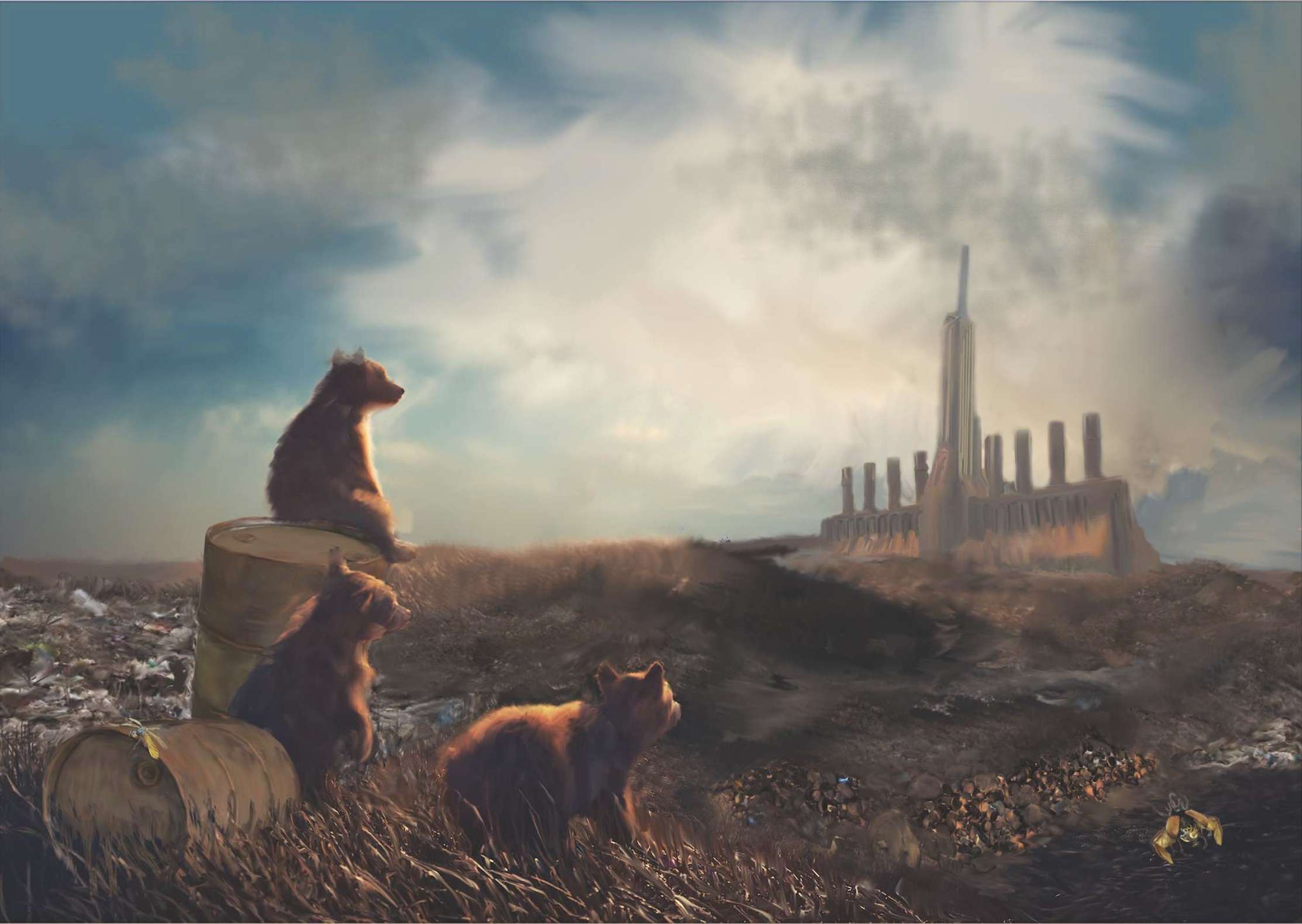
In Maria Akopova’s recent series, The Stolen Sun, we are met not with grand vistas, but with quiet, unsettling tableaus. Consider "Hello, Golden Sunshine," a work that encapsulates the project's core tension. Here, three creatures, bear-like and curious, are perched on rusted oil drums. Their fur seems to emit its own soft light in a world otherwise drained of it. They gaze towards a looming factory, its chimneys still breathing a faint smoke into the sky - a stark symbol of the very thing that has, in the series’ narrative, stolen the sun.

Yet, something is shifting. The oppressive haze is beginning to break, suggesting the industrial gloom may not be permanent. This is a world teetering on the edge of recovery.
Akopova constructs a world rich with the texture of decay. The landscape across The Stolen Sun is a meticulous catalogue of ecological decline: rusted metal juts from overgrown vegetation, and smoke hangs in the air. The colour palette reinforces this, built on a foundation of muted browns and greys that speak of a world starved of natural light.

This makes the pockets of warmth - the gentle glow of the animals’ fur, the softening light around the distant factory - all the more potent. They are not just points of colour; they are visual arguments for hope. These creatures, emerging cautiously from their shelters, represent the end of a long age of fear and the first stirrings of a new beginning. It is, in a sense, a fairy tale for our industrial age, rooted in a tradition but speaking directly to the anxieties of the present.
While the animal characters make the series approachable, Akopova’s work is layered with themes that resonate with a mature audience. The story is a powerful allegory for the conflict between industrial expansion and environmental health. The factory’s theft of the sun is a direct metaphor for how pollution dims our skies and degrades entire ecosystems.
Over time, this toxic influence has physically warped the forest's inhabitants, transforming them into biomechanical hybrids. This haunting detail shows the consequences of unchecked industrialisation not as an abstract concept, but as a physical corruption of life itself. The slow poisoning of the land, the quiet decay of an entire ecosystem - it’s all there on the canvas.
Through this blend of whimsical fable and stark reality, Akopova has forged a memorable series. The Stolen Sun functions as a poignant reflection on our industrial past and a clear warning for our present. But within its desolate landscapes, it also lodges a quiet, persistent glimmer of hope for the future, suggesting that the sun can, eventually, be reclaimed.
Muted browns and greys create a world drained of life, but they are always punctuated by the defiant warmth of an animal’s fura small, biological spark against the monochrome despair.
The slow poisoning of the land, the quiet decay of an entire ecosystem - it’s all there.
Over time, we learn, the factory's toxic influence has even begun to warp the forest’s creatures, turning them into biomechanical hybrids.