By Yulia Tulegenova
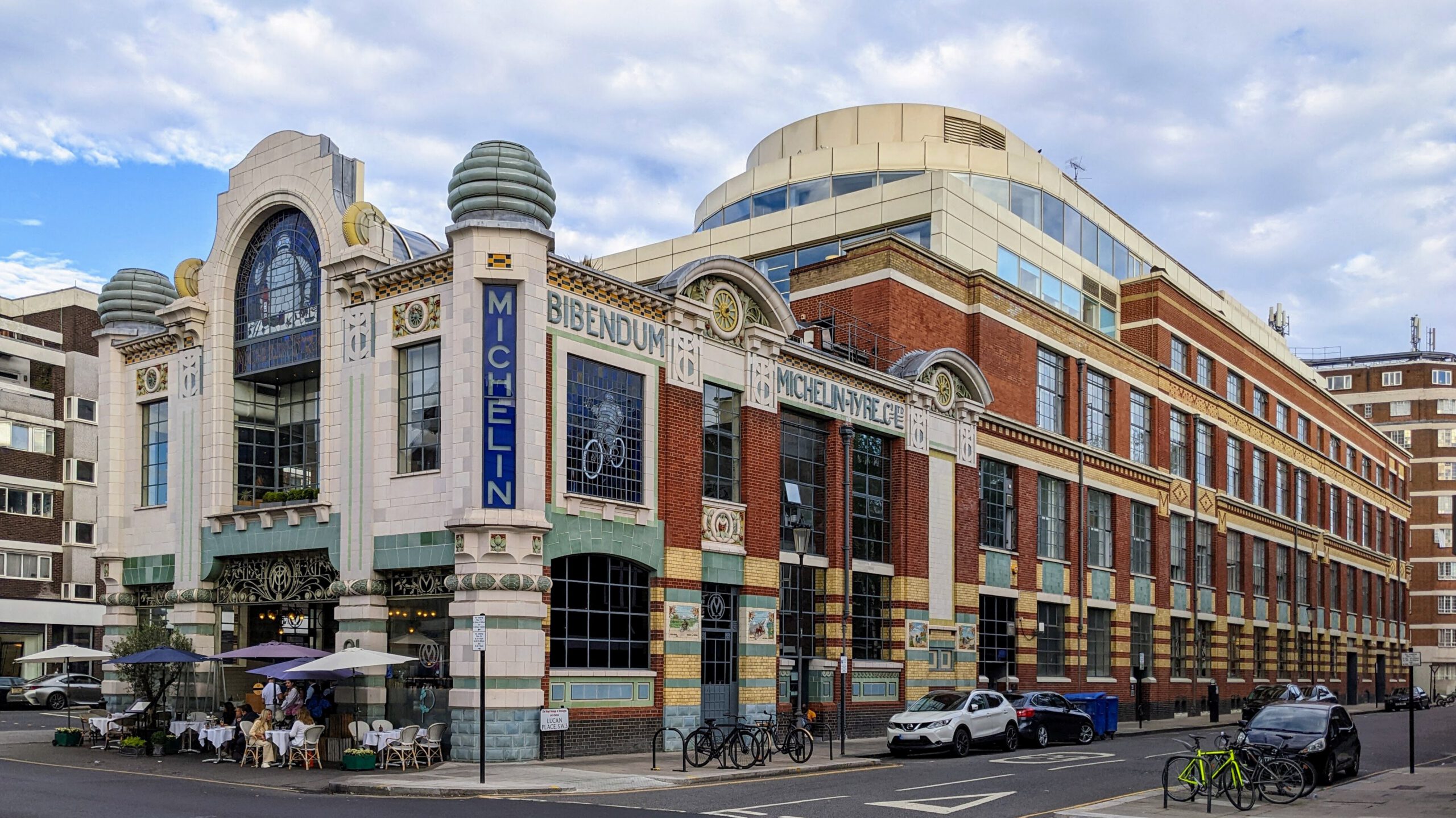
On the curve where the Fulham Road leaves South Kensington for Chelsea sits a building that was made to be looked at. Michelin House has been catching the eye of passing traffic since January 1911, when the tyre company opened it as its first permanent British headquarters. It was a depot, an office and a showroom, and it was also a billboard in glazed terracotta, a piece of corporate theatre dressed up as architecture. More than a century later it remains one of the most photographed corners of west London. The restaurant that turned it into a destination for a certain kind of Londoner, Bibendum, served its last covers in the summer of 2025. That ending is a useful place to begin, because the story of this building is really a story about what a city keeps and what it quietly lets slip away.
A showroom built for the motor age
Michelin commissioned the building at 81 Fulham Road from François Espinasse, an engineer employed by the company rather than a fashionable architect. It opened on 20 January 1911, after a construction programme that was rapid for its day. Espinasse used the Hennebique system of reinforced concrete, which made Michelin House one of the earliest buildings in Britain to be raised on a concrete frame. The structure gave the wide, well-lit interior that a tyre-fitting business needed, and it freed the exterior to become pure display.
And display it did. The two original storeys were faced in cream and coloured faience, trimmed with octagonal corner cupolas and crowned by a great arched window whose gable carried moulded tyres for decoration. Critics have never quite agreed on which style it belongs to; the building borrows from Art Nouveau, anticipates the Art Deco that had not yet been named, and in the end answers only to itself. In 1969 the frontage facing the Fulham Road was listed at Grade II, the protection that has guarded its most theatrical features ever since.
Reading the façade
The building is a lesson in selling a product through ornament. Its presiding spirit is Bibendum, the rotund figure assembled from tyres who has served as Michelin's mascot since the 1890s. The name is a small classical joke. It comes from an 1898 poster by the cartoonist known as O'Galop, in which the tyre-man raises a goblet of nails and broken glass beneath the Latin tag Nunc est bibendum, "now is the time to drink". The boast was that a Michelin tyre swallows road hazards without complaint. That motto reappears in mosaic at the entrance, where Bibendum lifts his glass to everyone who walks in.
Around the base of the building runs a sequence of decorative tiled panels, thirty-four in all, celebrating the racing cars and drivers who won on Michelin tyres between 1900 and 1908. They were produced in Paris by the firm Gilardoni Fils, and they turn a set of commercial premises into something closer to a shrine for the early years of motor sport. Few office buildings anywhere carry their company history so proudly on the outside.
The windows that vanished
The building's most romantic feature is also its greatest loss. Three large stained-glass windows once showed Bibendum in glowing colour. At the outbreak of the Second World War in 1939 they were taken down and moved out of London for safekeeping, and somewhere in the war years they disappeared. They have never been recovered. When the building was restored in the 1980s, replicas were made from old drawings and photographs, so what visitors admire today is a careful reconstruction of something genuinely gone. Even a centenary appeal, which offered an amnesty to anyone who might return the originals, produced nothing.
The vanished windows are the building's own small legend, the kind of half-solved mystery that fixes itself to old London addresses and never quite lets go. They are also a warning about how easily the finest things slip out of a city's grasp.
From tyre depot to design landmark
Michelin sold the building in August 1985. The buyers were the publisher Paul Hamlyn and the designer and restaurateur Terence Conran, who paid a reported eight million pounds and set about giving the place a second life. They restored the original features, added floors, and reopened the building in August 1987 as a mixed cultural address: offices for Hamlyn's publishing house, the flagship of The Conran Shop, and a restaurant on the first floor called Bibendum. For a generation of Londoners with an interest in design, Michelin House became a place of pilgrimage, somewhere to buy a well-made corkscrew and look up at the reconstructed glass.
The restaurant, with Simon Hopkinson in the kitchen, soon earned a reputation as one of the capital's most assured dining rooms. Its cooking was French and unshowy, and its setting, beneath the arched windows on the first floor, was among the most flattering in the city. Bibendum became shorthand for a particular Chelsea confidence, the kind of place where a long lunch could still feel like an event.
The Bosi years, and an ending
In 2017 the restaurant entered a new phase when the French chef Claude Bosi took it over. He closed his Mayfair restaurant Hibiscus and reopened the first-floor room in March that year as Claude Bosi at Bibendum. The gamble worked. By 2018 the kitchen held two Michelin stars, a neat symmetry for a restaurant living inside the tyre company's old headquarters. Bosi kept the building's character in the cooking, serving the offal dishes he felt belonged there. "It's always been on the menu at Bibendum, along with other French classics," he said of the tripe that a smarter address might have refused.
The ending came in the summer of 2025. Bosi could not agree new lease terms with the building's owners, and the restaurant and its ground-floor Oyster Bar closed at the end of August. He pointed to the building's ageing infrastructure, the cramped kitchens and strained services behind the glamour of the dining room, as reasons the site had become hard to run at the level he wanted. "It has been an honour to be part of the Michelin House story," he said as the doors shut. The Conran Shop had already gone, closing its original Michelin House store in early 2023. Within a couple of years the building had lost the two tenants that had defined its modern life.
What the lost legends tell us
It is tempting to read all this as decline, yet the building itself is fine. Michelin House still stands, still listed, still turning heads on the Fulham Road, its reconstructed windows glowing at dusk. What changes is the life inside it. A listing protects a shell and its ornament; it cannot guarantee the restaurant, the shop or the crowd that once gave the shell its meaning. Bricks endure. Uses do not.
That is the quiet lesson of London's cultural landmarks. The city works like a palimpsest, writing new purposes over old ones while keeping just enough of the original text to remind you what came before. A tyre depot becomes a design temple becomes a two-star restaurant, and the building absorbs each identity without ever quite belonging to any of them. The vanished stained glass, the departed shop, the shuttered dining room: these are chapters rather than failures. Michelin House has outlived all of them, and it will outlive whatever arrives next. The pleasure of a building like this lies in watching the city rewrite it, and in trusting that the terracotta and the tyres will still be there, waiting for the next tenant to move in and make the place mean something again.