By Anna Zhila
Orson Welles began filming his Don Quixote on 29 June 1957 in Mexico City, with the Spanish exile Francisco Reiguera as the knight and Akim Tamiroff as Sancho Panza. It was never a conventional shoot. The project had started two years earlier as a half-hour television commission for CBS, shot in colour with Mischa Auer as Quixote; when the network passed on it, Welles recast the knight and expanded the idea into a black-and-white feature. Without a proper budget and with a taste for experiment, he then filmed when he could - days in Mexico in 1957, more in Italy and Spain in the years that followed, and again in 1961 while making a travel series for RAI in Spain. Reiguera died in 1969, Tamiroff in 1972. Welles kept working, kept rewriting, and kept insisting the end was near. He never finished.
Almost seventy years later the film may finally be seen as Welles imagined it, not as a finished work but as a comprehensible mosaic. Four public film archives have agreed to pool what they hold: Filmoteca Española in Madrid, which acquired some 50,000 metres of film in 1991; the Cineteca Nazionale in Italy, where roughly the same length of negative is now stored at Cinecittà, having been held for years by the editor Mauro Bonanni and surrendered to Oja Kodar after an Italian supreme court ruling in 2017; the Cinémathèque Française in Paris, with about eighty minutes of 35mm positives; and the Filmmuseum München, with work prints, negatives, fragments, tapes and paper documents. Together they amount to more than thirty hours of projection.
Filmoteca Española will gather the material in Madrid. The historian and film-maker Esteve Riambau, former director of the Filmoteca de Catalunya and the author of four books on Welles, will examine it and try to put the film in order. He presented the project alongside Valeria Camporesi, director of Filmoteca Española, at Il Cinema Ritrovato in Bologna on 22 June 2026.
A puzzle without a single image
The closest most viewers have come to Welles' Quixote is Don Quijote de Orson Welles, assembled in 1992 by Jesús Franco, who had worked as Welles' second unit director on Chimes at Midnight. Franco cut together the Spanish holdings and the RAI documentary footage for Expo '92 in Seville. It was a brave placeholder, but it was not Welles' structure.
The problem has always been dispersion. The negative that Oja Kodar, Welles' partner and collaborator, recovered in 2017 amounts to roughly what Spain already had. France and Germany hold the rest. No single archive could see the whole.
Riambau describes the task as a large puzzle with missing pieces. The team knows roughly how many are missing, but they have enough to show what the whole might have been. He is clear about the limit: the group will not finish a film that Welles did not finish. The aim is to arrange the surviving material so that a viewer can sense where Welles was heading.
Il mio bambino
Welles called the project il mio bambino - my child - and kept returning to it until his death in 1985. At Bologna, Riambau recalled the famous Rosebud sled from Citizen Kane and suggested a parallel: what if Welles' Rosebud was Quixote itself. For Welles, Quixote was more than a literary adaptation. Riambau argues the identification was double - Welles was both the delusional knight and the grounded squire.
That identification helps explain why the film kept changing. The script was labyrinthine, rewritten perpetually, with different versions of the same scene coexisting. To handle it, the team will work scientifically. No scene that was not shot will be recreated, nothing will be invented. The method is archival, not speculative.
A shared archive without a commercial clock
The four archives bring a rare advantage: no commercial pressure and no fixed deadline. That shared ethos matters because the material resists a quick assembly. The plan, as Riambau outlined it with caution and humour, is to spend 2026 ordering the script and digitising, 2027 comparing script and footage, and 2028 working with a professional editing team to assemble the material into an unfinished but presentable form.
He jokes that he does not want the project to inherit the title Welles himself once threatened to give it, When Are You Going to Finish Don Quixote? - the question people asked him for thirty years.
Thirty hours to sort
The scale is daunting. Riambau has seen parts of the material, but not all. The first job is simply to know what survives and what does not - and to worry, as he puts it, about what may survive but whose location is still unknown.
Even if everything is found, the result will remain incomplete by definition. The value, as he frames it, is not in delivering a lost masterpiece, but in making the existing work legible. Viewers will be able to see where Welles was, even if they cannot see where he would have ended.
For art history, the project is a reminder that some works live as process. Welles shot Quixote across eras, stocks and aspect ratios, turning a seventeenth-century novel into a diary of his own exile and invention. Four public institutions have now given that diary a table to be laid out on. What emerges will be fragmentary, rigorous and, for the first time, close to the delirium Welles carried for three decades.
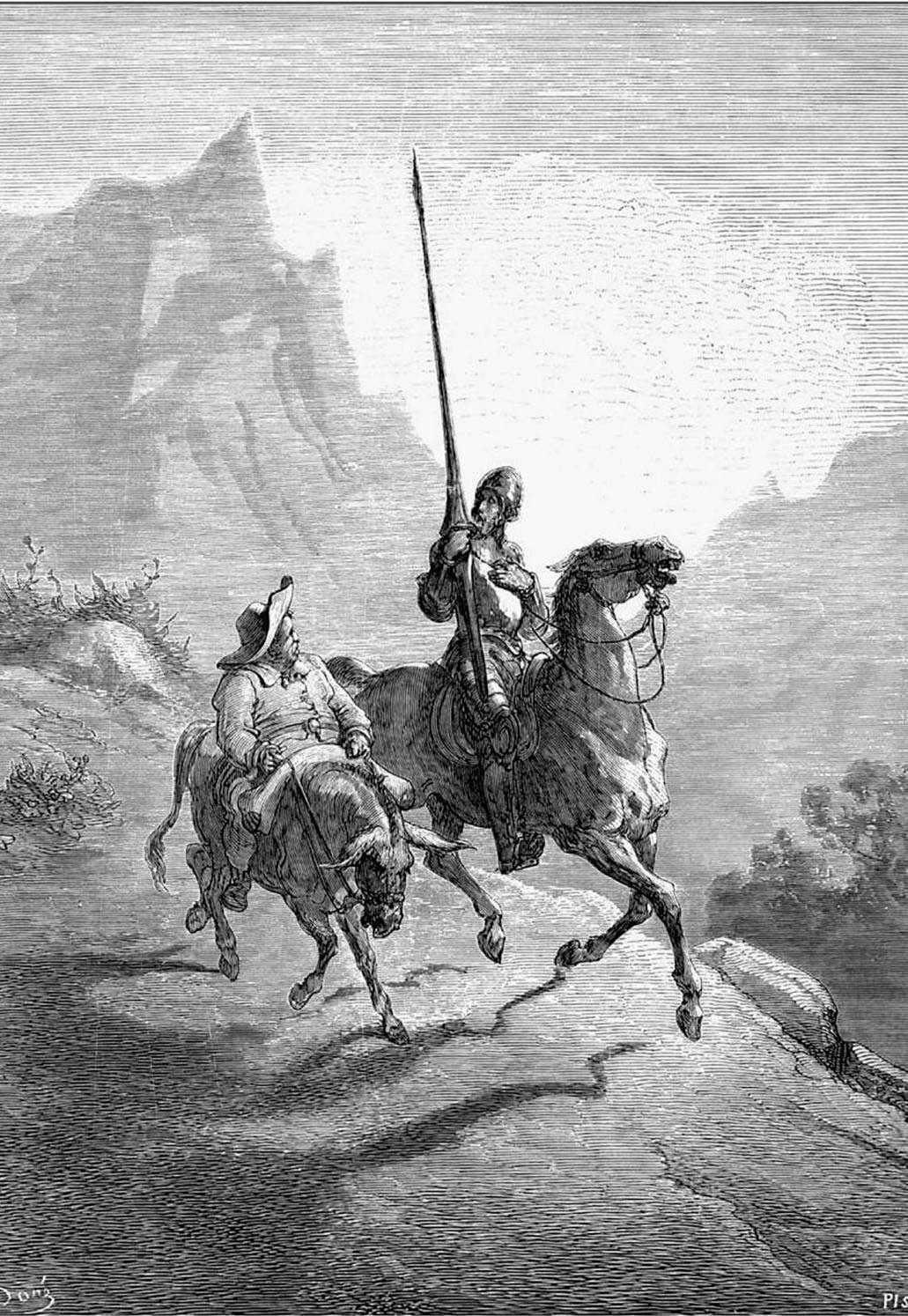
Sources: Javier Zurro, elDiario.es, 22 August 2026; project details and holdings checked against the Il Cinema Ritrovato presentation of 22 June 2026 and the participating archives. Illustration: Gustave Doré, Don Quixote and Sancho Panza (1863), public domain, via Wikimedia Commons.