By Yulia Tulegenova
By Yulia Tulegenova
Every June, the Royal Academy of Arts does something no other major institution attempts. It throws open its Piccadilly galleries to a show assembled partly by strangers. A retired GP from Devon can hang a few feet from a Turner Prize winner; a first-year student can share a wall with a Royal Academician. The Summer Exhibition is the largest open-submission show in the world, and for more than two and a half centuries it has been the one fixed point in the British
cultural calendar that belongs to everybody.
The 2026 edition, the 258th, opened on 16 June and runs until 23 August at Burlington House. It is coordinated by the conceptual artist Ryan Gander, who has built the whole thing around a single idea: interconnectedness. What that produces on the walls is the whole point of a show that no single curator controls.
A show older than the public museum
The Royal Academy was founded in 1768 under the patronage of George III by a group of 22 artists that included Joshua Reynolds, its first president, and Angelica Kauffmann, one of only two women among the founding members. Its first exhibition opened the following spring, in 1769, and it has been staged every year since. That makes the Summer Exhibition the longest continuously running exhibition of contemporary art anywhere, and the oldest open-submission show of its kind.
The founding principle has barely changed. Then as now, anyone could send in work to be judged by a committee of Academicians. What began as a way to raise money for a fledgling institution and to give living artists a public platform has outlasted the reign that created it. The Academy settled into Burlington House on Piccadilly in the late 1860s, and the mansion's grand rooms have hung the show ever since.
For a long stretch the Summer Exhibition was the event of the social season, the place where reputations were made and pictures were sold. Over its history the walls have carried work by Reynolds and Constable, Turner, Millais and Sargent, alongside thousands of names now forgotten. Its authority has waxed and waned, and by the late twentieth century some critics wrote it off as a genteel relic. That reading has not aged well. The show remains a genuine cross-section of what people in Britain are making, from the amateur watercolourist to the internationally collected name.
How the Summer Exhibition actually works
The mechanics are unusual enough to be worth spelling out. Submission opens in the winter; for 2026, artists could enter between 7 January and 11 February. Anyone may apply, for a fee, and the first round of judging is done from digital images. Shortlisted works are then delivered in person, where the Summer Exhibition Committee sees them in the flesh and makes the final cut. Thousands enter, and roughly 1,500 works make it onto the walls.
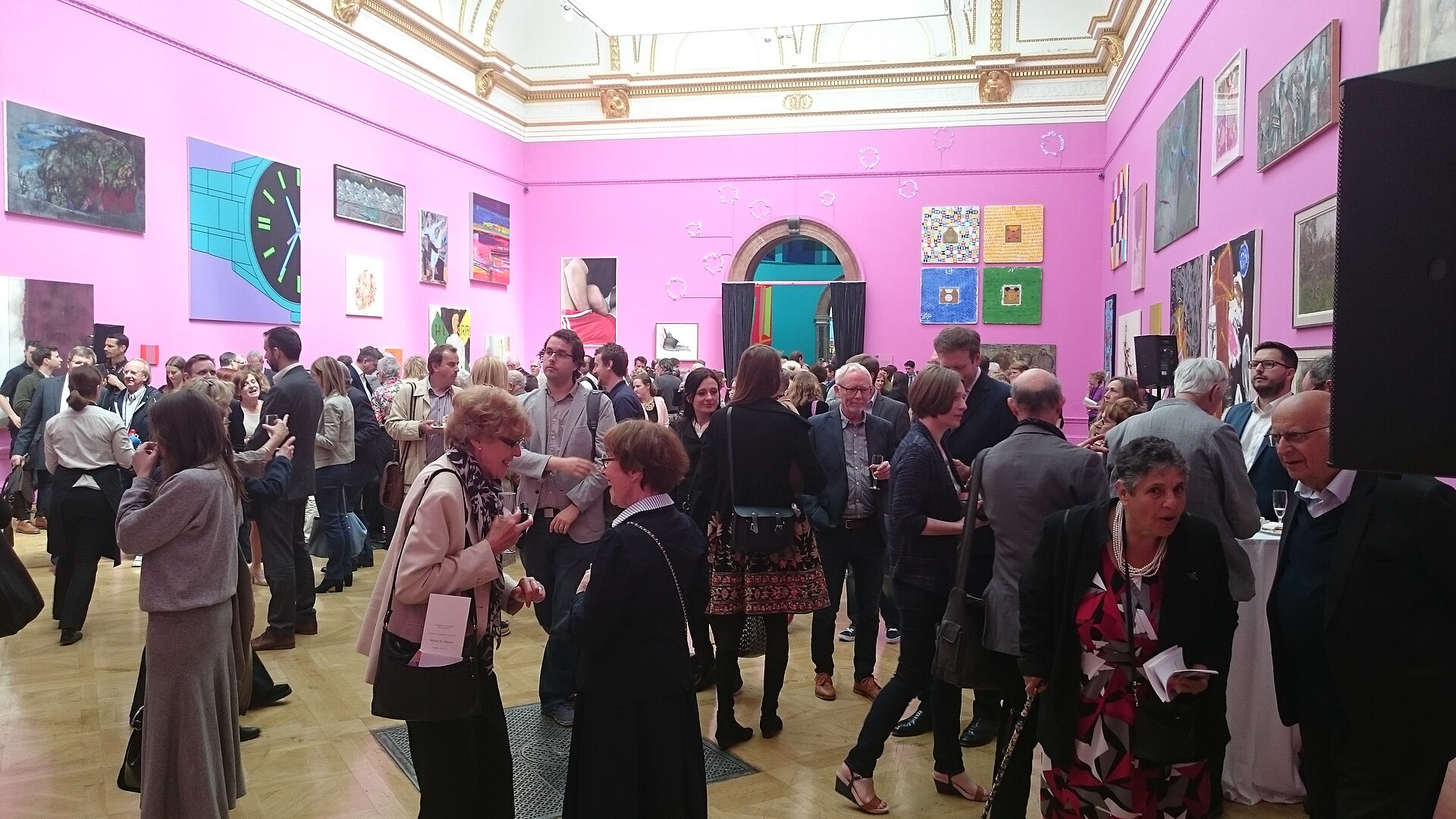
Each year a senior Academician takes on the role of coordinator, setting a loose theme and shaping the character of the show. The coordinator works with a committee of fellow Academicians, and by tradition each member takes charge of hanging a gallery. This is where the Summer Exhibition earns its reputation. The hang is dense and salon-style, with pictures stacked from the skirting board to the cornice. A work placed at eye level, "on the line", carries prestige; a work "skied" near the ceiling is easy to miss. Deciding what goes where is a curatorial art in itself, and the committee's choices are argued over every year.
Almost everything is for sale. The Summer Exhibition is a commercial engine as much as a cultural one. It is the Academy's biggest annual fundraiser, and the proceeds help support the institution, which receives no regular public funding, along with the RA Schools, whose students still pay no tuition fees. Buying a print or a small painting here is one of the few ways the public directly bankrolls a working art school. A handful of prizes are awarded each year as well, chief among them the Charles Wollaston Award for the most distinguished work in the show.
2026: Ryan Gander and 'interconnectedness'
Gander is an apt choice to coordinate a show about connection. A conceptual artist whose practice ranges across sculpture, installation and text, he has spent his career drawing unlikely links between objects, ideas and the systems that hold them together. He also comes to the role from a different direction than most recent coordinators, several of whom were painters or architects, and a conceptual sensibility tends to reward wit, association and juxtaposition as much as pure technique. For 2026 he has asked the committee and the entrants to think about interconnectedness. The Academy describes the theme as an exploration of entanglement and of the unexpected, fortuitous connections between disparate things.
Gander leads a committee whose members each take charge of a gallery, among them Eileen Cooper, Michael Craig-Martin, Oona Grimes, Katherine Jones, Goshka Macuga and Humphrey Ocean, with the architect Peter St John responsible for the architecture room. Rebecca Salter, the Academy's president, chairs the committee. The 258th edition will fill the main galleries with around 1,500 works across painting, sculpture, photography, printmaking, drawing and architecture.
Beyond that, and sensibly, the finer details of what will hang stay unknown until the show opens. The logic of an open-submission exhibition is that no one, not even the coordinator, can predict the whole of it in advance. A theme is a prompt rather than a filter, and the pleasure of the Summer Exhibition has always been the collision of things nobody planned to see together. That uncertainty is the appeal.
The stories in the walls
The Summer Exhibition's long history has left it with a stock of good stories. The best known dates from 1832, when John Constable and J.M.W. Turner found their paintings hanging side by side. Constable was still fussing over
The Opening of Waterloo Bridge, a canvas loud with red and gold, while Turner's grey seascape looked muted beside it. On one of the varnishing days, when Academicians were allowed to retouch work already on the wall, Turner walked up to his own picture and added a single daub of red, a buoy bobbing in the water, that pulled every eye towards it. "He has been here and fired a gun," Constable said. Turner returned days later to work the blob into shape.
More recently, the show has used its coordinators to reintroduce itself to a wider public. In 2018, for the Academy's 250th anniversary, Grayson Perry oversaw a famously exuberant, colour-saturated edition and made a point of championing what he called "the democracy of the exhibition". In 2025 the architect Farshid Moussavi coordinated a version themed around "dialogues", hanging more than 1,700 works and giving the show an unusually spatial, structural sensibility. Each coordinator leaves a fingerprint, which is part of why the exhibition rarely feels like the same event twice.
Why it still matters
For all the talk of themes and coordinators, the Summer Exhibition's real subject is breadth. Few places let you see, in a single afternoon, the full spread of what a country is making: the ambitious and the modest, the famous and the unknown, the accomplished and the endearingly rough. It is a portrait of British
art assembled without a gatekeeper deciding in advance who counts.
That is what makes the 2026 edition worth the visit, whatever ends up on the walls. Gander's theme of interconnectedness suits a show that has always been a web of chance encounters, between artists who will never meet and viewers who stumble on a picture they had no way of anticipating. From 16 June, the walls of Burlington House will once again be open to everyone.