
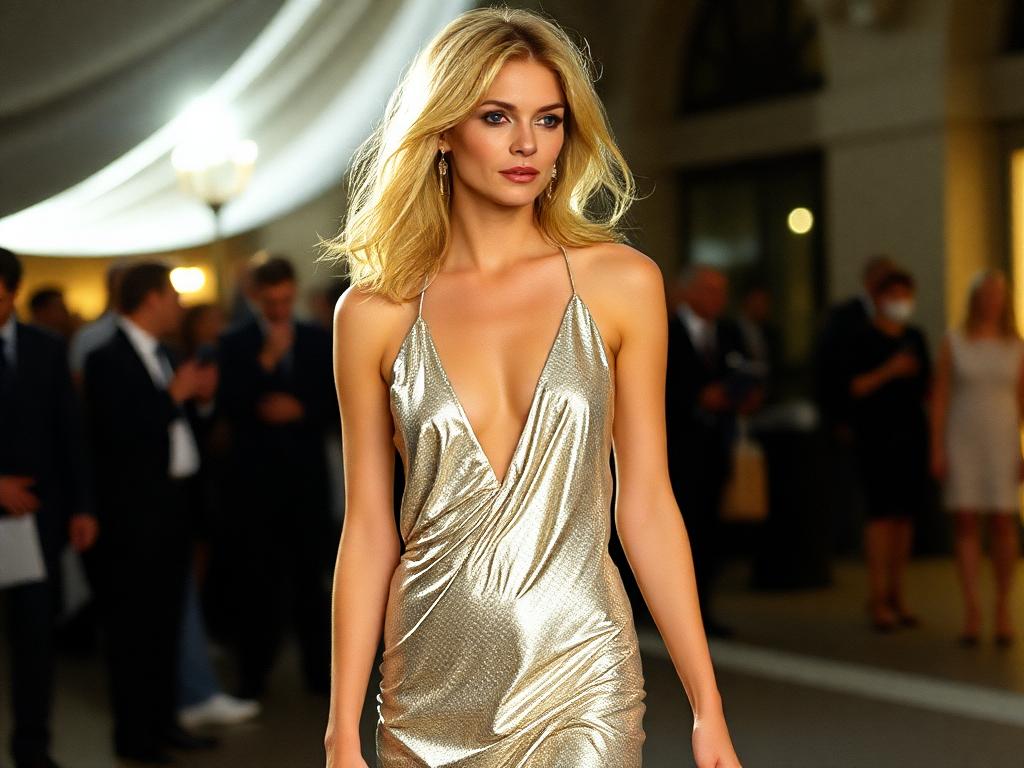
It wasn’t a gown encrusted with a king’s ransom in diamonds, nor a meticulously structured piece of haute couture that took a Parisian atelier months to complete. It was a slip. A simple, shimmering, silver slip dress that, under the unforgiving glare of a thousand flashbulbs in 1993, became utterly transparent and, in doing so, laid bare the changing mores of an entire generation. This was the moment Kate Moss arrived, not merely as a model, but as a cultural phenomenon, and with her, a new, starkly different definition of glamour took hold. The sentience of this single garment rippled through the decade and beyond. ArtCulture.UK will tell you about the slip dress that bared all and changed fashion forever.
An era of grunge
To understand the explosive impact of Kate Moss’s Liza Bruce dress, one must first be immersed in the cultural soup of the early nineties. The preceding decade had been one of conspicuous consumption and hyper-glamour. The supermodels - Cindy, Christy, Naomi, Linda - were goddesses of inaccessible perfection, their powerful physiques and high-octane runway struts the very embodiment of eighties excess. Fashion was loud, shoulders were wide, and hair was high. Then, like a needle scratching across a vinyl record, everything changed. From the Pacific Northwest of America, the raw, melancholic howl of grunge music emerged, with bands like Nirvana and Pearl Jam providing the soundtrack to a generation disillusioned with the slick artifice of what came before.
This was a seismic cultural shift. A new aesthetic of anti-conformity, of authenticity, of a certain studied carelessness, began to permeate everything. Flannel shirts, ripped denim, and combat boots replaced power suits and stilettos. It was in this climate of rebellion and raw expression that fashion found itself at a crossroads. The industry needed a new face, a new body, a new attitude to reflect this paradigm shift. It found all three in a quiet, elfin girl from Croydon, South London. Kate Moss was the antithesis of the Amazonian supermodel. At five-foot-seven, she was shorter, her frame boyish and slender, her beauty unconventional and imbued with a palpable sense of vulnerability. She was the "anti-supermodel," and her ascendancy marked the official end of one era and the raw, unfiltered beginning of another.
A sliver of silver
The setting was a party for the Elite Model Agency, a typical industry affair. Yet the image it produced would become one of the most canonical in fashion history. Moss, then just 19 years old and on the arm of her photographer boyfriend Mario Sorrenti, appeared in what seemed, at first glance, an unassuming choice: a floor-length, bias-cut slip dress by British designer Liza Bruce. In the dim light, it would have been merely elegant, its liquid silver fabric draping her slight frame with minimalist grace. But the moment she stepped into the firing line of the paparazzi, their relentless flashes transformed the dress into something else entirely. It became diaphanous, a gossamer-thin veil that revealed everything beneath it - her silhouette, her black pants, her bare torso.
What was so shocking, and ultimately so powerful, was Moss’s complete nonchalance. There was no panicked clutching of fabric, no embarrassed shielding of her body. She was photographed smiling, smoking a cigarette, utterly unfazed. Years later, she would claim it was an accident. “I had no idea why everyone was so excited,” she famously recalled. “That was the first time I really got papped. I had no idea it was see-through.” Whether an act of genuine naivety or masterful performance, her indifference was the key. It suggested a new kind of cool, a freedom from the self-conscious, hyper-sexualised posing of the past. Her body was not presented for the male gaze in the traditional sense; it was simply there, a fact of nature, unadorned and unashamed.
A controversial silhouette
The image instantly ignited a firestorm, becoming the visual emblem for the decade's most polarising aesthetic: ‘heroin chic’. The term, believed to have been coined in 1993 by the journalist Amy Spindler, described a look characterised by extreme thinness, pale skin, dark circles under the eyes, and an air of androgynous languor. Moss, with her waifish figure and hollowed cheekbones, became its poster child. The sheer dress, which left nothing of her slender frame to the imagination, was held up as Exhibit A. A moral panic ensued. Critics, including then-US President Bill Clinton, condemned the fashion industry for glorifying a look that seemed to romanticise drug addiction and unhealthiness.
This debate was not merely about fashion; it was about body politics. The ‘heroin chic’ silhouette was a direct, almost violent, rejection of the healthy, athletic, and quintessentially feminine bodies of the eighties supermodels. It presented a different, more ambiguous form of beauty, one that was angular, raw, and devoid of the buxom curves that had previously defined sex appeal. The cultural impact was profound, sparking a conversation about body image, media responsibility, and societal anxieties that continues to this day. Moss’s sheer dress was the lightning rod for this entire discourse, a single garment that encapsulated a complex and contentious cultural moment.
Beyond the nineties
Whilst controversial, the slip dress became the unofficial uniform of the nineties. Its minimalist simplicity was the perfect canvas for the decade’s pared-back style. It was seen on everyone from Gwyneth Paltrow, in her iconic pink Ralph Lauren gown at the 1999 Oscars, to Courtney Love, who wore vintage slips with a grunge-infused, deconstructed glamour. The slip dress signified a certain kind of insider cool, a rejection of try-hard maximalism in favour of effortless elegance. It was versatile, capable of being dressed down with trainers or up with a marabou-feathered jacket.
Its influence, however, did not wane with the turn of the millennium. The ‘naked dress’ trend, which now dominates contemporary red carpet events, owes its entire existence to that 1993 moment. What was once accidental and shocking has become intentional and commonplace. When Rihanna attended the CFDA Awards in 2014 in a sheer, Swarovski-encrusted Adam Selman gown, or when Zoe Kravitz wore a barely-there, crystal-mesh Saint Laurent dress to the Met Gala, they were walking a path paved by Kate Moss. They were consciously channelling the spirit of that original act of sartorial rebellion, albeit with a new, 21st-century sense of empowered self-possession. The sheer trend, from Florence Pugh’s defiant Valentino gowns to the transparent creations on the runways of Nensi Dojaka and Ludovic de Saint Sernin, is a direct aesthetic descendant of Moss’s Liza Bruce slip.
The anti-supermodel's uniform
Unlike the meticulously planned "method dressing" we see from celebrities today, where red carpet choices are an extension of a film role or a carefully curated brand narrative, Moss’s style felt innate. The slip dress wasn’t a costume; it was an extension of her own burgeoning persona. It captured the essence of her appeal: a blend of high-fashion sophistication and street-level grit. She was the girl who could grace the cover of Vogue and then be spotted in a pub in Camden, looking just as effortlessly cool. This authenticity was her currency.
Her fashion choices throughout the nineties - the simple Calvin Klein shifts, the vintage finds, the Hunter wellington boots at Glastonbury - cemented her status as a genuine style icon, not just a model. Her influence came from the fact that her clothes looked lived-in, real. The sheer dress moment was pivotal because it established this persona on a global stage. It wasn't about trying to be sexy; it was about an inherent, unstudied sensuality. It was this anti-glamour glamour that made her so compelling and has allowed her to remain a benchmark for style fashion for over three decades.
Redefining public nakedness
Ultimately, the enduring power of Kate Moss’s 1993 dress lies in its duality. It was both a whisper and a scream. A whisper in its physical form - a delicate, simple garment. A scream in its cultural resonance - a bold-faced challenge to the status quo. It questioned what was acceptable to show, how a woman’s body should be presented in public, and who had the right to be shocked by it. It was a catalyst, accelerating a shift in fashion away from constructed perfection towards something more raw, more real, and infinitely more interesting.
Almost thirty years on, the image retains its potency. It stands as a testament to a time of profound cultural flux, a moment when the polished veneer of the eighties was irrevocably shattered. It’s a reminder that sometimes, the most revolutionary statements in style fashion are not the most ornate or expensive, but the most audacious. The dress itself may have been a simple sliver of silver fabric, but its legacy is woven into the very fabric of modern fashion, a transparent thread connecting the rebellious spirit of the nineties to the empowered, body-positive red carpet of today. It wasn't just a dress; it was a declaration.





One response to “The sheer audacity of a dress that changed everything”
[…] interested in how public image is built and controlled in film and fashion may want our piece on the dress that changed everything, and our look at Ben Uri and the émigré roots of modern British art for a different kind of […]