By Anna Zhila
The 83rd Venice International Film Festival opened on the Lido on 2 September 2026 with Danny Boyle's "Ink", a film about how Rupert Murdoch bought a struggling London newspaper in 1969 and turned it into the country's best-selling tabloid. Festival director Alberto Barbera had already described this edition as the most political in recent memory. Choosing to open it with a film about the manufacture of public opinion was not a subtle way of making the point.
The competition runs to 21 features and closes on 12 September, when a seven-member jury led by Maggie Gyllenhaal announces the Golden Lion. What sits inside those 21 films is unusual. Barbera's selection returns repeatedly to power: who holds it, who reports on it, and what happens to the people underneath it.
A competition organised around power
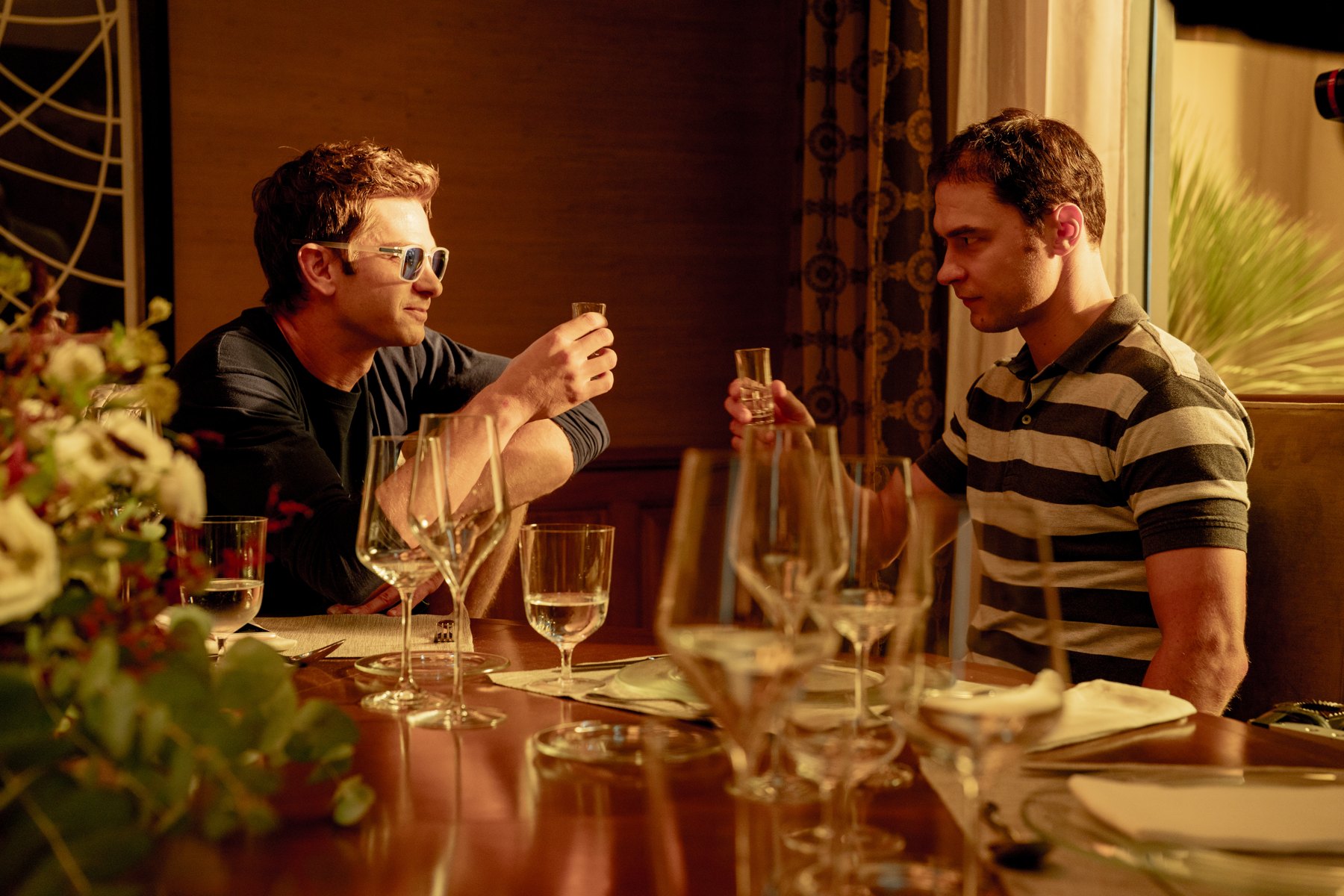
"Ink" sets the terms. Guy Pearce plays Murdoch and Jack O'Connell plays Larry Lamb, the editor hired to remake The Sun. It is a newspaper film, but the subject is not journalism so much as the discovery that a mass readership can be assembled by giving people what they did not know they wanted. Boyle is not a neutral observer of that discovery, and the film arrives at a moment when the same question has moved to platforms that nobody edits at all.
Around it, the competition keeps circling similar ground. Lance Oppenheim's "Primetime", with Robert Pattinson, looks at television. Andrea Pallaoro titled his film "The Echo Chamber". Casey Affleck's third feature as director is called "Company". Florian Zeller's "Bunker", with Penélope Cruz and Javier Bardem, puts its title where its subject is. Ilya Khrzhanovsky brings "Dau", a project many years in the making.
The rest of the field reads like an auteur summit rather than a discovery platform. Werner Herzog is in competition with "Bucking Fastard". Martin McDonagh brings "Wild Horse Nine". Hirokazu Kore-eda has "Look Back", Lee Chang-dong has "Possible Love", Nanni Moretti has "It Will Happen Tonight", and Shinya Tsukamoto asks, in a title that leaves no room for evasion, "Mr. Nelson, Did You Kill People?". Alongside them sit Stéphane Brizé, Cédric Kahn, Nicolas Pariser, Marco Bechis, Edoardo De Angelis, Paolo Strippoli, Ali Asgari and May el-Toukhy.
Palestine on the Lido
The clearest reason this edition is being called political has nothing to do with metaphor. Two Palestinian films are in the programme: Ahmed Hassouna's "Citizen Osama", which follows a photojournalist trying to work and to keep a family alive in Gaza, and Muayad Alayan's "Conversation with the Sea", about a Palestinian man caught inside Israeli bureaucracy. The Israeli director Amos Gitai brings "Road to Jericho", which tracks the fate of Khan al-Ahmar, a Bedouin hamlet outside Jerusalem facing demolition.
Late in the process the festival added "NAZA" to the main competition, a documentary by Yuval Abraham and Rachel Szor, who shared an Academy Award for "No Other Land". Its inclusion moved the subject from the sidebars into the Golden Lion race.
None of this happened quietly. An open letter organised under the Venice4Palestine banner, signed by more than 200 people including the Nobel laureate Annie Ernaux, the director Céline Sciamma, the Palestinian directors Arab and Tarzan Nasser, Alia Shawkat, Indya Moore and the festival's own opening-night lead Guy Pearce, asked the festival to hoist the Palestinian flag for the duration of the festival alongside the flags of the films in the official selection. The festival then cancelled the traditional jury press conference and reversed the decision after the backlash. The press conference went ahead.
That sequence is worth holding onto, because it describes how a large cultural institution actually behaves under pressure. It did not take a position. It tried to remove the room in which positions get taken, and then discovered that removing the room is itself a position.
Two women in twenty-one
At that restored press conference, Gyllenhaal was asked why only two of the 21 competition films have a woman director. Her first answer was a joke delivered flat: "I guess it's just finally become clear that men make better movies than women do."
Her second answer was not a joke. She called it "a systemic problem", said "it's much harder for women to get their films financed", and then asked the question that is harder to legislate away: "could it be possible that the things that women, having had a different experience of being alive in the world, want to make movies about are not always deemed high art?"
The arithmetic behind the question is stark. Of 21 films, one is directed by a woman alone, May el-Toukhy's "Woman Unknown", and one is co-directed by Rachel Szor on "NAZA". A festival that has spent a decade issuing statements about parity opened its most political edition with a competition that cannot demonstrate parity in its own selection.
Asked whether cinema should be political at all, Gyllenhaal declined the premise and said films are "fundamentally, unavoidably political", adding that "the answer has something to do with empathy". It is a defensible position and also a convenient one: if everything is political, no single programming decision has to answer for itself.
Two Golden Lions
George Clooney and Ellen Burstyn both receive Golden Lions for Lifetime Achievement this year. Clooney arrived on the opening-day carpet with Amal Clooney, and Laura Dern delivered the tribute.
The pairing is more interesting than the coverage suggests. Burstyn's career runs from "The Last Picture Show" and "The Exorcist" through "Alice Doesn't Live Here Anymore", for which she won the Academy Award, and on to "Requiem for a Dream". Clooney's arc is the reverse of the usual one: a television actor who became a star and then spent two decades using the leverage to direct and produce films about the press, the state and the uses of celebrity. Honouring both in an edition preoccupied with media power is a piece of programming, not a coincidence.
What to watch until 12 September
Three things will decide how this edition is remembered. The first is whether "NAZA" wins anything, and what a jury chaired by Gyllenhaal and containing Kaouther Ben Hania, whose "The Voice of Hind Rajab" took the Grand Jury Prize here last year, decides to say with its prizes. The second is whether the auteur wing, Herzog, Kore-eda, Lee Chang-dong and McDonagh, produces work that outlasts the argument around it. The third is whether Venice's habit of launching awards campaigns survives a lineup this uncomfortable, or whether the money quietly steers itself towards safer autumn festivals.
The jury also includes Daniel Blumberg, Francesco Casetti, Xavier Giannoli, Shahrbanoo Sadat and Johnnie To. Giovanni Veronesi's "God Laughs" closes the festival. The prizes are announced on 12 September.