By Nicole M. Mayer
In Lost Illusions, Honoré de Balzac follows Lucien Chardon, a young provincial poet who arrives in Paris hoping to establish himself as a writer. He soon discovers that literary success depends on more than the quality of one's work. Publishers judge manuscripts by their commercial potential, while journalists manipulate criticism to serve professional alliances and financial interests. Through Lucien's experience, Balzac exposes how the commercial machinery surrounding cultural production can overshadow the work itself.
Fashion faces a comparable problem. It is often treated as the frivolous member of the cultural world. While painting and literature, for example, are routinely discussed in terms of their intellectual and historical significance, clothing is frequently reduced to questions of shopping and appearance. Its proximity to consumption and vanity seems to undermine its claim to be taken seriously as an artistic medium. Public discussion of fashion is also frequently dominated by the excesses of the industry, from overproduction to environmental damage. While these are legitimate and urgent subjects of criticism, they are not the same as an examination of fashion as a legitimate discipline.
Understanding fashion requires much more than knowing what is in season. It involves examining garments in relation to the historical, political, social and artistic contexts that shape them. To explore the intellectual merits of fashion, it is therefore worth looking beyond the industry itself and examining what designers are actually creating.
Fashion as Cultural Preservation and Reinterpretation
Rahul Mishra presented Devi: The Eternal Muse at the Collège des Bernardins in Paris on 6 July 2026, during Haute Couture Week. For the collection, he turned to India's ancient temple sculptures, particularly their representations of female deities and celestial figures. He examined how sculptors used the human body, jewellery and ornament to create these figures. His references gave the collection a historical foundation that extended beyond the use of Indian motifs as decoration. Mishra was engaging with an established artistic tradition and considering how its visual language might inform contemporary fashion.
This is significant because Mishra was not attempting to recreate historical clothing or reproduce existing sculptures. He was interested in the artistic decisions behind them: how the body was represented, how ornament contributed to its form and how intricate surfaces were constructed. He then explored how these principles could be applied to couture through embroidery, materials and silhouette. The resulting garments offered his own interpretation of the sculptural references, rather than straightforward reproductions of them.
The collection also took on a particular significance within the context of Paris Haute Couture Week. Mishra became the first Indian designer invited onto its official calendar in 2020, bringing a distinct artistic and craft tradition into an institution historically associated with European couture. With Devi, he placed Indian sculptural heritage at the centre of a contemporary fashion collection, demonstrating that couture can engage with art history as a subject of study and interpretation, rather than simply drawing on it for visual inspiration.
Fashion as Intellectual Inquiry into the Natural World

Where Rahul Mishra examined how contemporary fashion could engage with an established artistic and sculptural tradition, Iris van Herpen used material experimentation and technology to investigate natural forms and the body. Van Herpen presented Crystallization, her Spring/Summer 2011 collection, at London Fashion Week in September 2010. The collection explored the relationship between water and ice, and the transformation of a fluid substance into a structure with a defined form. Van Herpen was interested in how something that appears formless can contain an underlying order, and how that process might be expressed through clothing.
The collection emerged at a time when designers were beginning to explore the possibilities of digital manufacturing. Three-dimensional printing, in particular, was still unusual in fashion, and van Herpen became one of the first designers to bring the technology onto the runway. But her interest extended beyond the novelty of the process. She was investigating whether new technologies, alongside traditional handwork, could produce forms that conventional garment-making could not. This interest in construction was closely connected to the collection's central idea: giving physical shape to a process that is difficult to capture in a fixed image.
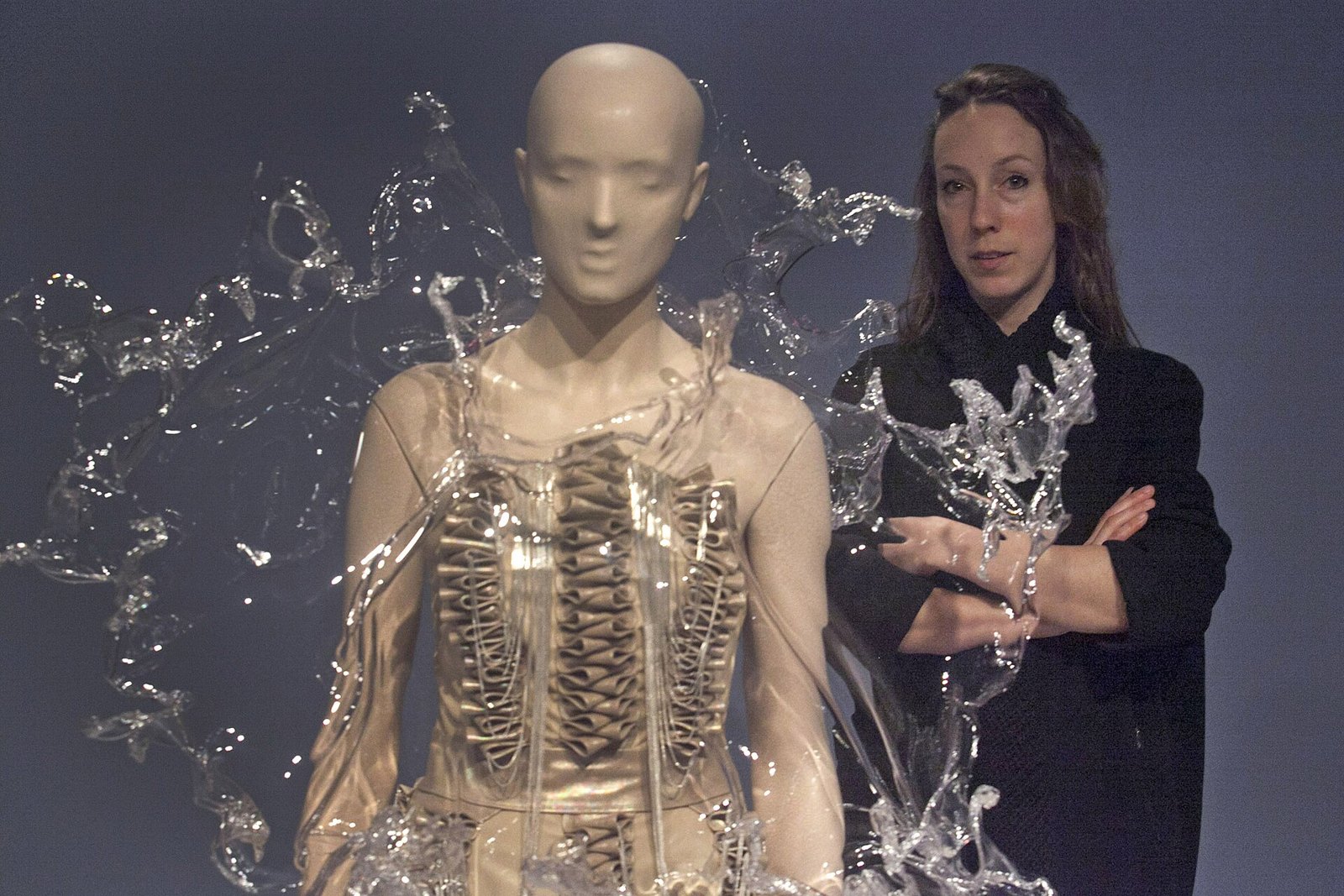
That investigation took different forms across the collection. For one of its most striking pieces, van Herpen worked by hand, using heat and tools to shape transparent PET material into sweeping structures. The resulting garment appears to hold a moment of movement around the wearer, its extended forms suggesting a splash of water. A separate piece, developed with architect Daniel Widrig, became the first 3D-printed garment presented on a runway. Made using a process that allowed for intricate, sculptural construction, it demonstrated how technology could expand the possibilities of garment design. Neither approach simply reproduced the appearance of water or ice. Instead, van Herpen used the properties of the materials and the methods of their construction to investigate how natural forms could be translated into clothing, revealing the new possibilities that emerge when designers challenge the conventional limits of garment-making.
Fashion as a Language of Class, Identity, and Society
Matthieu Blazy's first Métiers d’art collection for Chanel explored how fashion communicates social identity. Presented on 2 December 2025 at the decommissioned Bowery subway station in Manhattan, the 2025/26 collection drew on the different people who share New York's public spaces, from students and office workers to society women. Rather than presenting a single idealised Chanel customer, Blazy considered how the house's designs might be worn and interpreted across different social groups.
The historical reference was Gabrielle Chanel's visit to New York in 1931, when she encountered women wearing imitations of her designs in downtown shops. Rather than seeing these copies as a threat, she reportedly took pleasure in discovering that her style had reached beyond her established clientele. Blazy returned to this episode to consider what happens when a designer's work leaves the social environment for which it was originally intended. A garment's meaning is not necessarily fixed by the house that produces it; it can change according to who wears it and how it is incorporated into everyday life. Professional dress, casual clothing and elaborate eveningwear appeared alongside one another, showing how fashion can communicate differences in occupation, status and personal taste.
The garments themselves reinforced this contrast. One example was a pair of trousers that appeared to be ordinary denim but was made from silk in collaboration with Lesage. By applying the house's specialist craftsmanship to a familiar everyday garment, Blazy brought casual dress into the world of luxury construction, complicating the distinction between the two. The collection also exposed a contradiction. The subway represented a shared public space, yet Chanel transformed the disused station into an invitation-only fashion show. Similarly, although Blazy explored how Chanel's designs could circulate beyond their original clientele, access to the craftsmanship and garments themselves remains limited. The collection did not dissolve these class distinctions; it showed how fashion can cross social boundaries in its influence while remaining exclusive in its production and consumption. It also suggested that a fashion house's identity is shaped not only by the designs it creates, but by the people who adopt and reinterpret them.
So, when are we going to stop deintellectualising fashion? The collections discussed here demonstrate that clothing can preserve cultural heritage, investigate the natural world and offer a way of understanding social structures. In each case, the designers take ideas that extend beyond fashion and give them a material form through clothing. This is where fashion's intellectual contribution becomes apparent: not simply in the references it draws upon, but in how it interprets and develops them through its own medium. Looking at fashion in this way allows us to move beyond questions of appearance and consumption and consider what designers are actually thinking through their work. Perhaps the question to ask is not whether fashion can be intellectual, but why we so often fail to recognise the intellectual work taking place in the clothes themselves.
Sources
- rahulmishra.in/pages/devi-fall-26
- rahulmishra.in/pages/about-us
- irisvanherpen.com/DOCS/IVH-Crystallization.pdf
- irisvanherpen.com/about/the-maison
- dezeen.com/2010/08/11/crystallization-by-iris-van-herpen-daniel-wright-and-mgx-by-materialise
- omniscientdesign.fr/fr/references/crystallization
- chanel.com/fr/mode/collection/metiers-art-2026