By İlker Ortaç
When we look at a body, we cannot see beyond the idea of normality imposed on us by society. When looking at that body, we keep looking for such things as proportion, symmetry, physical soundness, youth and productivity. As a disabled artist, I can do this too. But this is a reality imposed on us by society. Starting from this reality does not mean we can conclude that it is right. Even while writing this piece, I find myself facing contradictions within myself. I am writing these words to you today because I believe art can help chip away at this, first in me and then in society.
Perhaps the art I make is a space in which I disrupt this, deform it, preserve it and tell you about it. A body can be brought closer to an ideal form, just as it can be moved away from that ideal. Someone who does these things cannot be normal anyway. Starting from my own abnormality, I object to criticism of whether the characters I create are normal or not.
There is no single truth in the world. I reject a view of the world in which only heterosexuals and non-vegans are considered right. People may not be heterosexual; people may not be non-vegan either. This does not mean these people are abnormal. What is abnormal to you may be normal to me. When I wake up, paint, leave the house, make work, think and make love, I live my own normality. If this seems abnormal to you, my way of responding is to live it everywhere, to create and to declare that such a world can exist.
As Michel Foucault describes in Abnormal:
“[The norm] is an element on the basis of which a certain exercise of power is founded and legitimized.” [1]
In Leonardo da Vinci's Vitruvian Man, drawn around 1490, a nude male figure is placed inside a square and a circle to examine the proportions of his body. Although more than five hundred years have passed, I think people have not progressed in certain respects. At its heart, this example expresses what troubles me.
Some of my drawings do not seem ideal to people, so viewers may have doubts about what they see at first. In drawings of people, they naturally look for symmetry, normality, an upright stance, a whole body. Just as we believe this search is unnecessary and destructive in real life, perhaps it is also the main reason I find myself confined in what I draw. It may not be what I produce itself, but the contradiction between my work and people's basic perceptions, that sometimes causes unnecessary exhaustion. But there is no rule that everyone must produce within the same templates, look the same or live the same way.
The disabled, fat, thin, disproportionate or unattractive figures I draw do not fit the norms in the viewer's mind, and the viewer questions them. This questioning brings about an argument between the viewer and the work. Either the viewer continues this argument or escapes it, excluding from art the realities they exclude from society, continuing to act as if these beings, these works, these people did not exist, and to ignore them.
Pity and admiration may seem very far apart, but when we find ourselves alongside these bodies, these characters, the places they ultimately take us are not so different. One may continually evoke pity, while the other may evoke the feeling that “These people are doing extraordinary things.” In both cases, these people's sexualities, temperaments and anger can disappear. Instead of accepting them, we fit them into a template in our minds and place conditions on meeting them face to face in life.
Velázquez’s The Boy from Vallecas (Francisco Lezcano) complicates a simple account of historical exclusion. The portrait gives Lezcano a visible presence, but visibility in a painting does not in itself mean equality in social life. What interests me is the tension between being represented and being accepted.
It is possible to give many examples from history. Perhaps tracing a path from these examples to the present is something a historian, an art historian, should do. I do not want to recount them all here and bury you in the pages of history.
Yet I cannot help giving examples. Sometimes seeing that a mistake made today has been made throughout history may help us understand just how hard it is to overcome that mistake.
How much of a role can painting play in other people's decisions, or how much can it change the way they make decisions? This is something that sometimes occupies my mind too.
At such times, perhaps choosing to use other arguments, other tools, I did not limit myself to painting; I also tried writing, making videos and taking photographs.
In doing all this, we should not overlook the fact that I was born and grew up in a country where rigid Ottoman customs and traditions continue, and that I was brought up in this culture.
In doing all this, I first had to educate myself, because I too was one of the people shaped by this country's culture. First, I had to change my own way of thinking.
In doing all this, I had to educate myself enough to be able to stand alone in life, not give up in the face of criticism and keep struggling.
Perhaps certain figures entered history because they possessed these abilities. Perhaps that is why they seeped into this piece.
Looking at history and using the past to diagnose the present may be a misleading shortcut. I am aware of that. When I look at historical works with compassion and try to understand them, I cannot reopen this case. This does not erase the suffering they endured, or perhaps understanding these things from where we stand today is much easier than it was then.
The question of who can find a place in public life has come back to us time and again throughout history.
Marc Quinn's Alison Lapper Pregnant, installed on Trafalgar Square's Fourth Plinth in 2005, brings this question into the language of public monuments. Made of Carrara marble, the sculpture represents Lapper, herself an artist, during her pregnancy.
In this example too, we can once again see public visibility being debated in history.
Marble carries expectations of permanence, ideal beauty and historical authority. To give an example, imagine a person without an arm. Last night I drew a person without an arm and shared the drawing on social media. I saw that it did not receive the response a normal work would, because it did not fit people's perceptions. But if it had not been a drawing I made, if they had encountered it as a historical sculpture with a broken arm, perhaps it would not have received this reaction. This raises another question: does each of us have to be a work of art to be accepted? Must each of us be a marble statue? Must each of us refer to something else as a work from before modernism?
The ordinary right to exist in public space does not depend on extraordinary achievement, motherhood or the ability to inspire strangers.
Even as we use a monument to oppose exclusion, we can turn the person we see there into a symbol. Remembering Lapper's name and that she is an artist herself may keep us from reducing her to a single symbol. Being visible in public space and being able to use that space are also different things. We can celebrate a sculpture of a disabled person in a square while maintaining conditions in the surrounding institutions that restrict people's participation.
In her 2011 work Coloring Book, Riva Lehrer describes her own body. Paper dolls and surgical needles surround her self-portrait. Crayons rise from the crown on her head. Lehrer says she placed images of organs removed during her operations inside these dolls. She uses acrylic paint, dimensional collage and different materials on amate paper. She describes her body by bringing these pieces together. We learn about her through the pieces she chooses to show, rather than by looking from the outside and working everything out.
We are experiencing such difficulties because others do not do what I am trying to do here.
When we open a colouring book, the lines are already there; we are expected to fill them in. Looking at Lehrer's work, we question that expectation too. Within what boundaries should a person stay when describing themselves? Who draws those boundaries? What happens when the pieces the artist brings together do not fit into a neat, finished whole?
If I had made all the works I produce into a colouring book like this one, I am sure no one would have followed the forms I created. They would have coloured the work according to the norms in their own minds. And these works would never have existed.
That is why I am occupied with protecting the freedom of the works I make and finding places in art for people who cannot find a place on the street. A curator, too, might not be very receptive to these works, perhaps because they are looking for their own idea of normality. So, in making these works, I shoulder the struggle with these things from the outset as something I have already accepted.
This is how I read Lehrer's work; I do not think I have the final word on what she means to say. We also need to pay attention to how the artist works. When discussing a disabled artist's work, we can get stuck on their life story. Yet we should also discuss the surface they choose, how they put pieces together and the scale they work on. I want what we make to receive the same attention and serious examination as other artists' work.
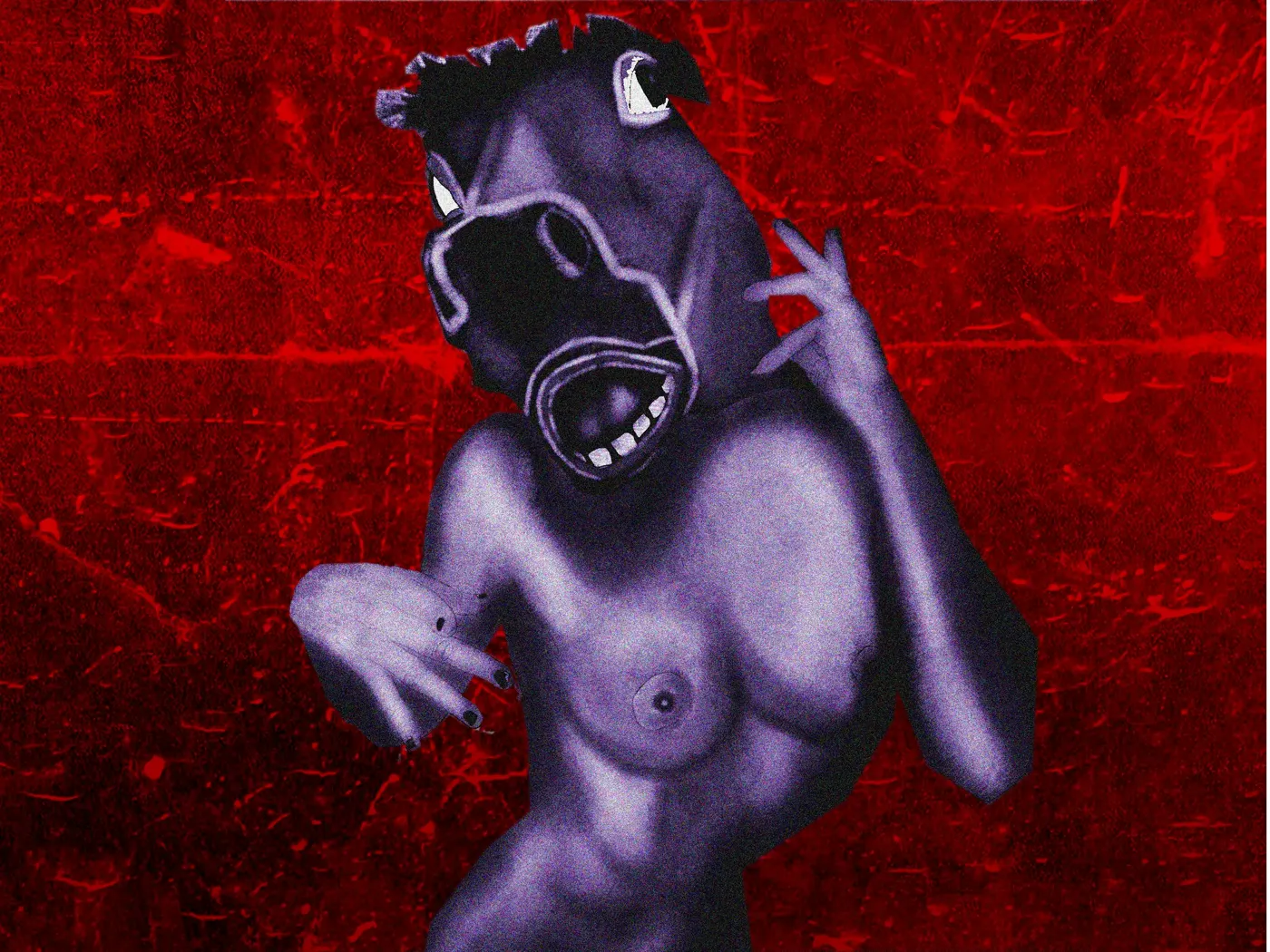
As a disabled artist, this subject concerns my own body and my work. In LIMIT, I question the way bodies are regarded as things that need fixing. Working with exaggerated figures, masks, make-up and codes of masculinity, I look at what we expect from a person's body in order to know them. Why do we want to understand them straight away and put them somewhere? The distortions in the figures I draw should not be read as a diagnosis. I am not trying to show different kinds of disability or to equate disability with strangeness.


In one drawing, there is a naked torso against a red background. There is an animal mask on the face. The mask's eyeholes are dark. We see the body, but looking at the face does not tell us who this person is or what they are thinking. Seeing someone does not mean knowing everything about them.
Perhaps we do not need to know everything about this person. Still, it bothers me if the only thought that stays with us when we look at them is “not normal”.
We may think that removing the mask would let us understand that person completely. But our clothes, hair, make-up and posture also affect how others see us. We recognise masculinity through certain clothes and familiar gestures too. When I exaggerate these in my drawings, things we accept without noticing in daily life become more visible.
In doing this, perhaps I am making these drawings harder to accept. But this too is something art allows me to do. I have struggled all my life to make myself free enough to use that possibility with such audacity. I think I have some right to it too.
Someone looking at my drawings may find the difference interesting from a distance and move on. That is why I also think about what the discomfort these drawings create actually changes. If a viewer leaves saying, “I saw an unusual body,” their measure of normality may remain the same. Part of what I am questioning is why we want to put that body somewhere straight away.
At one point in my life, I tried to describe these characters I draw through short films. Like Michael Haneke and Pedro Almodóvar in their films, I too may be unsettling people. But I am not as talented as Haneke or Almodóvar.
That is why I returned to drawing. Drawing is much more personal; it is work I can make with much more limited resources. But its visibility also depends on many things. Not having those resources may keep its visibility far below where I would like it to be.
Starting from history and building a bridge to my own work, I have tried to explain how people look at artworks through my own observations. If I had chosen to describe socially approved norms rather than people's “abnormalities”, and to glorify that person, I believe this work would certainly have found greater acceptance. But my experience shows me that anxieties continuing from the past into the present either make these works and their artists invisible or turn them into targets.
These questions have a place in daily life too. We may see works about disabled bodies in a museum while overlooking whether disabled people can comfortably enter it. An editor may talk about an artist's courage without giving enough space to their work. When we admire someone's independence, we do not always notice the labour and support behind it. Other people contribute to all our lives. Yet while the support some of us receive is barely visible, others can become known for the help they need.
What matters to me is that the people I draw should not have to become someone else to be accepted. I am looking for a place in art for people who cannot find a place on the street. In doing this, I continue to question my own way of looking. Perhaps these drawings can help us pause before immediately dividing the bodies we encounter into normal and abnormal.
[1] Michel Foucault, Abnormal: Lectures at the Collège de France, 1974-1975, translated by Graham Burchell, lecture of 15 January 1975, p. 50. The bracketed words replace “it” in the original sentence to identify the subject. https://web.colby.edu/sp236/files/2020/09/Foucault-Abnormal-Selection.pdf#page=22
Exhibition: limitartproject.com