By Yulia Tulegenova
Few artists have built a career out of things designed to fall apart. Anselm Kiefer, who turned 80 in March 2025, makes paintings from lead, ash, straw and dried flowers, materials chosen precisely because they rot, oxidise and crumble. His surfaces buckle and flake. Sunflowers dry to powder. Molten lead cools into grey scabs across the canvas. None of this is accident. For six decades the German artist has treated the artwork as a site of ruin, and 2025 became the year the art world agreed to look again, with major exhibitions running almost simultaneously in London and Amsterdam.
Born in the rubble
Kiefer was born on 8 March 1945 in Donaueschingen, two months before the German surrender. His first playground was a bombed country, and that fact has hardened into a worldview. "I like vanished things, because I like things that are ruined. That's a starting point for me," he told the critic Martin Gayford in the Spectator in 2014. For Kiefer, ruin is a beginning, the ground floor of everything that follows.
He announced himself with a provocation. In 1969, aged 24, he produced "Besetzungen" (Occupations), a series of photographs of himself performing the Nazi salute at sites across Switzerland, France and Italy, later published in the conceptual journal Interfunktionen. The West Germany of his youth had largely buried the recent past beneath its economic miracle, and a national silence had settled over the war years. Kiefer refused the silence. The images were made to make his own generation flinch, and they still do. His work became an early and unwelcome contribution to what Germany would spend decades calling the reckoning with its past, and that refusal to let history stay buried has organised everything since.
The weight of materials
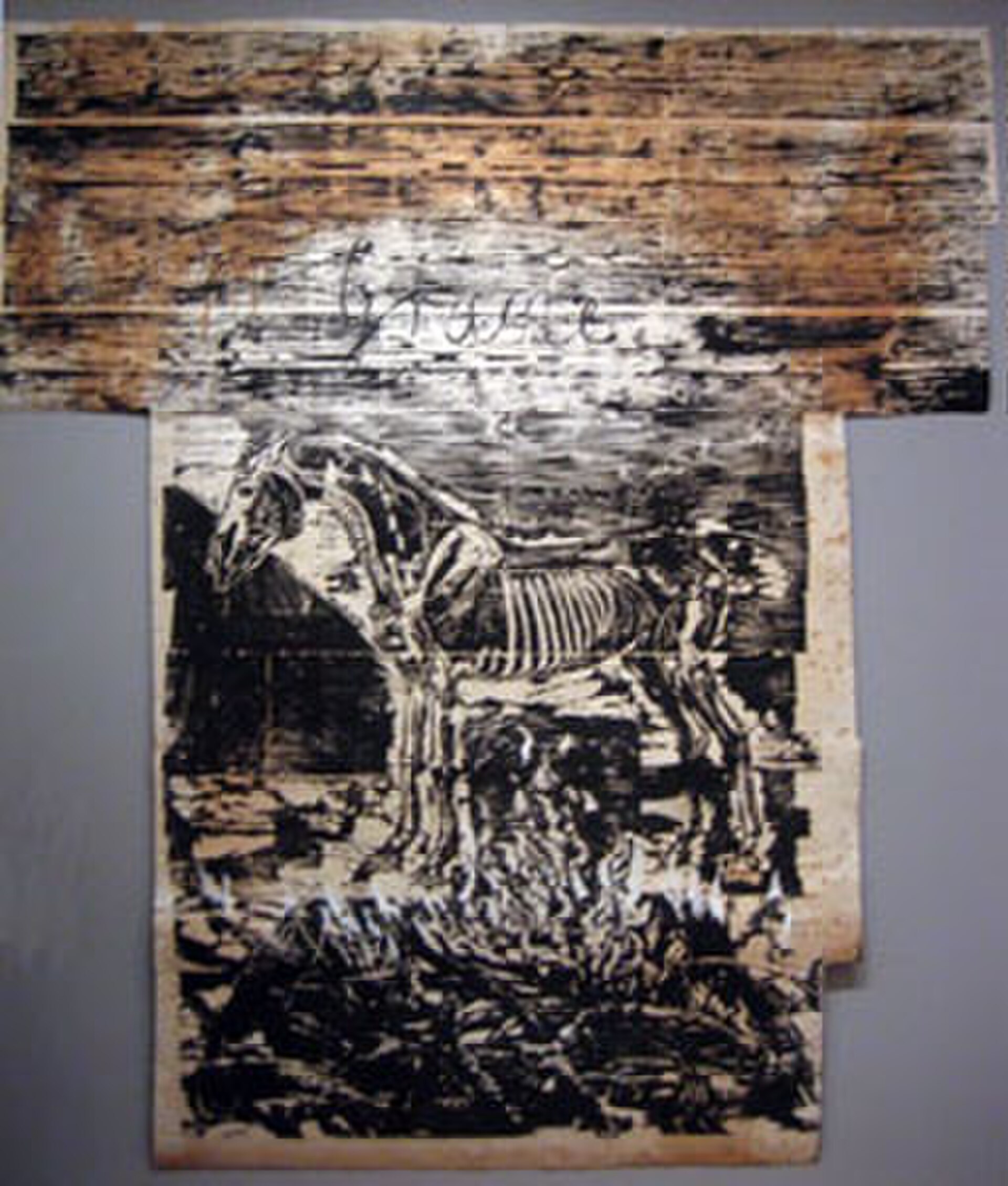
Kiefer's materials are his argument. Lead, ash, clay, straw, shellac and gold recur throughout his work, each carrying a charge. Lead is the base metal of alchemy, heavy and toxic, the substance medieval philosophers dreamed of turning into gold. Ash is what fire leaves behind. Straw stands for hair, and for the harvest that feeds and the harvest that burns. He treats a painting less as an image than as a process, a transformation caught mid-reaction, closer to a furnace than a window. Gold leaf flares against fields of grey; shellac darkens and cracks. The largest canvases are big enough to surround a standing viewer, who enters the decay rather than watching it from a safe distance.
Nowhere is this plainer than in his decades-long engagement with the poet Paul Celan, a Holocaust survivor whose "Todesfuge" ("Death Fugue") gives Kiefer two recurring figures: Margarete, the German woman with golden hair, and Sulamith, the Jewish woman with ashen hair. Kiefer renders Margarete in straw and Sulamith in scorched black, letting physical matter carry a weight no caption could. The meaning sits in the substance.
His preference for painting over photography follows the same logic. "A photograph is only the instant the shutter was open, while a painting doesn't only show a moment; it presents a history. It's a living thing. It changes, it has depth," he told the Spectator. His canvases are built to keep reacting long after they leave the studio, oxidising and settling on the collector's wall.
Scale, and the long ascent
Kiefer thinks on the scale of landscape. He represented West Germany at the 1980 Venice Biennale alongside Georg Baselitz, splitting critics between those who found the work grandiose and those who found it necessary. In 1992 he left Germany for France and built La Ribaute, a 35-hectare studio compound at Barjac fitted with towers, tunnels and pavilions, a terrain he could work into three dimensions. In 2007 the Louvre commissioned him to create a permanent installation beside its antiquities galleries, the first permanent work there by a living artist since Georges Braque in 1953.
His reach now runs past the gallery wall. In 2023 the director Wim Wenders released "Anselm," a documentary shot in 3D that moves through the artist's vast studios and open-air structures. The film introduced Kiefer to audiences who had never stood before the paintings, and it primed the appetite that 2025 would feed.
Kiefer in 2025 - three cities, one reckoning
The clearest measure of his standing was the calendar. In Amsterdam, the Van Gogh Museum and the Stedelijk Museum jointly staged "Anselm Kiefer: Sag mir wo die Blumen sind" from 7 March to 9 June 2025, taking its title from the German version of the anti-war song "Where Have All the Flowers Gone." Roughly 25 works filled both institutions. The centrepiece was a single painting more than 24 metres long, worked with clay, dried rose petals, gold and military uniforms. Kiefer's canvases hung beside Van Gogh's "Wheatfield with Crows" (1890), forcing an old debt into the open.
That debt is genuine. In 1963, aged 18, Kiefer won a travel grant and spent it retracing Van Gogh's route from the Netherlands through Belgium to Arles. The wheat fields, high horizons and circling crows that recur across his work were inherited from a painter who died more than half a century before he was born. Placed side by side, the two reveal shared instincts: heavily worked surfaces, landscape charged with emotion, and a pull towards the written word, Van Gogh through his letters and Kiefer through poetry. The difference is temperature. Van Gogh's fields blaze with life, while Kiefer's carry the ash of a later, darker century.
London extended the conversation. From 28 June to 26 October 2025 the Royal Academy of Arts presented "Kiefer / Van Gogh," the first time the two have been shown side by side in the UK. The Academy, which had given Kiefer a landmark retrospective in 2014, set Van Gogh drawings and paintings against Kiefer works including "Nevermore" (2014), together with new pieces made in response to its galleries. Minutes away, White Cube Mason's Yard ran a concurrent solo show of paintings, "Anselm Kiefer," from 25 June to 16 August 2025, with works such as "Sweet golden clime (for William Blake)" (2023–25) and "La Berceuse (for Van Gogh)" (2010), their surfaces heavy with burnt straw, charcoal, ash and gold leaf. Three shows at once, all falling in his eightieth-birthday year, amounted to a coordinated case for his continuing hold on contemporary art.
Why it matters now
Kiefer's true subject has never been Germany alone. It is the way societies remember, and more often the way they forget. He works at the scale of myth because he distrusts the tidiness of official history, and he keeps returning to fire, harvest and ruin because those cycles do not resolve. As Europe rearms and the certainties of the twentieth century fray, an artist who insists that the past is combustible and never quite buried reads less like a relic and more like a warning.
He has never sold the work as comfortable. "Art is difficult. It's not entertainment," he told the Guardian in 2011, and the 2025 exhibitions honoured that. They asked visitors to stand before surfaces that are cracking, shedding and slowly changing, and to sit with what the materials imply. The Wenders film and a steady presence in the culture pages have since carried him to audiences too young to remember the war he keeps circling, which is part of the point. Then Kiefer hands over the final move. The artist, he told the Spectator, is only half of the process, and "every spectator creates his own painting." At 80 he is still handing over the other half. The ruins, as ever, are where he begins, and that insistence is culture doing the job it should: refusing to let us look away.