By Maria Bregman
A few days before shooting began, Yura Borisov has said, he hit a wall with Ilya Sutskever. Then he remembered that he and the OpenAI co-founder share a birthday, decided that was connection enough, and stopped trying to copy the man. What he built instead is a character inspired by Sutskever, and by most accounts from New York it is the performance that holds Luca Guadagnino's Artificial together.
The film reaches London on 11 October as a Gala of the 70th BFI London Film Festival, six days after its world premiere at the New York Film Festival. This is a guide to what arrives with it: the story, the argument already running among critics, and the questions worth taking into the cinema.
Five days in November
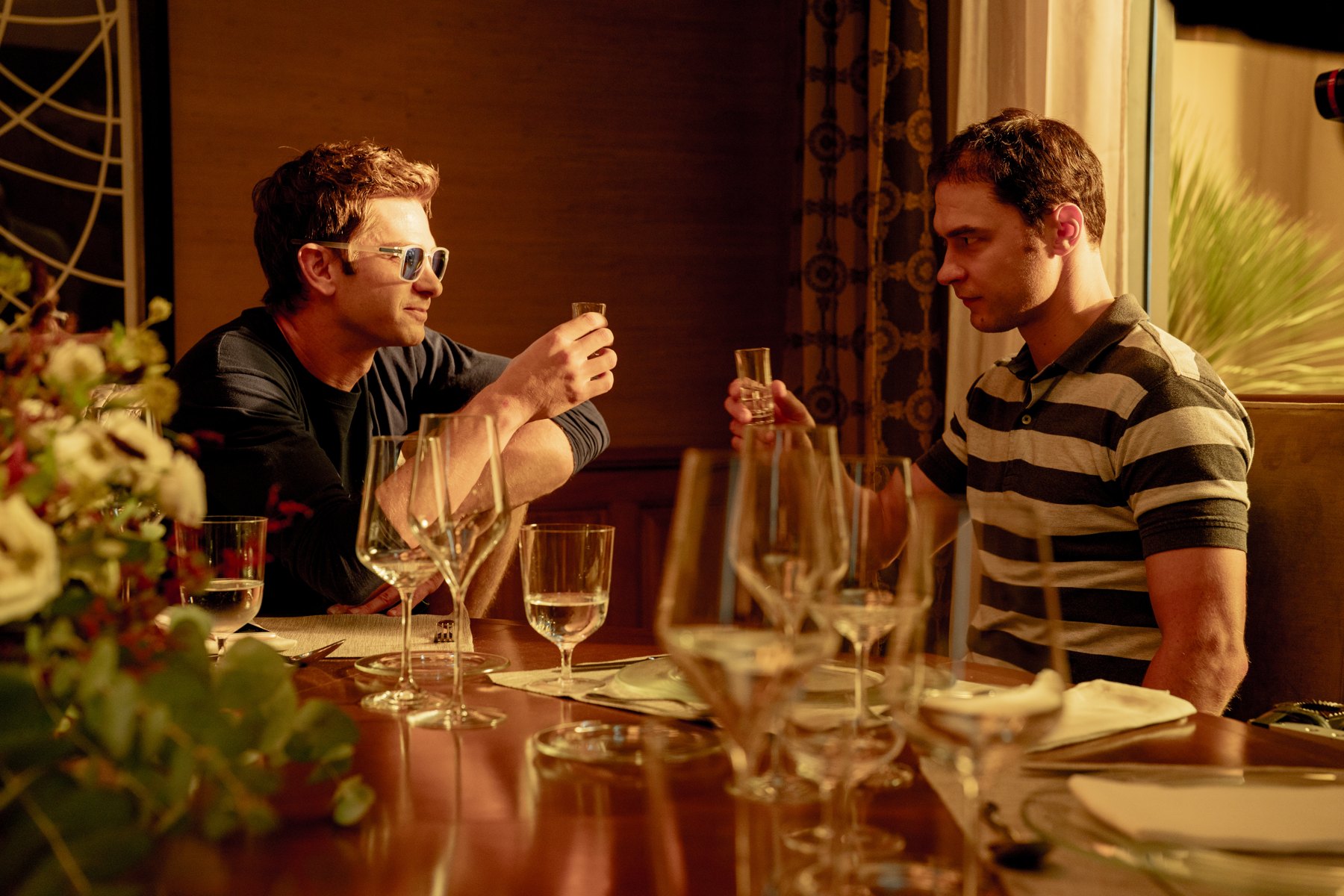
The festival describes Artificial as a chronicle of the days leading up to 'the sudden firing and reinstatement of Sam Altman as CEO of OpenAI'. That happened in November 2023: the board removed Altman, and within five days he was back. Simon Rich wrote the screenplay. Andrew Garfield plays Altman and Borisov plays Sutskever, with Monica Barbaro, Cooper Hoffman, Jason Schwartzman, Chris O'Dowd, Ike Barinholtz and Mark Rylance around them. The score is by Damon Albarn.
The Guardian's review from New York describes a longer arc than the logline suggests. The film opens in 2003, with the young Sutskever visiting Geoffrey Hinton, played by Rylance, in the hope of a job. Barinholtz is Elon Musk, who introduces Sutskever to Altman, and Barbaro is Mira Murati. The firing and the return five days later are where the story ends up, not where it starts.
Guadagnino has said that artificial intelligence as such interests him less than the people who own it: a technological oligarchy with radical control over how society is organised, how we consume and how we talk to each other. That shifts the centre of the film. It is less a portrait of Altman than a contest between two men who built the same company and came to disagree about what it was for.
A film its first studio let go
The production has its own boardroom story. Amazon MGM Studios was due to release Artificial and dropped it in June. Amazon had agreed a multibillion-dollar partnership with OpenAI some months earlier, and the film is reported to show Altman in an unflattering light; the studio has not said the two things are connected. Neon, the distributor of Anora, picked the film up.
That link matters for Borisov. His role in Sean Baker's Anora brought him an Academy Award nomination for supporting actor. Neon now reportedly plans to put him forward as lead actor for Artificial, with Garfield in the supporting category, and to campaign for the film across the board, best picture included.
What New York made of it
The first reviews lean favourable, and they agree on the acting. In Variety the film has been called Guadagnino's best in a decade, and Borisov's work possibly the performance of the year: a character who is hard to warm to at first and who gains the audience as he begins to warn about what is being built. The Hollywood Reporter's David Rooney makes a similar case, that Borisov's quiet, thoughtful playing supplies the humanity without which the film would turn bitter. Garfield is praised for holding charm and manipulation in the same face.
The tone may come as a surprise. Owen Myers in the Guardian calls it 'the most outwardly comedic Guadagnino film to date'; Rich is a former writer for Saturday Night Live, and Myers finds the humour 'frustratingly broad' in places and 'satisfyingly savage' in others.
The comparison nearly everyone reaches for is David Fincher's The Social Network, in which Garfield also appeared.
The objections are just as consistent. IndieWire's David Ehrlich finds the script blunt, its people closer to archetypes than to human beings, and its last act short of the cold intrigue Fincher managed. TheWrap finds the film preachy in places, while crediting it for stating a humanist position plainly at a time when technology executives prefer vague language. Screen International's Tim Grierson argues that it registers the anxiety around AI without really examining the people who hold the power.
Myers, whose review carries three stars, lands between the two camps. He calls the film 'a stylish and blunt satire' and Garfield 'brilliantly slimy', and he too singles out Borisov as 'the heartbeat of the film'. His reservation is the sceptics' one: 'I found it to be more of an op-ed than a movie, with little insight into what makes Altman and the tech elite tick.' He would have liked, he writes, 'a leaner, meaner version of this movie'.
What to watch for in London
Three things will decide whether Artificial lasts beyond awards season. The first is tone. The reviews describe dry humour that gives way to something close to horror, and that turn either lands or it does not.
The second is fairness. A film about living people, released while they still run the companies in question, has to earn its portrait. If the characters are archetypes, as the sceptics say, the film becomes an opinion piece with a famous cast.
The third is Borisov. If the film's conscience rests on one performance, as the New York reviews suggest, then London will be watching him as closely as it watches Garfield.
Artificial screens as a Gala at the BFI London Film Festival on 11 October. The festival runs from 7 to 18 October 2026. According to the Guardian, the film opens in UK cinemas on 27 January.
Image: Andrew Garfield as Sam Altman and Yura Borisov as Ilya Sutskever in Artificial. Courtesy of NEON.