To analyse sound design in film, split the soundtrack into its layers (dialogue, music, effects and ambience), decide whether each sound belongs to the story world or sits outside it, and then ask what each choice makes you notice, feel or imagine that the picture alone would not. The most reliable method is to watch a short scene several times: once normally, once listening with your eyes closed, and once concentrating on the edges of the mix, where off-screen sound and silence often do the real work. Then test your reading against what the filmmakers actually did, using credits, interviews and published accounts.
What sound design covers
Sound design is the art and practice of creating the auditory elements of media: specifying, acquiring and creating audio, editing recorded dialogue and effects, performing sounds (as in Foley) or building them from scratch with synthesisers, as the general account of sound design puts it. In a film, that work runs from the production sound recorded on set to the final re-recording mix heard in the cinema.
The job title is younger than the craft. For his work on Apocalypse Now (1979), Walter Murch became the first person to receive a screen credit as "Sound Designer", according to his Wikipedia biography, which also records three Academy Awards from nine nominations, six of them for picture editing and three for sound mixing. Murch's career is a useful reminder that sound and editing are closely linked: he cut picture and mixed sound on several of the same films.
Awards recognise the same work. The Academy Award for Best Sound recognises sound mixing, recording, sound design and sound editing, and is generally given to the production sound mixers, re-recording mixers and supervising sound editors. Between 1982 and 2019 the Academy split sound into two competitive categories, mixing and effects editing, before returning to a single award. Reading the credits of a film you are analysing, and noticing who held those roles, is a sensible first step.
Learn the vocabulary first
A small set of terms will make your analysis precise.
- Diegetic and non-diegetic sound. Diegetic sound exists in the world of the film and can be heard by the characters; non-diegetic sound, such as most score and voice-over, is heard only by the audience. The entry on diegesis notes that most soundtrack music is non-diegetic, and that Baby Driver reverses the convention by setting many action scenes to music the characters play on their own devices.
- Foley. The reproduction of everyday sounds (footsteps, clothing, doors, breaking glass) added in post-production and named after the effects artist Jack Foley. According to the history of Foley, Foley worked at Universal from 1914 and joined the crew that turned Show Boat into a musical after The Jazz Singer; his basic methods are still used today.
- Acousmatic sound. Sound heard without its cause being seen. The term comes from the composer Pierre Schaeffer, and the entry on acousmatic sound notes that the theorist Michel Chion uses it for off-screen sound in film.
- Audio-vision. Chion's argument, summarised by Columbia University Press in its description of the 2019 second edition of Audio-Vision: Sound on Screen, is that we do not see images and hear sounds separately but "audio-view a trans-sensory whole". The edition carries a foreword by Murch and a glossary of terms, which makes it a practical reference for this kind of analysis.
Separate the layers
Start by listing what you can hear in a scene of two or three minutes. Use four columns: dialogue, music, effects (including Foley) and ambience (room tone, weather, traffic, crowds). Then mark which layer dominates from moment to moment.
Murch offers a way to think about how many layers an audience can follow. In his essay "Dense Clarity, Clear Density", published by Transom with clips from his films, he describes a spectrum running from "encoded" sound (speech, whose meaning sits in the words) to "embodied" sound (music, whose meaning is in the sound itself), with most effects falling in between, "half language, half music". He recalls the "Law of Two-and-a-Half" he discovered on George Lucas's THX 1138 (1971): syncing footsteps for one or two robot policemen had to be exact, but with three or more, any sync point was as good as any other, because the mind hears the group "as a single entity, like a musical chord". Spread across that spectrum, he suggests, an audience can manage about five layers at once: one each of dialogue, music, linguistic effects such as footsteps, musical effects such as atmospheric tones, and effects balanced between the two.
You do not need to accept the numbers to use the idea. When a scene feels muddy, ask whether too many sounds are competing in the same part of the spectrum. When it feels clear despite being busy, look for how the layers have been spread out.
Dialogue, voice and point of view
Dialogue usually carries the plot, so the mix is built to protect it. Notice when it is not protected. Overlapping lines, voices buried under traffic, or speech that drops out while lips keep moving are all decisions, and they tell you whose experience the film is prioritising.
Listen for perspective. Does a voice sound close and dry, as if inside the character's head, or distant and reverberant, as if heard across a room? A voice-over is non-diegetic narration; a voice from an unseen speaker in the next room is acousmatic but diegetic. Each changes the relationship between viewer and character. Write down where you are being placed: in the room, in someone's ears, or outside the scene altogether.
Music, irony and silence
Music is the layer most likely to tell you how to feel, which is why it is worth checking when it pulls against the image. In Stanley Kubrick's A Clockwork Orange (1971), the film's production history records that the fight with Billy Boy's gang and several other violent or frantic scenes are accompanied by Rossini's William Tell or The Thieving Magpie overtures, and that the soundtrack contains more Rossini than Beethoven, including Wendy Carlos's electronic arrangements of the Ninth Symphony. Ask what that contrast does: does it distance you from the violence, make it grotesquely entertaining, or align you with the narrator's taste?
Silence is a choice too, and often a technical one. Alfonso Cuarón's Gravity (2013) keeps space scenes silent: the Wikipedia account of the film quotes Cuarón saying "there is no sound in space. In the film, we don't do that", and explains that the soundtrack in those scenes consists of Steven Price's score and the sounds astronauts would hear in their suits or vehicles. The film won Academy Awards for both Sound Editing and Sound Mixing. A later Blu-ray edition included a "Silent Space Version" without the score, which offers an unusual chance to compare the same images with and without music.
Off-screen sound and the space beyond the frame
Some of the most important sound in cinema comes from things we never see. Jonathan Glazer's The Zone of Interest (2023) is the clearest recent case. The film follows the family of the Auschwitz commandant in their house and garden; the camp itself is heard rather than shown. According to the film's Wikipedia entry, Glazer called the sound "the other film" and "arguably, the film", and sound designer Johnnie Burn compiled a 600-page document of events, witness testimonies and a large map of the camp so that the distance and echoes of sounds could be judged. Burn spent a year building a sound library before filming began. The film won the Academy Award for Best Sound.
When you analyse a scene like this, map the sound geographically. Where is the source? How far away does it seem? Does it change when a door closes or a character moves indoors? Then ask what the gap between what you see (a garden, a meal) and what you hear does to your attention. Here, more than anywhere, the meaning lies in the relationship between the two channels rather than in either alone, which is exactly Chion's point about audio-vision.
Sound as subject, and the space of the cinema
Francis Ford Coppola's The Conversation (1974) makes sound its subject. Its protagonist is a surveillance expert, and the film turns on a recorded conversation he replays and reinterprets. The film's Wikipedia entry records that Murch was supervising editor and sound designer, that the film won the Palme d'Or at Cannes in 1974 and was nominated for the Academy Award for Best Sound, and that David Shire's piano score used musique concrète techniques, distorting taped piano sounds to create new tonalities. Watching it, track how the same recording sounds different each time it returns, and ask whether the change is in the tape or in the listener.
Format matters as well. Dolby's cinema guide to Dolby Atmos explains that the system introduced "audio objects and overhead speakers": individual sounds can be placed and moved anywhere in the cinema's three-dimensional space, rather than being confined to a fixed set of channels. The first Atmos installation was at the El Capitan Theatre in Los Angeles for the premiere of Brave in June 2012, and the format supports 128 audio tracks with positional metadata, according to the history of Dolby Atmos. If you see a film in a cinema equipped for it, note when sound moves overhead or behind you, and whether that movement serves the story or simply shows off the room.
A practical method for your own analysis
Choose one scene, no longer than five minutes, and work through it in passes:
- Watch normally. Write a sentence on what the scene is about and how it made you feel.
- Listen with eyes closed. List every sound you hear, in the four columns above.
- Sort the sounds. Mark each as diegetic or non-diegetic, on-screen or off-screen.
- Find the dominant layer at each moment, and note every point where it changes.
- Mark silences and drop-outs. What was removed, and what fills the gap?
- Check the contrast. Where does sound agree with the image, and where does it pull against it?
- Verify. Read the credits, then look for interviews or published accounts by the sound team or director before you claim intention.
Write up your findings as an argument, not a list. A good paragraph of sound analysis names a specific moment, describes the sound precisely ("a low room tone that cuts out when the door shuts"), and explains what it contributes to character, space or meaning. Separate what you can hear from what you infer, and flag the difference.
For more writing on how films are made and read, see the work of film critic and documentary director Maria Bregman, and our wider film and culture coverage at artculture.uk.
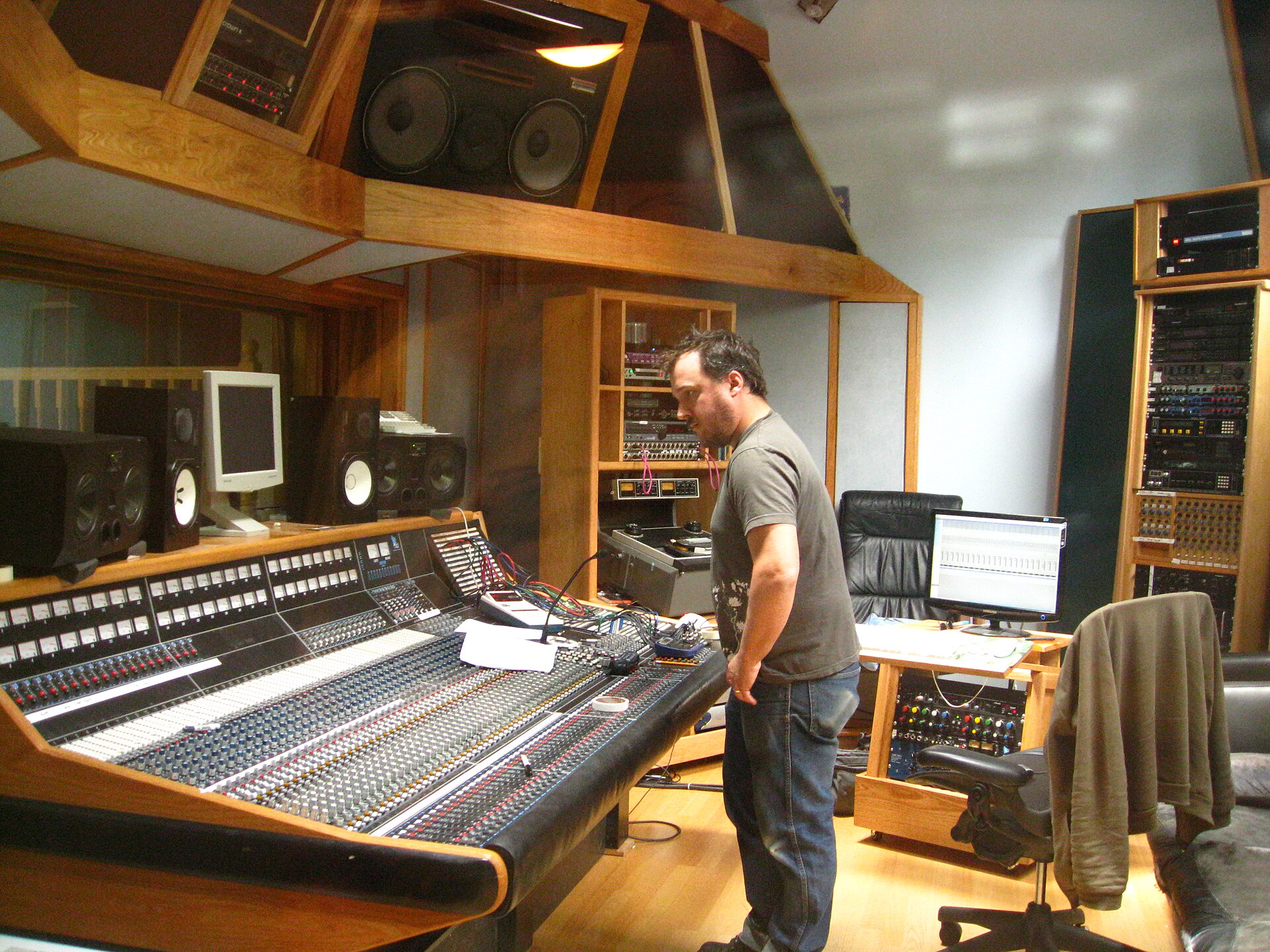
Photo: eyeliam from Portland, United States, CC BY 2.0, via Wikimedia Commons