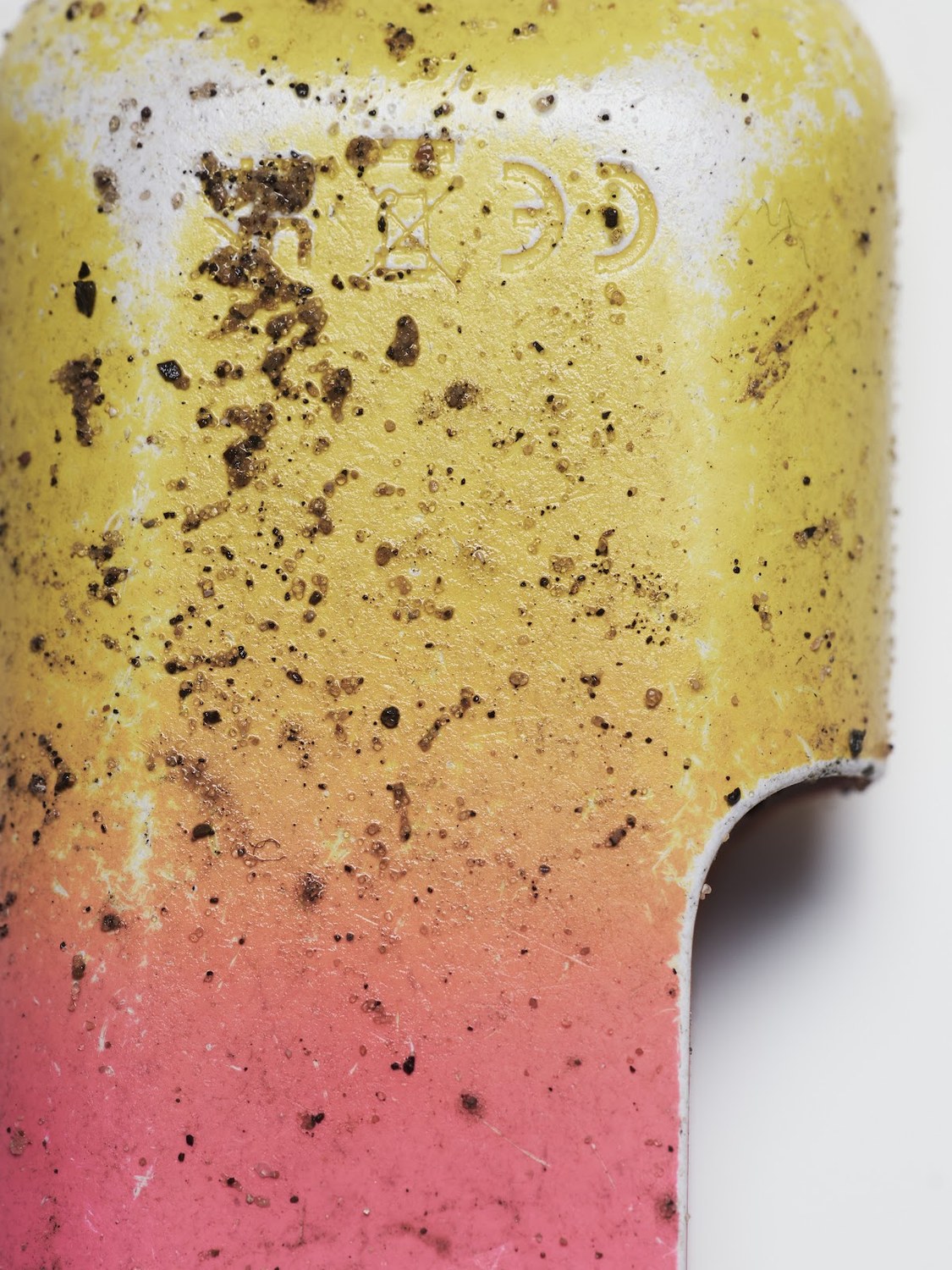
Opening tonight at ANNEX, The Koppel Project, in London, Lost & Found brings together five years of intensive observation by photographer Ryan Blackwell. At once an urban archive and an inquiry into material culture, the project examines what a metropolis leaves behind – and how we assign, negotiate, and strip value from everyday objects.
The exhibition unites two contrasting photographic bodies of work: a series of 100 images documenting discarded mattresses across London streets, and Portraits (2026), a collection of objects gathered from the foreshore of the River Thames and photographed in the studio with the meticulous lighting, grading, and composition typically reserved for luxury watch or perfume campaigns. Alongside the exhibition, Blackwell has self-published a limited photobook of 100 copies, with all proceeds donated to the Trussell Trust.
Ahead of tonight's private view, Ryan Blackwell spoke with Maria Bregman about the origins of the project, unlearning commercial habits, and how photographing forgotten things slows down the pace of city life.

An Interview with Ryan Blackwell
Maria Bregman: Lost & Found took five years. Where did it start – was there one object, or one morning on the foreshore, that made you think this was a project and not just a habit?
Ryan Blackwell: I'd just moved to London and was surrounded by a new world, noticing everything, big and small. I think coming from the North, leaving a mattress outside your house would feel quite taboo. In London, where people often have less space and no garage, garden or car, the relationship with discarded things is different. The mattresses became a way for me to understand this new environment and the way we live in a big city.
Initially, I was photographing mattresses for fun and out of curiosity. It was only when I started mudlarking that I realised both bodies of work came from the same intrigue: the idea that messy, overlooked things can also be beautiful. The project emerged gradually. I was following my curiosity before I understood what connected the images.
MB: You light these things the way you would light a watch or a perfume bottle. What does the language of luxury product photography do to a stained mattress or a piece of river debris, and what did you have to unlearn from commercial work to make it?
RB: I've become more reflective about the power of beauty as a tool for communication. Whether you're leaning into high beauty, as I do in my commercial work, or using beauty as a contrast, it's incredibly effective.
I don't think I had to unlearn my commercial practice so much as understand what else those skills could do. Lighting, colour grading and composition can transform how we perceive something, but the subject still matters most. It needs to resonate with the audience on a deeper level. With this work, the aesthetics draw you in, but the objects themselves complicate that attraction. I'm interested in what happens when the same visual language used to create desire is applied to something we've been conditioned to reject.

MB: A hundred mattresses is a lot of mattresses. Why that number, and what did you see across the series that you could not see in a single picture?
RB: I have over 500 images now, but there are just 100 in the show. Each one evokes a memory of where I was when I took it, so I had to put my own attachment to the images aside and think about how they would work together, and how the audience would read them as a whole.
What emerged from the project was the contrast between the methods behind the two series. Portraits (2026) is an extractive process. I go to the river, collect objects and bring them back to the studio, where I photograph them using the visual language of commercial still life. The mattresses are the opposite. I encounter them while going about my life and photograph them on my phone, leaving them where I found them.
The mattresses form an archive, and it's the accumulation that matters. One mattress might tell you very little, but collectively they reveal a pattern. You start to see something about the city, its habits and the traces people leave behind. The repetition becomes the subject.
MB: The Thames foreshore gives up objects that may be centuries old next to things thrown away last week. How do you choose what to photograph, and do you ever find out the story of an object?
RB: I'm fascinated by value and time. I'm someone who struggles to live in the present, so I find myself looking at the world today in relation to how it will be understood tomorrow.
The objects I'm collecting are a record of our present: single-use plastics, batteries, makeup and vapes. They're things we barely notice now, but given enough time, they might be viewed with the same curiosity we bring to historical artefacts. By then, I probably won't even be here.
I don't tend to trace the individual histories of the objects. I'm more interested in what they reveal collectively about the time we live in. Photography allows me to preserve something of the present, but it also makes me think about how differently that present might be understood in the future.

MB: The work asks how an object's meaning changes with its context. Has the project changed how you yourself look at what you throw away – or what you value?
RB: It definitely has, although I don't have any simple answers. As part of the wider Lost & Found project, I've been conducting research interviews. One conversation with Aniela, a PhD researcher, made me think differently about what happens when I remove an object from the river. Once I've collected it, it becomes something worth keeping, something closer to treasure. But after I've photographed it, I no longer need the physical object. My relationship with its value is quite convoluted, and I haven't resolved that contradiction.
I think the wider theme of my work is how easily we negotiate the value of things. We become so accustomed to the objects around us that discarding them can feel almost automatic. In a way, the speed at which we consume and replace things is also a way of buying back time. We choose convenience because we're busy doing other things.
What's interesting is that mudlarking and photographing mattresses do the opposite. They slow me down. They make me stop, look closely and spend time with things I would otherwise pass by. That change in pace has become just as important to the work as the objects themselves.
MB: The photobook is limited to 100 copies, with the proceeds going to the Trussell Trust. How does that decision connect to the work itself?
RB: I'd love to produce a larger run of the book eventually. But I'm an independent creative funding the exhibition myself. I'm doing it because it's a passion project and because I want to bring people together to close this chapter of work through the exhibition. The edition of 100 is a financial decision rather than a conceptual one.
Donating the proceeds to the Trussell Trust connects more directly to the wider themes of the exhibition. Behind the mattresses and the objects from the river, the work is ultimately about people and behaviour. None of these objects exist independently of us. The Trussell Trust does important work supporting people facing hardship, and donating the proceeds is a way for me to support that work through my own practice. For me, it comes back to the importance of community and caring for the people around us.
Exhibition Information:
Lost & Found by Ryan Blackwell runs from 12–17 November 2026 at ANNEX, The Koppel Project, London. Private View: Thursday 12 November, 6–9pm. The accompanying photobook is published in a limited edition of 100 copies, with proceeds benefiting the Trussell Trust. For more information, visit The Koppel Project and ryanblackwell.co.uk.