
By Anna Zhila
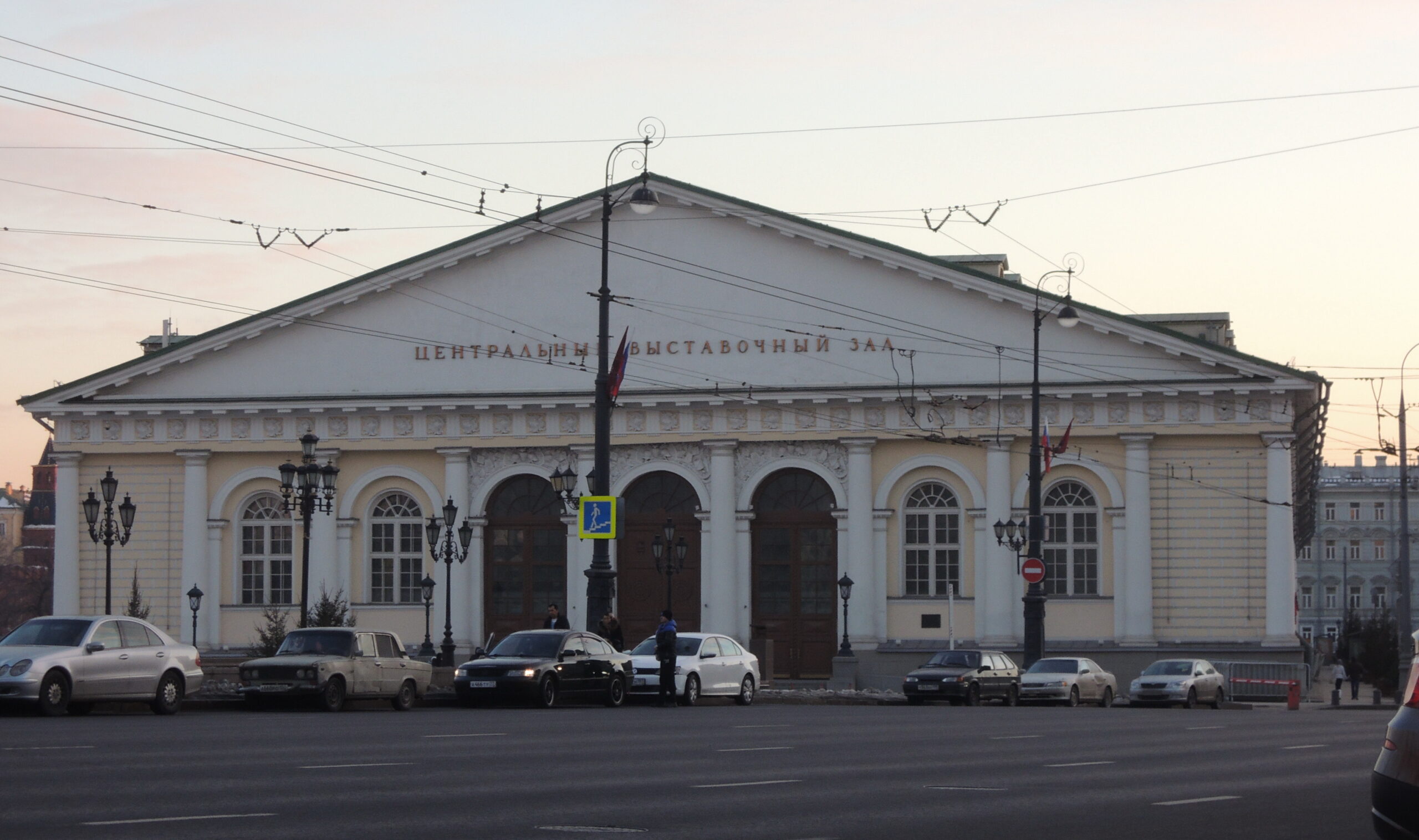
Cover: the Moscow Manege, the week's principal venue — photo: Shakko, Wikimedia Commons, CC BY-SA 3.0.
The seventh Moscow Fashion Week ran from 26 September to 1 October 2026, with the Central Exhibition Hall "Manege" as its principal venue and nearly fifteen venues across the city in its orbit. Read as visual culture rather than as trade calendar, the week made an argument that is easy to miss between the show credits: the runway here is treated first and foremost as an image-producing machine — a room, a light plot, a sequence of materials — and only second as a place where clothes are sold.
A building that works like an instrument
The facts of the venue matter because they shape everything the audience sees. The Manege operated three runway halls simultaneously, with shows scheduled nearly every half hour, so that a designer's final bow in one hall coincided with guest arrival in the next. Below the runways, on level minus two, a market and showroom with more than ninety brands ran daily from 13:00 to 21:00, co-organised with the "Made in Moscow" project. Alongside them worked a lecture hall, an AI fitting room built with GigaChat, and an on-site studio of the Moskva 24 television channel, where designers and guests discussed the shows as they happened.
That is not a neutral container. Three halls firing at once turns the week into a montage: no single spectator can see everything, and every account of the week — including this one — is a cut made from a larger body of material. The market underneath adds a second register: the same building holds the spectacle upstairs and the transaction downstairs, the image and its price tag separated by a staircase.
The scale around the building is worth recording. According to the city, 1,047 applications from 63 Russian regions were submitted for this season, with nearly half coming from debut brands; the final programme brought together more than 350 designers from 24 regions and over ten countries. The organiser of the week and of the parallel BRICS+ Fashion Summit is the Fashion Fund with the support of the Moscow Government.
Materials that photograph before they dress
Two material motifs recurred across the Manege programme strongly enough to count as the season's visual signature: leather and feathers.
Leather appeared as construction rather than trim. The Tver label Unke built its "Remembrance" collection around washed and waxed velvet, checks and layering — and set technological materials, puffer jackets and leather bombers against them. Ruban, showing its spring–summer 2027 collection off-site at the Trekhgornaya Manufactory, used multicoloured leather appliqués as flowers and cut a leather jacket and a cotton parka with alternative fastenings, one of which recalls a hook-and-eye corset construction.
Feathers carried the most theatrical moments of the week. The St Petersburg debutant relchér opened its "Secret Room" collection from an art-deco starting point — fur collars, low waistlines, rhinestones, plunging necklines — and closed it with a finale maxi dress made entirely of feathers. On the fourth day, Moscow's Masterpeace closed the evening with "Silk of Time": heavy hand-embroidered silk combined with jacquard and brocade, fur and feathers. Its author, Evgenia Linovich, staged the collection through the lens of Wong Kar-wai's "In the Mood for Love" — a film in which clothing is, in her words, a full part of the narration — and described her own role in mounting the show as that of "a producer and a director to some extent".
Leopard print enters this season's visual record through a different door: not the runway reports, but the street. Lenta.ru's closing photo-report of 2 October 2026, shot by Maria Plotnikova, is headlined around guests who "were ready to outshine the models on the podiums" — its formula: lingerie dressing, leopard and feathers (the article's URL slug adds leather to the same list). The distinction matters and is kept explicit here: leopard is verified as a streetstyle motif worn by guests outside the Manege, not as a confirmed motif of the runway collections themselves.
Scenography: the shows that leave the catwalk
The most consequential visual work of the week happened where the catwalk format itself was stretched.
Ruban's show was built on hypnagogia — the transitional state between waking and sleep — and carried the idea through silhouettes and decorative detail into music, video sequence and model styling. The brand's co-founder Alisa Ruban formulated it as an attempt "to convey [the possibility of stepping beyond the habitual] through clothing, music, video sequence and the general mood of the show". Flowers ran through the collection as the binding motif: small prints on silk, silk organza and batiste, stitching across fabric, three-dimensional appliqués — and, in the most structural pieces, flowers becoming the construction itself, as in a black silk-flower vest-dress with a voluminous pocket-like detail.
The "Russian Fairy Tales" runway show-performance went further, merging haute couture with classical choreography and visual art: models and ballet dancers presented costumes created by Igor Chapurin for a production staged to music by Petr Dranga, with live orchestral accompaniment, ballet passages danced by the models, and direct video broadcast. Realistic goose heads, a sculptural Baba Yaga headdress in the form of a hut, hand embroidery and experimental textured materials shared the stage — and the scenography of the production was created with the participation of the GigaChat neural network. The ballet's premiere is announced for 12 November in Moscow.
A quieter scenographic note came from the technology zone: the GigaChat AI fitting room, integrated this season into the "Giga-Art" competition, paired digitally generated fairytale imagery with physical runway collections, letting visitors try on the looks and, in the organiser's phrase, become the protagonists of their own fashion story. Whatever one thinks of the gadget, its placement inside the exhibition hall — between market stalls and lecture rows — says something about where the image now sits in the fashion economy: at the exact point where heritage reference becomes interactive content.
Ballet on the runway, twice
Dance appeared on the Manege runway in two distinct guises, and the contrast is instructive. Solangel dedicated its collection to Russian ballet: corset constructions, opera gloves, pearls and crystals — and real ballerinas in classical tutus walking alongside the models. The brand translated stage costume into a contemporary women's wardrobe rather than quoting it literally. In "Russian Fairy Tales", by contrast, the dancers were not guests of the show but its dramaturgy: choreography carried the narrative that the clothes alone could not.
Both point to the same condition. A runway show lasts minutes and produces a sequence of frontal images; inserting trained bodies that know how to hold duration — dancers, or models directed like dancers — is the cheapest reliable way to give those minutes a memory.
The steps of the Manege: streetstyle as the second show
Plotnikova's report relocates the week's most democratic image-production to the pavement: "tall alien-like girls and guys in incredible outfits prop up the massive doors of the Manege, posing for several photographers at once, while crowds of Chinese tourists stand in the second echelon and, mouths open, film the walk-throughs on their phones" (translated from the photographer's verbatim Russian account). Her working note doubles as a theory of the streetstyle image: shooting unnoticed "works out badly", she says — dressed-up guests instantly pick the photographer out of the flow and compel "the creation of joint staged beauty" — and the honest response is to accept the rules of the game and direct openly. That is the exact inverse of the runway inside: there the staging is institutional and the audience watches; on the steps the audience stages itself, and the photographer is conscripted as director. For a visual-culture reading, the two shows are one system — the Manege produces official images upstairs and provokes unofficial ones on its doorstep within the same hour.
What it means for the visual scene
Three things are worth holding on to.
The first is that the Manege worked as an editing machine. Three halls, thirty-minute intervals, a market below and a lecture hall beside — the architecture decided what could be seen and what had to be missed, which is a curatorial act whether or not anyone claims it as one.
The second is that material did the arguing. Leather as construction, feathers as finale, paper as a full material in Pirosmani's "Paper Creature" collection [нп — details beyond the organiser's summary not independently verified], lace as both evening wear and everyday dress in the Shuya and Vologda collections — these are visual theses about weight, surface and fragility, and they survive in photographs long after the seating plans are forgotten.
The third is the inheritance question in its Moscow form. Student showcases from the Universal University and the British Higher School of Art and Design, the Academy of Branding and Design Metrics, the B&D Institute and the Kosygin University shared the schedule with established houses such as Slava Zaitsev, Ianis Chamalidy and Julia Dalakian. A week that programmes debutants and incumbents in adjacent half-hour slots is staging a comparison — and inviting the audience to judge who owns the visual language and who is merely renting it.
None of these shows will be reviewed as art. All of them are.
Sources: the organiser's day-by-day reports on moscowfashion.ru (26 September – 1 October 2026, including the opening-day, fourth-day and fifth-day coverage); mos.ru news item of 06.08.2026 on the 1,047 applications; TASS culture report on the opening at the Manege; totalexpo.ru event card (dates 26.09–01.10.2026, venue Manege, organiser Fashion Fund); Lenta.ru photo-report "Раздали стиль…" (00:01, 02.10.2026, photographer Maria Plotnikova, streetstyle outside the Manege). Designer quotes above are reproduced verbatim from statements published in the organiser's own reports; the Plotnikova passages are verbatim from the Lenta piece (Russian original; translations in the article body are marked as such).
Open questions
- Lenta.ru photo-report located and integrated (02.10.2026, "Раздали стиль…", photographer Maria Plotnikova, streetstyle; headline motifs: lingerie, leopard, feathers; URL slug adds leather). Lenta passages used verbatim; no Lenta facts beyond what the piece itself states.
- Leopard print — half-closed: verified as a guest streetstyle motif via the Lenta headline of 02.10.2026, but still [нп] as a runway-collection motif (absent from the organiser's published day-by-day reports for this edition). Do not present leopard as a podium trend without a further source.
- Pirosmani "Paper Creature" paper-material details [нп] — known only from the organiser's summary line; construction and footwear claims need a second source.
- Attendance and commercial figures for the seventh edition (the March 2026 edition drew 65,000+ visitors; no equivalent published figure for September–October 2026 found at the time of writing) [нп].
- "Russian Fairy Tales" ballet premiere date (12 November, Moscow) and the "185th anniversary of Sberbank" tie-in are given as announced by the organiser [нп — confirm against premiere listings before presenting as fact].




.JPG)