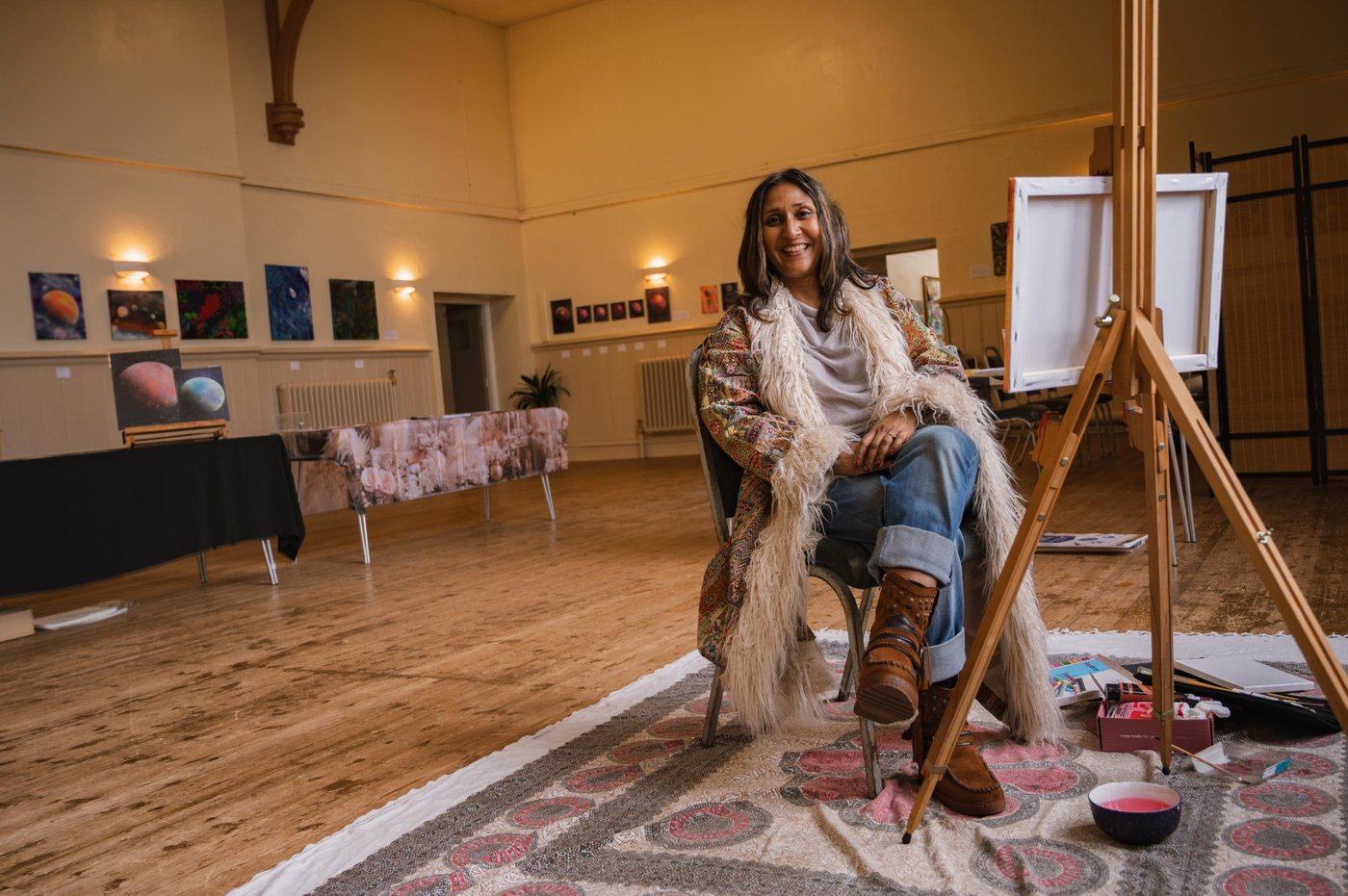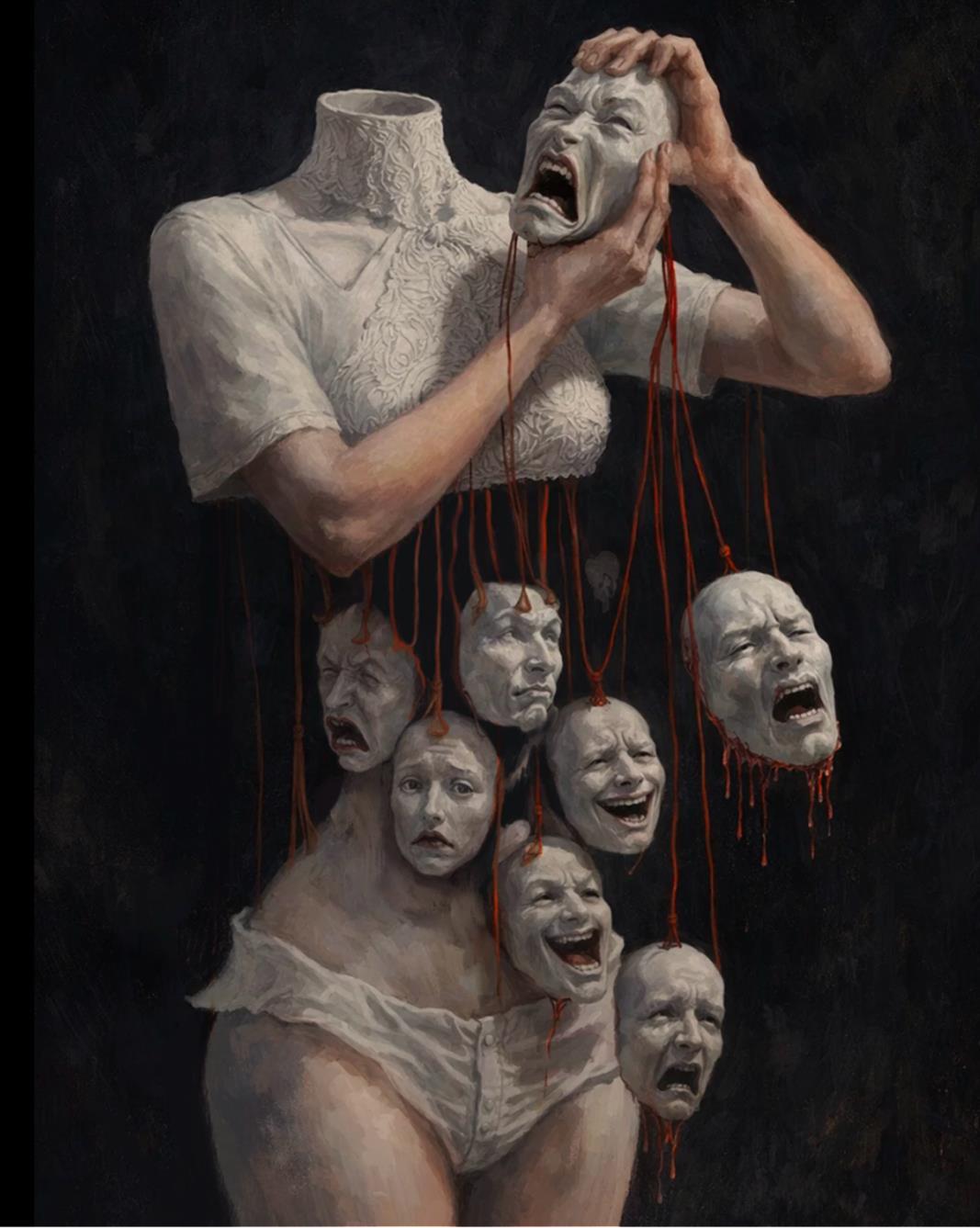
Sozyar Abdalla is a Kurdish-Iraqi artist and writer based in Birmingham. She paints, works digitally, and is finishing her first children's book, I Was Once a Purple Cat, which she has both written and illustrated. Its heroine, Mimi, is a purple cat with ADHD who changes colour to match the animals around her.
Abdalla was diagnosed with autism and ADHD in 2021, after saving for the assessment herself. Three years later, during an MA in Education at the University of Wolverhampton, she came across the word for something her paintings had been describing for years: masking, the practised effort of appearing to cope. We talked to her by email about how that effort became a visual language.

When did you first recognise masking in yourself, and when did it first appear in your art?
I first recognised masking in myself in 2024, when I began my Master's degree and started researching for my thesis. Until then, I had never heard the word "masking" in the context of autism and ADHD. Growing up in the Kurdistan Region of Iraq, where there was very little awareness of neurodivergence and limited access to mental-health and learning-disability resources, I did not even know I was autistic and had ADHD until I was diagnosed in 2021. I had saved money for the assessment myself because my family did not believe that these difficulties were something that needed to be recognised.
When I eventually read about masking, I began recognising myself in the literature almost immediately. But I also realised that masking had been present in my art long before I knew its name. My paintings had already been circling around disorientation, loneliness, burnout, identity and the feeling of being out of place. In a way, my art understood me before I understood myself. The research simply gave me the language to recognise what my work had already been trying to say.

Mimi, the purple cat, changes herself to fit in and then finds her way back. Why a cat, and why purple?
I chose a cat because cats are often imagined as calm, quiet, independent and well-behaved. These are also qualities that girls are frequently expected to embody: to be obedient, composed, pleasant and easy to manage. Mimi challenges that image. She is curious, energetic, emotional and impulsive, and when those parts of her begin to disturb the expectations around her, she learns that being herself can come with consequences.
Purple came from the idea of making her visibly different from the beginning. A purple cat is unusual; she stands out before she has even done anything. That became important to the story because Mimi grows up feeling that she is somehow different from everyone around her, without understanding why.
She eventually begins changing her colour to match the animals around her. She becomes orange, brown, green and other colours because she believes belonging means becoming more like everyone else. Her return to purple is therefore not simply about accepting a colour. It is about discovering that belonging should not require the disappearance of your identity.


How do your writing and your images grow alongside each other? Which usually comes first?
Writing usually comes first. Most of my artwork begins with a short piece of writing based on something I have experienced, remembered or felt. I use writing to understand the experience first, and then the visual work develops from it. A sentence, memory or feeling can become a colour, a character, a landscape or an entire story.
I don't really see my writing and visual art as two separate practices. They are two ways of approaching the same experience. Writing allows me to say something directly, while art allows me to communicate it through symbolism, atmosphere and emotion. Sometimes the image can express something that the words cannot quite reach.
My work is personal, but I don't make it only as a record of my own experiences. Through my Master's research and my work in SEN education, I have become increasingly interested in making invisible experiences more visible, particularly around autism, ADHD and masking. I want the personal starting point of the work to open into something that another person can recognise in themselves.

Growing up within a minority culture adds its own expectations. How does that shape your work?
Growing up in the Kurdistan Region of Iraq shaped my understanding of identity, particularly because I grew up with strong expectations around what it meant to be a girl. There were expectations of obedience, femininity, emotional stability and behaving in ways that would not bring shame or difficulty to the family. Being different was not always something that felt safe to express.
For me, neurodivergence existed underneath those expectations. I was trying to understand myself while simultaneously learning how to become the person other people expected me to be. I became very aware of how I was behaving, speaking and presenting myself, and of which parts of me were considered acceptable.
That tension has become central to my art. I am interested in what happens when adapting yourself becomes so habitual that you eventually lose track of where the performance ends and where you begin. My work explores that sense of disorientation and the loneliness that can come from feeling disconnected from your own identity. It also explores what happens when you finally begin questioning the idea that you were ever supposed to fit perfectly into someone else's expectations.

What would you like a neurodivergent girl who reads your book, and an adult who looks at your paintings, to take away?
I would like them to leave with the feeling that they are not alone.
For a neurodivergent girl reading I Was Once a Purple Cat, I hope Mimi can become a reminder that being different does not mean that you need to correct yourself. I want her to understand that she should not have to become quieter, easier, or more like everyone else in order to deserve acceptance. Mimi does not find herself by becoming better at fitting in; she finds herself by realising she does not need to keep changing.
For an adult looking at my paintings, I hope the work creates a moment of recognition. Masking can make someone look as though they are coping while internally they may feel exhausted, lonely or disconnected from who they are. I want to give some form to those experiences.
Ultimately, I want my work to create a sense of community. I want someone who has spent years feeling out of place to look at it and think: I know this feeling. I am not the only one.

All images © Sozyar Abdalla, reproduced with the artist's permission.