By Emma Richmond
When you first arrive in the Lake District, you’ve probably already seen it. Be it through photographs of the stone walls winding through fields, paintings of sheep scattered across fells, or walking guides that take you along distant summits; you’ve already been promised a certain experience through the media you’ve consumed.
The landscape is physically there, but so is the idea of the landscape that has been constructed around it. We aren’t arriving at the Lakes with an empty mind. We bring images, stories, and expectations with us that influence what we notice when we look. William Wordsworth played a major role in creating a cultural image that continues to shape people’s experience of the landscape today.
Learning How to Look
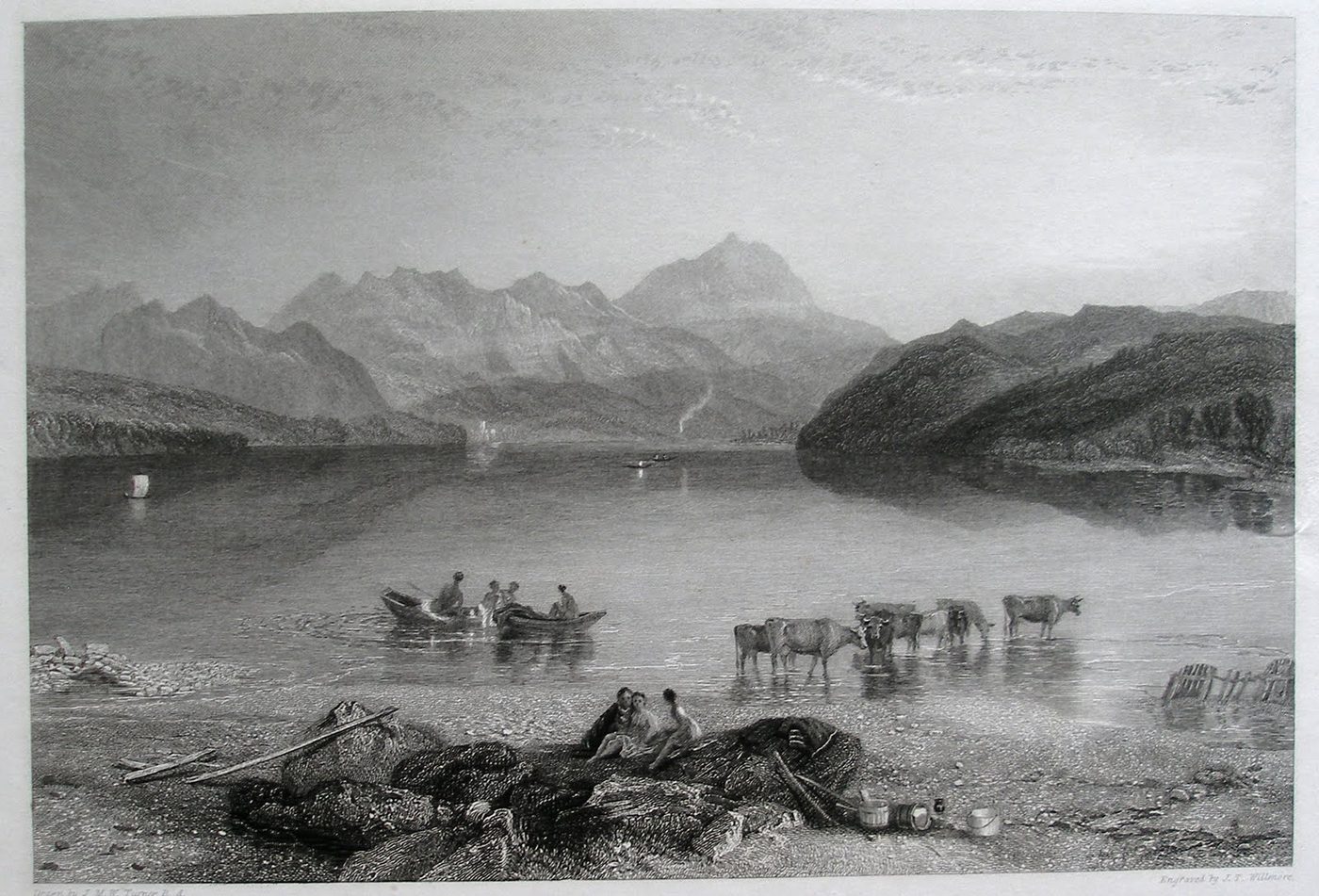
Wordsworth wasn’t the first person to shape how visitors saw the Lakes. By the late eighteenth century, the region was attracting tourists searching for picturesque views. Thomas West’s A Guide to the Lakes, published in 1778, identified ‘stations’ from which visitors could observe chosen scenes. They were being taught exactly where to stand and what to look at.
The Picturesque emerged in the eighteenth century alongside the growing popularity of landscape painting and theories of aesthetics. Writers such as William Gilpin defined the qualities that made a landscape visually attractive, and encouraged travellers to seek out scenes that resembled the compositions of paintings. The Picturesque organised the landscape through varied, irregular forms, contrasts of light and shade, and compositions that guided the eye on a journey through the scene. The physical landscape was therefore being treated as something to be framed and viewed aesthetically, with ‘stations’ becoming destinations in their own right.

Wordsworth was then brought into this existing culture of travel by Reverend Joseph Wilkinson, who, in 1810, commissioned him to write an introduction to his collection of Lake District engravings: Select Views in Cumberland, Westmoreland, and Lancashire. Wordsworth’s contribution was published anonymously as a companion to Wilkinson’s engravings, and it later developed into the Guide through the District of the Lakes in the North of England, which Wordsworth revised and expanded over the following twenty-five years.
The Guide shifted attention from the arrangement of picturesque scenes to the experience of the person encountering the landscape. In the later 1835 edition, Wordsworth observes that visitors who repeatedly come to the Lakes ‘deem the district a sort of national property, in which every man has a right and interest who has an eye to perceive and a heart to enjoy’. He positions the landscape as something more than a view to admire. It becomes something to be valued, experienced, and shared, giving the Lakes a cultural meaning that extends beyond their physical appearance.
Wordsworth presented the Lake District as a rural landscape whose beauty came from the relationship between nature and human life. In his Guide (1835), he described its mountains as having forms that were ‘endlessly diversified’, praising their ‘beauty and variety’ and the way they combine to create a unique view. The Lakes offered natural beauty, traditional rural communities, and relative seclusion, where the landscape could provide a source of reflection and emotional renewal. His writing transformed the region from a physical landscape into a place associated with tranquillity, memory, and the restorative power of nature.
The relationship between land and experience is furthered in Wordsworth’s poetry. In I Wandered Lonely as a Cloud (1807), the daffodils are a significant natural object that sustains him:
For oft, when on my couch I lie
In vacant or in pensive mood,
They flash upon that inward eye
The landscape is therefore transformed into memory, returning later as an emotional experience through the ‘inward eye’. The physical scene lives beyond the original encounter, later returning through memory. Wordsworth’s representations of the Lakes helped establish a landscape that existed in front of the visitor and within the imagination.
When a Landscape Becomes Desirable
The relationship between landscape and experience moves beyond poetry. Once the Lake District was established as a place that offered a specific emotional and imaginative experience, visitors wanted to experience it for themselves. Wordsworth’s writing helped reshape the landscape from one to be admired to one that should be experienced, but tourism gave that concept a physical form.
Wordsworth’s opposition to the proposed railway stretching from Kendal to Windermere exposes the anxiety created by the growing popularity of the region. In 1844, he published a sonnet and letters arguing that the railway threatened the character and seclusion that made the Lakes valuable. In his letter to the editor of the Morning Post, he wrote that the ‘staple’ of the region is its ‘beauty and its character of seclusion and retirement’. He was concerned about the prospect of large numbers of visitors arriving on ‘cheap trains pouring out their hundreds at a time along the margin of Windermere’. Yet, he was partly the reason for the demand he was resisting. In his sonnet ‘On the Projected Kendal and Windermere Railway’ he asks, ‘Is then no nook of English ground secure/ From rash assault?’, imagining the intrusion the railway would bring to a landscape whose ‘peace’ was part of its appeal.
The line nevertheless opened in April 1847, with tourism being cited among the reasons for its development. The railway marked a shift in how the Lakes were encountered. A landscape that had been imagined through poetry and picturesque views became increasingly accessible as a tourist destination. The experience Wordsworth had helped attach to the landscape was now packaged, travelled to, and consumed.

Wordsworth’s influence extended beyond his poetry and Guide. During the nineteenth century, guidebooks increasingly made the connection between Wordsworth and the Lakes as part of the appeal of visiting. Saeko Yoshikawa’s research traces a transition in these guides from an interest in the Picturesque towards an interest in poetic connections, using Black's Picturesque Guide to the English Lakes (1841) as an example. As guidebooks began quoting Wordsworth’s poetry and linking spots to places in his life and writing, they gave tourists a new sort of ‘station’, but this time focused on an individual rather than a scene. A tourist could follow a route through the Lakes, retracing the poet who had once written about it. Wordsworth’s writing gave physical places a literary history, and the guidebooks taught visitors how to interpret that history as part of their journey.
Wordsworth’s celebrity status and the tourist industry therefore developed together. His poems, routes, and places associated with his life became part of the tourist culture, while the industry helped to construct his public reputation and the cultural identity of the Lake District. The Lakes became a place encountered through Wordsworth, not just somewhere he had written about.
Competing Versions of the Lakes
The growth of Wordsworthian tourism made the Lakes a place for aesthetic appreciation, literary pilgrimage, and personal reflection. However, this Romantic vision left other relationships with the space less visible. For farmers and local workers, the land was a source of livelihood, shaped by work and practical dependence. A dry-stone wall or cultivated field can be a part of a picturesque image while the generations of labour disappear from view. The landscape appears timeless because the human work that produced it has now been absorbed into the scenery.
The Lake District National Park describes the region as a ‘world class cultural landscape’, recognising how its present character has developed through centuries of human activity alongside its natural features. It is a place that they consider as continuing to inspire ‘the millions who seek out what captivated Wordsworth, Ruskin and Beatrix Potter’. Wordsworth’s Lake District has become part of the official story told about the region, as well as the way visitors are encouraged to experience it.
That history is still being written and rewritten. The Romantic Lake District now exists within newer forms of imagery. Paintings were followed by photographs, the guidebooks became tourism campaigns, and now social media circulates thousands of images of the Lakes. A photograph of a mountain reflected in the water can look like a neutral record, but the image depends on where the photographer was standing, and what falls outside the frame. We recognise the landscape through images that have already taught us what it is supposed to look like, while also participating in producing those images ourselves. Every photograph shared from the Lakes adds another version of it to the visual archive through which the region is now recognised.
The anxiety Wordsworth felt in the tourism boom of his time would probably not have been calmed by these modern depictions. The railway made the Lakes physically accessible to thousands, but social media makes versions of the Lakes instantly accessible to millions who may never have been there. Wordsworth worried that making his home easier to reach would undermine the seclusion that formed part of their appeal. Today, the landscape can be photographed and circulated so extensively that the experience resembles the image we arrived expecting to find. The roads, crowds, and working landscape are outside of the frame, leaving behind the Lake District as an idealised version of itself. What looks like an untouched scene is actually the result of choices about where to stand, and what to include in the picture; much like the ‘station’ prescribed to eighteenth- and nineteenth-century tourists.
Wordsworth’s vision remains part of that process. His writing established the Lakes as an amalgamation of landscape, memory, and feeling, and those associations have become a natural and familiar part of the local image. Two centuries later, we still encounter his version of the landscape, but we now bring our own expectations to it. By the time we arrive at the Lakes, some of the looking has already been done for us.
Note
Saeko Yoshikawa, William Wordsworth and the Invention of Tourism, 1820–1900 (Farnham: Ashgate, 2014), pp. 37–61.
Emma Richmond is a writer and researcher with a PhD in English. Her research focuses on eighteenth-century landscape literature, law, and cultural memory, exploring the ways in which texts shape our understanding of place. Alongside her academic work, she writes accessible articles on literary criticism and theory for curious readers. She writes on Substack at richmondemma.substack.com.