By Maria Bregman
Maria Bregman - writer, literary and art critic and curator. She has written for Cosmopolitan, Glamour, ELLE and Esquire, curated solo exhibitions of Zurab Tsereteli, presented on CultFM, organised international art festivals in the UK, Tunisia and Israel. https://en.wikipedia.org/wiki/Maria_Bregman
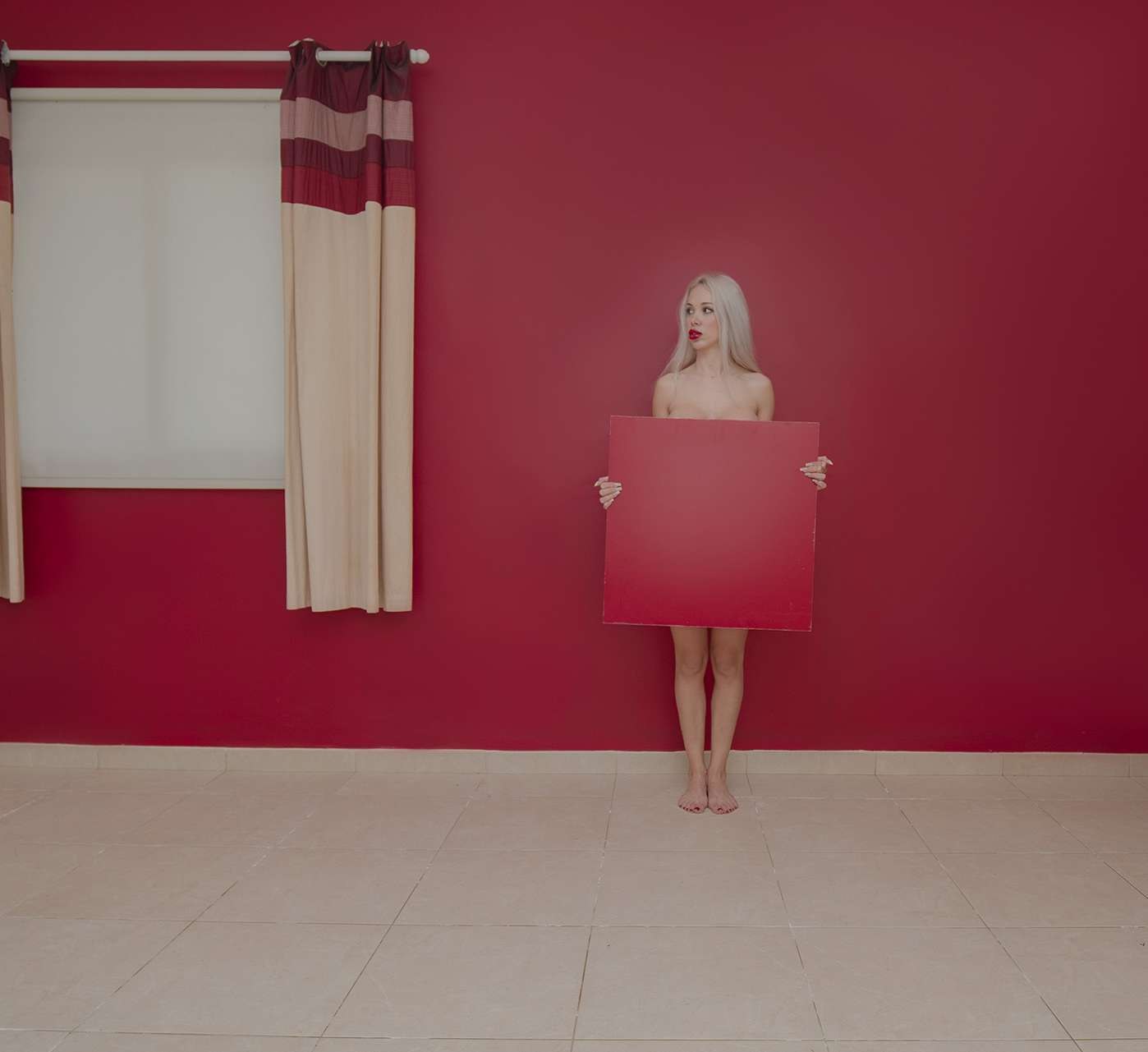
A nude woman stands up against a red wall with a red square held up in front of her body. The colour of the square is nearly identical to that of the wall behind her. This is what one notices first, but it is also the crucial element in the image because she does not just cover herself; she also disappears into the interior.
The photo is part of a series of images in which the photographer Anna Air, based in both London and Dubai, turns her own emigration into a series of staged interiors. In one picture she folds herself up in a kitchen cupboard, while in another she crouches in the corner of a room with red curtains, pieces of white scattered across the floor. Air's statement on her work is unusually blunt: "In emigration, I began to shrink. The world around me grew: a new language, new walls, new rules."
The red square is the instant when retreat becomes a means to an end. Air says it's "the attempt to hide beautifully". For an artist who studied in Nizhny Novgorod and Moscow, that object isn't something innocent. Back in 1915, Kazimir Malevich painted a red quadrilateral on a white canvas and gave it the name Painterly Realism of a Peasant Woman in Two Dimensions, making a person into a flat colour space. Air turns this around. She places a woman back behind the plane, and the symbol of the height of Russian modernism turns into a modesty shield, which is firmly held with both hands. Intentional or not, this reference adds some weight to the photograph that its fashion glossiness would have hidden otherwise. Notice the window as well. The blind is pulled down: there is light, but no view.
It is also the economy which underlies the pink still life, the most attractive picture in her portfolio. A girl puts her head on the pink table surrounded by pink lipsticks, a bottle of varnish, and pink wine glasses arranged in a pyramid-like shape. Everything in the picture is pink – even the skin of a girl; only her grey-green eyes do not blend into the whole. It goes from the constructed heroines of Cindy Sherman to the monochrome rooms of Sandy Skoglund, and Air handles it effectively: the head rests on the table just like another item in the composition. Her series Soft Control says it outright, describing the body as "a constructed image suspended between beauty and detachment".

This becomes evident precisely in the problematics of her work. The pink image is just as desirable as the advertisement it critiques, and it can be consumed without the consumer even being aware of the underlying question. This is a dilemma indeed, which does not always get solved in her favour.
In the third image, the one where the cherries are offered, we have the solution of this dilemma. A figure with a platinum fringe and a powdered face faces us from within a black, high-collared jacket, reminiscent of clerical garb. Red liquid flows from the mouth onto the chest, while in the cupped hands there is a pile of cherries being offered. The symmetry of the icon, the gesture of communion and the fruit symbolizing paradise as well as lust make this an un-decorative piece of work. The gloss that made the pink image such an easy subject for consumption has been stripped away, leaving behind an image of a body that has eaten something and now reveals what is left.

Air describes herself as an artist whose practice spans photography, AI imagery and abstract painting. Looking at these works, though, one can see that Air's true tool is the camera and the staged environment. Her most powerful pictures are those with the least digital manipulation. Moreover, they are the most personal. The artist stops pretending to perform femininity and begins capturing its cost when shooting in the red room and cherry portrait. That is where she becomes a photographer worth watching.