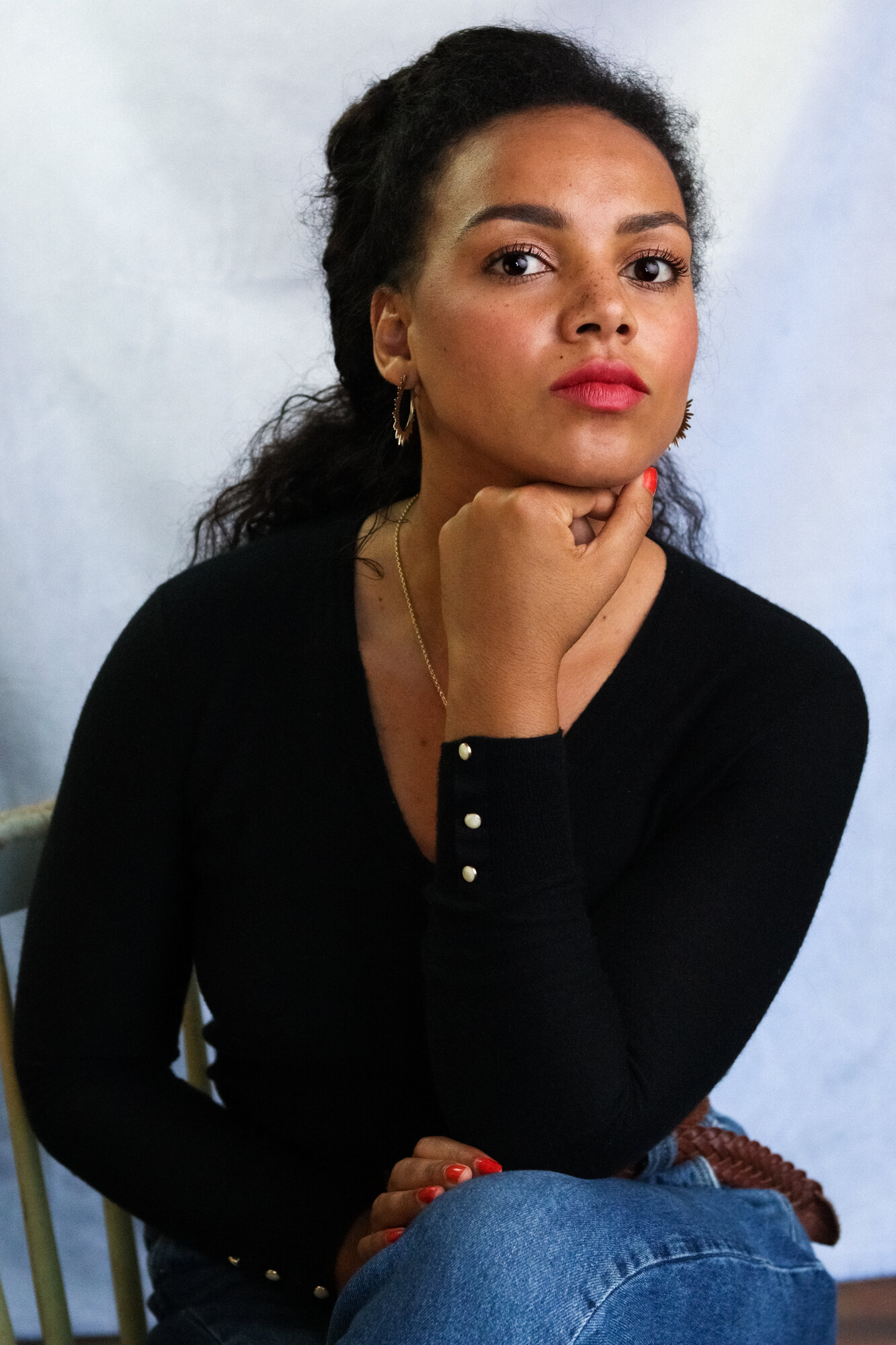
Catherine Joy White is an author, actor and filmmaker. Her first book, This Thread of Gold: A Celebration of Black Womanhood, published in the UK by Dialogue Books, won the 2025 Zora Award for Nonfiction. On screen she has appeared in Bridgerton and The Capture; on stage she recently played Ruby in Martina Laird's Driftwood at the Royal Shakespeare Company and Kiln Theatre. She is also the founder of Kusini Productions.
This October she takes the book into a theatre. This Thread of Gold: Black Women Who Wove British Theatre, a free exhibition at Chichester Festival Theatre for Black History Month, follows six women: Una Marson, Hattie McDaniel, Yvonne Brewster, Winsome Pinnock, Martina Laird and Michaela Coel. It has six portraits commissioned from the artist Whitney Ellis and, at its centre, the Golden Thread, a tree from the theatre's props department on which visitors hang the name of someone who passed something on to them. The launch on Saturday 3 October is marked by White's conversation with Jessica Huie MBE. We put six questions to her by email.

Your book follows Black women across film, politics and activism; the Chichester installation narrows the thread to theatre. What did you find on the stage specifically that the book could not hold?
This Thread of Gold was always about connection for me. It connects the threads between women across generations and the ways that we can all be inspired by them today. An exhibition felt like a beautiful way of making those invisible connections visible.
I wanted people to be able to physically move through those stories and so we have all of these different elements: the portraits, the Golden Thread interactive installation where people can share the name of somebody who passed something on to them, the talk with Jess Huie MBE and even the theatre itself all become part of the storytelling.
I also just think that theatre is such a physical art form. It grabs you in a visceral way and bringing these women to the stage in this way helps us to see them as real people, not names in a history book. There is also something particularly moving about all of this taking place in a theatre because so many of these women had to fight to get into those spaces in the first place! Some performed, some wrote, some directed, some built companies and platforms for other people. They quite literally changed what theatre could be.
Una Marson, Yvonne Brewster and Winsome Pinnock worked decades apart. Is this a lineage they recognised themselves, or one that has to be drawn afterwards?
I think it is probably a bit of both. There are certainly direct lines of influence and some of the women have consciously acknowledged the women who have come before them (or, in the case of Hattie McDaniel, recognised the role they play for those who come after them). But then I am also interested in the kind of quiet inheritance that happens without us necessarily knowing it.
The fact that Yvonne Brewster could build Talawa Theatre Company or that Winsome Pinnock could become the first Black British woman to have a play produced at the National Theatre changes the landscape for someone coming after them, whether they ever met or not. That's one of the things I love about the idea of the thread of gold. It doesn't have to mean that everyone sat around a table together and consciously passed something from one hand to another. The lineage is about recognising that a door exists because someone else spent their life building it.
And then of course there are the people like me who come along afterwards and realise that the possibilities in front of us exist because someone else paved the way.
Performance disappears when the run ends. What survives of these women's work, and what did you have to reconstruct to build the display?
I mean that is pretty much the thing I find so beautiful about theatre. It is just utterly ephemeral. It's a moment in time. The main thing that survives in the case of some of these women is the writing itself. We still have their scripts, in some cases reviews and photographs. Bringing them to life for the exhibition was where working with artist Whitney Ellis became really beautiful. I was able to tell her about the women and the snippets of their lives that I was highlighting and she then captured an essence of them. So part of making the exhibition was about bringing together those fragments and trying to give them somewhere to sit alongside one another.
I wanted to create a point of entry rather than pretend that an exhibition can somehow reconstruct an entire life and I found that I kept coming back to the question "what became possible because this woman was here?" It was a really powerful question and somehow felt like it captured the essence of the exhibition more than any list of achievements ever could.

Who is carrying the thread now? Which actors, writers or directors working today would you place in it, and why?
Where do I begin?!
Michaela Coel is one of the women in the exhibition precisely because she has expanded what is possible for a Black woman writing and performing for screen and stage. Winsome Pinnock is another because of the generations of writers and audiences her work has reached. Martina Laird is another because I had the joy of playing Ruby in her debut play Driftwood and seeing how powerful it was for her to write the personal into the political in an exploration of Trinidad's history.
But beyond those already in the exhibition, I think about people like Monique Touko, Sharon D Clarke, Sheila Atim, Chinonyerem Odimba, Cynthia de la Rosa and Natasha Gordon, among so many others.
What interests me isn't necessarily who is "the next" person in the lineage, it's the sheer breadth of what Black women are creating now. That is just so exciting to me. The women in the exhibition had to create possibilities in environments where there were often very few entry points. My generation coming through now is inheriting those possibilities but also creating entirely new ones. Just imagine what we can leave for those who come after us.
You move between writing, acting, film and Kusini Productions. How does working across forms change the way you tell these histories?
I think first and foremost I just care so much about people. I am always putting myself in someone's shoes, thinking about how they view the world. As an actor, I'm always thinking about what someone is going to feel. As a filmmaker, I'm thinking about how I craft a world and as a writer, I'm interested in language and whose voice is being heard, so I approached my work quite instinctively through all three of those lenses.
What would you like someone who walks into the theatre knowing none of these names to leave with?
POSSIBILITY.
I would love for them to leave knowing at least one name they didn't know when they walked in, and wanting to find out more. Maybe they'll go and read Leave Taking or look up Una Marson. Maybe they will go and see a Talawa show. Or maybe they simply see a Black woman represented in British theatre history and realise there is a much bigger story than they had been taught.
But I also hope it feels surprisingly personal! You might walk into the exhibition expecting to learn about six women and then suddenly you're being asked to think about someone in your own life. I would absolutely love for someone to walk through the exhibition and understand that they are not starting from nowhere. There is a golden lineage of women behind them and they can become part of the people carrying it forward. Because ultimately, I do think that's what legacy is: making room for someone you may never even meet. And if someone walks out of the theatre thinking, perhaps I have a thread too, and perhaps I have something to pass on, then that's everything I could want from it.
Visiting
This Thread of Gold: Black Women Who Wove British Theatre is on display at Chichester Festival Theatre throughout October 2026. Entry is free. The theatre is open Monday to Saturday, 9am to 6pm, and until the end of the show on evening performance days. More on the Chichester Festival Theatre website.
This Thread of Gold: A Celebration of Black Womanhood is published in the UK by Dialogue Books and in the US by Tiny Reparations Books.