By Lee Sharrock
About the Author. Lee Sharrock is an internationally recognised curator, art critic and communications consultant based in London. She began her career as Global Creative PR Director at Saatchi Gallery and later served as Head of Global Creative PR for Saatchi & Saatchi Worldwide. Sharrock contributes expert analysis on global art and culture to leading international publications including Forbes, Dazed, AnOther, and The Saatchi Gallery Magazine. She is also the founder of the arts platform Culturalee, through which she travels internationally to cover major exhibitions, biennials and art fairs. In addition to her writing, Sharrock has curated numerous exhibitions and projects in London and abroad, championing both emerging and established artists. Her critical voice and curatorial work situate her as a respected figure in the contemporary art world, bridging discourse, cultural commentary and visual innovation.
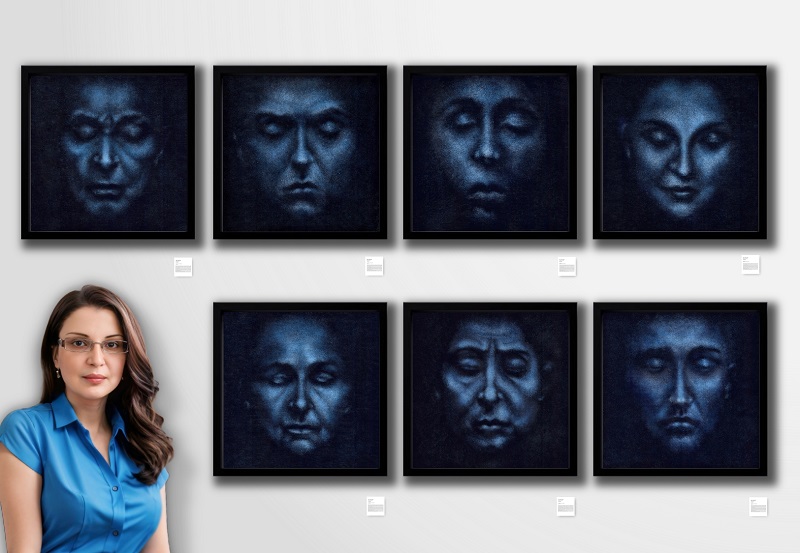
Assaya’s series, Open Your Eyes, draws viewers into a quiet, almost meditative space, where it becomes hard to tell what perception is and what is reality. The faces she paints, usually with their eyes closed, feel as if they’re caught in a moment between dreaming and waking. There’s a stillness to them that makes me think of the Mona Lisa’s mysterious expression. Assaya uses a painstaking pointillist technique, layering tiny dots of color in a way that reminds me of Seurat and post-impressionists, but her palette leans toward blues that feel tinged with melancholy. These paintings aren’t just portraits; they seem to hint at private worlds of emotion and memory.
Open Your Eyes isn’t portraiture in the usual sense. It’s more of a philosophical inquiry. Assaya draws on her background in both economics and fine art, and you can see the influence of quantum physics, cognitive science, and Eastern philosophy in the way she approaches the canvas. Her process is both analytical and deeply personal. She builds each painting in layers, using handmade horsehair brushes to add one point after another, so the surface seems to vibrate. The result is a sense of impermanence – each mark fleeting, like a thought that appears and then fades.
At the heart of this project is a seven-stage model of awakening, expressed through seven paintings. These images feel as though they’re emerging not just from observation, but from somewhere deeper, moments of memory or self-awareness surfacing from the dark. The act of painting becomes almost meditative, a way of exploring how reality itself takes shape as we observe it.
These works were first shown in London as part of The Dark Side project. During the exhibition, viewers were often observed pausing for extended moments in front of the paintings, as if attempting to attune themselves to the emotional states suggested on the canvas. The series was later presented at the Edinburgh Art Fair with representation by Amove Gallery.
For me, what sets Assaya apart is the contemplative quality of her work. She bridges art and science in a way that feels both original and deeply resonant, inviting viewers to move past surface appearances and into a more reflective state.