By Yulia Tulegenova
The Royal Academy's Richard Dadd exhibition, Beyond Bedlam, closes on 25 October. Most visitors arrive knowing two facts about Dadd: he painted fairies, and he killed his father. The show gives both their place. But walk the rooms slowly and a third story comes up, quieter and in some ways stranger. For more than forty years, the people who looked hardest at Dadd's pictures, kept them and asked for more were the men who ran the hospitals that held him.
A career that started at the RA
Dadd enrolled at the Royal Academy Schools at 19 and did well there. He won medals for drawing and painting and was at the centre of the Clique, a group of students who made compositions from Shakespeare and Byron and painted each other in costume. By the early 1840s he was building a name as a painter of fairy scenes. Titania Sleeping, from 1841, is on loan from the Louvre.
In 1842 the lawyer Thomas Phillips took him as a travelling artist on a tour through Greece, Turkey, Syria and Egypt, paying his costs in return for pictures of the trip. The pace was rushed, and on the way Dadd began to develop psychosis. Back in England, he killed his father. In August 1844 he was admitted to Bethlem, the London hospital whose old nickname gives the exhibition its title.
That could have been the end of a painter. It was not, and the reason is mostly the people around him.
The visiting physician
The ward where Dadd first lived was harsh, and staff paid its patients little attention. He was still encouraged to paint. The Royal Academy names one of Bethlem's visiting physicians, Alexander Morison, as an avid collector of his work. Nicholas Tromans, one of the authors of the exhibition catalogue, wrote in Tate Etc. that Morison and Charles Hood both built substantial collections of Dadd.
Think about what this means in practice. A doctor walks through the ward, sees what a patient has made, and wants it on his own wall. Dadd had no gallery, no dealer and no public. For years his whole market was a few men with keys.
The superintendent and the better ward
In 1857 Dadd was moved to a more comfortable ward in the main hospital and given books to work from. The physician-superintendent saw painting as good for Dadd's mental health, took an interest in the work and, according to the Royal Academy, ended up with at least 33 of his paintings.
The 1850s is when Dadd made the series called Sketches to Illustrate the Passions, small watercolours that each take one emotion as a subject. The Victoria and Albert Museum holds one of them, Patriotism. Its inscription gives the place of making as plainly as a postmark: "Bethlehem Hospital, London May 30th 1857". Nobody hid where these pictures came from. The hospital was part of the signature.
The steward's picture
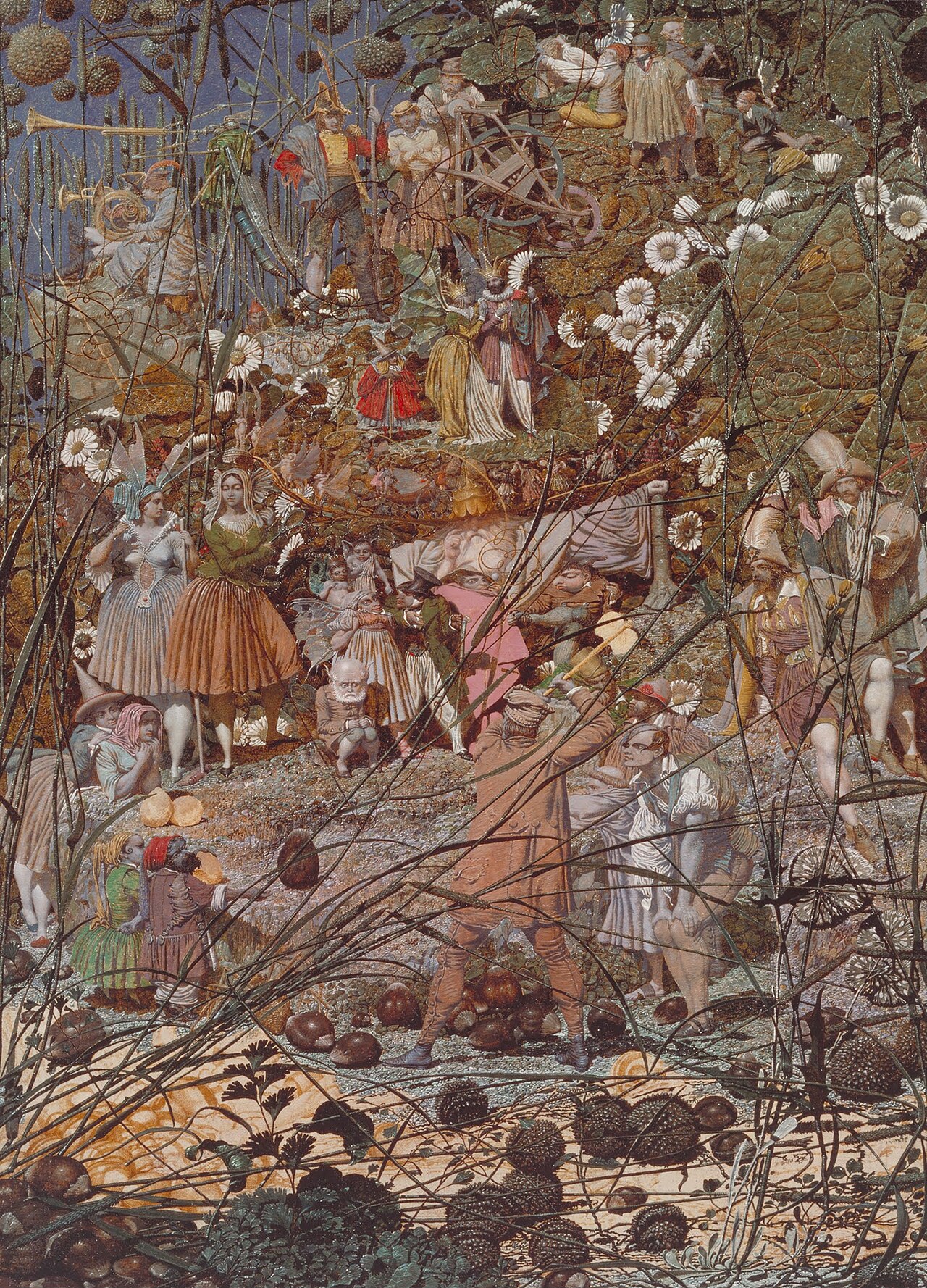
The most famous painting in the show was not made for a doctor at all. The Fairy Feller's Master-Stroke, a crowd of tiny figures gathered round a woodsman about to split a nut, was painted for the steward of Bethlem, George Henry Haydon. Dadd worked on it for almost a decade, from 1855 to 1864. In 1865 he wrote a long rhymed text about it, which he called an "Elimination", a sort of cast list with an account of how the picture came to be painted. A painting this dense is not a gift you finish in a week. It reads more like a long conversation between an artist and the one person he knew would look at every inch.
Broadmoor - stage paint and fire buckets
In 1864 Dadd was moved to Broadmoor, the asylum for the criminally insane in Berkshire. Tate dates a watercolour version of The Fairy Feller to November 1864, made there apparently for his own satisfaction. Tromans records that at Broadmoor he was commissioned to decorate the stage in the recreation hall, and that he painted images on objects around the asylum, fire buckets among them.
This is the part of the story that the exhibition can only point to, because institutional decoration rarely survives. It is also the part that says most about how Dadd lived. He was not only a patient who happened to paint. He was the institution's painter, used for the same jobs a local decorator would be used for, and trusted with a hall where everyone gathered.
Care, collecting and the question underneath
It would be easy to turn this into a warm story about enlightened Victorian doctors. Partly it is one. The Royal Academy's own wording is that Dadd was encouraged to keep painting, and the work we have exists because of that.
But a collector who also controls your books, your ward and your days is not an ordinary collector. Dadd was in no position to bargain over a commission or look for other buyers. The same men who decided what was good for his health decided where his pictures went. The exhibition does not pretend this is simple, and visitors should not either. The RA notes that some works carry historical language and imagery about mental health and racism, which is a fair warning about how much of the period sits in these frames.
How the pictures came back
After Dadd died at Broadmoor in 1886, his work was largely forgotten. In 1963 the war poet Siegfried Sassoon gave The Fairy Feller's Master-Stroke to Tate, in memory of three of Dadd's great-nephews he had served alongside in the First World War. The painting became popular, and in 1974 Tate held a full retrospective. Later the band Queen took the painting's title for a song.
Look at the lenders thanked by the Royal Academy: Bethlem Gallery, Bethlem Museum of the Mind, the Victoria and Albert Museum and the Yale Center for British Art. The first two are still connected to the hospital where the collecting began. In a sense the show is a reunion of what the doctors and the steward once kept in their rooms.
Seeing it before it closes
Beyond Bedlam is in the Jillian and Arthur M. Sackler Wing at Burlington House, Piccadilly, until Sunday 25 October 2026. It brings together more than 100 works. Tickets are £15, and Friends of the RA go free. Opening hours are 10am to 6pm Tuesday to Thursday and Sunday, and 10am to 9pm on Friday and Saturday, so the two late evenings may give you a quieter room. Additional security checks are in place on arrival.
A suggestion for the visit: in each room, check the credit lines and ask who owned each work first. It turns a show about one man's mind into a show about who was paying attention to it.