

By Anna Zhila
You arrive at a place that feels deliberately, aggressively mundane. A former aircraft factory in an industrial estate just off the M25. The sky is a familiar English grey. The architecture is purely functional. There is nothing to suggest that you are standing on sacred ground. And yet, for a generation, this is precisely what Leavesden has become. It is a site of pilgrimage.
The Warner Bros. Studio Tour, the permanent home of the sets, props, and costumes from the Harry Potter films, is a global tourist destination. But to describe it as such is to fundamentally misunderstand its function. This is not a theme park. There are no rides, no manufactured thrills. It is something far stranger, and far more significant. It is a new kind of cultural institution: a vast, secular cathedral dedicated to the preservation and veneration of a modern myth. It is a place built to house the relics of a story that, for millions, feels as real and as foundational as any ancient scripture.
The Great Hall and the Shock of the Real
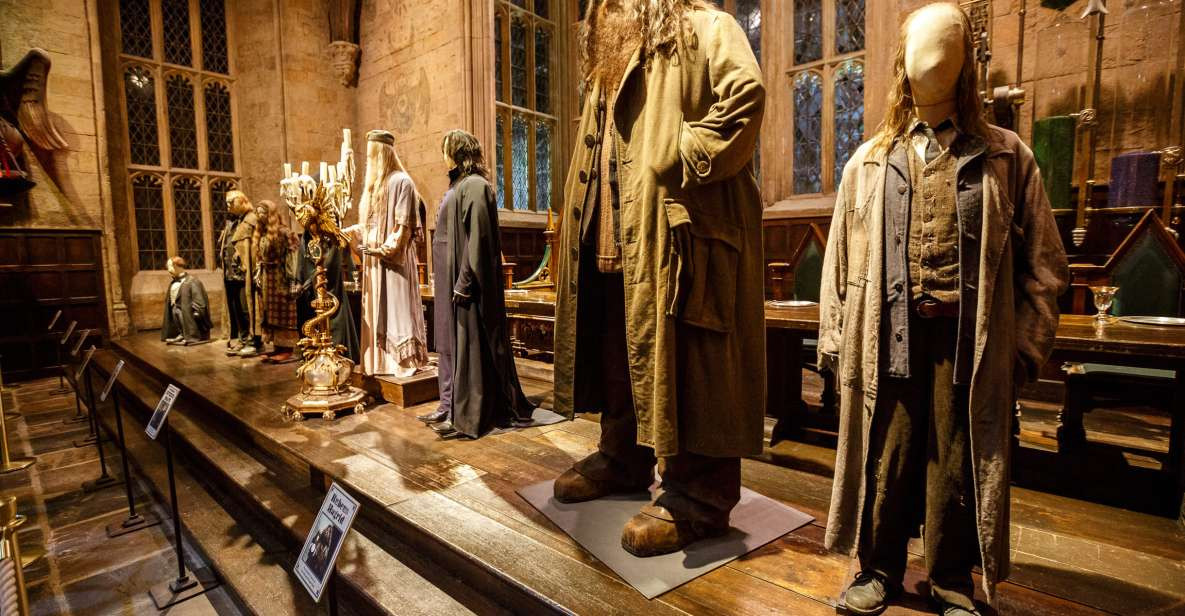
The tour begins with an act of architectural theatre. You are ushered into a dark cinema to watch a short film, a recap of the global phenomenon, a tribute to the story you already know by heart. And then, at the film’s conclusion, the screen rises, revealing a set of immense, solid oak doors. The doors to the Great Hall.
A guide invites a child from the crowd to push them open. A gasp, soft and collective, moves through the room. The shock is not one of fantasy, but of reality. The floor is made of real York stone, cold and worn underfoot. The long tables are solid English oak, their surfaces scarred with the carved graffiti of fictional students. The walls are not painted backdrops, but heavy, dressed stone. It smells of dust and old wood and a faint, lingering trace of magic, which you later realise is the smell of a decade of focused, human labour.
This is the tour’s foundational argument. The power of the illusion, it suggests, is built on a bedrock of the tangible. Before you see a single piece of visual effects wizardry, you are grounded in the physical fact of this space. It is a declaration that the magic you are about to witness was not summoned from thin air; it was built, by hand, with the same materials and the same craftsmanship used to construct a medieval church.
A Library of Things: The Power of the Prop
Beyond the Great Hall lies the heart of the collection. It is a vast, sprawling museum of things. Thousands of props, from the most significant to the most mundane, are displayed with the care of a national archive. In one cabinet, the Elder Wand and the Sword of Gryffindor. In another, the meticulously crafted, hand-lettered textbooks from the Hogwarts library, their pages filled with text that was never meant to be read on screen.
Perhaps the most striking display is the wall of wands. Thousands of individually designed wands, each housed in its own labelled box, rising from floor to ceiling. It looks less like a prop store and more like the specimen drawers in the Natural History Museum - a complete, obsessive taxonomy of a fictional world. Each wand, we are told, was designed to reflect the character of its owner. It is an absurd, beautiful, and entirely unnecessary level of detail.
This is the secret of the world’s hold on our imagination. Its reality is built not on grand, sweeping gestures, but on the accumulated weight of these small, tangible facts. The story feels true because the things are real. The texture of the parchment used for the Marauder’s Map, the satisfyingly solid clink of the Gringotts coins, the precise, spidery script of the graphic designers MinaLima on every sweet wrapper and newspaper - this is where the true magic lies. It is a particularly British kind of magic, rooted in a tradition of quiet, obsessive craftsmanship, a belief that God, or the devil, is in the detail.
The Grammar of a World
The larger sets are not backdrops; they are complete environmental arguments. Dumbledore’s office is a soaring, circular space, its walls lined with books, its air thick with the invisible weight of knowledge and history. It is a physical manifestation of a certain kind of benevolent, slightly chaotic wisdom. The Gryffindor common room, by contrast, is a womb-like space of reassuring warmth. It is deliberately shabby, with sagging armchairs and worn tapestries, designed to feel like the most comfortable and safest place in the world.
To walk through these spaces is to experience a kind of architectural psychoanalysis. You are moving through the physical representation of an idea, a feeling, a character. These are not just places where the story happens. In a very real sense, they are the story, rendered in plaster, wood, and paint.
The Unseen Architects
The tour’s greatest revelation, however, comes when it pulls back the curtain entirely. In the sections dedicated to the creature workshops and the art department, the true nature of the project becomes clear. You see the intricate, terrifying mechanics of the Basilisk’s head, the delicate animatronics that gave life to Buckbeak the Hippogriff. You see the original concept sketches, the architectural blueprints, the scale models of the castle.
This is the tour’s most profound and generous act. It demystifies the magic by celebrating the magicians. It shows you the wizard behind the curtain, and the wizard is not an all-powerful deity, but a sculptor, a painter, a carpenter, an engineer. It is an argument that the greatest magic of all is the collaborative, painstaking work of human hands and human ingenuity. The creature is not born of a spell, but of clay and silicone and the patient, brilliant work of an artist.
This celebration of craft over spectacle feels almost radical in the age of digital everything. It is a reminder that even in the most technologically advanced productions, the fundamental building block is still a person in a workshop, trying to make something imaginary feel real.
A Pilgrimage in Ordinary Time
Why do people come here? Why do they stand in line for hours to have their picture taken pushing a trolley into a brick wall on a fictional train platform? Because for a generation that came of age alongside Harry, Ron, and Hermione, this story is not just a story. It is a part of their own autobiography. For many, Hogwarts is the most stable and coherent moral universe they have ever known.
To visit Leavesden is to make a pilgrimage to the source. It is to walk through the physical spaces of a world that has, until now, existed only in the imagination. To drink a Butterbeer in the Great Hall, to step onto the Hogwarts Express - these are not empty tourist activities. They are acts of communion. They are a way of making a fictional world, for a few hours, completely and tangibly real.
Watching the faces of the visitors is as compelling as any exhibit. The quiet reverence in the Great Hall. The audible gasp when the vast, impossibly detailed model of Hogwarts is revealed. It is the look of people who have come home to a place that has never actually existed.
The Studio Tour is a monument to the power of a story. It proves that a myth does not need to be ancient to be potent. It is a physical archive of a narrative that has shaped the inner lives of millions. It is a reliquary, not of a saint’s bones, but of a generation’s shared dream. And its most powerful, most enduring magic is the simple, profound truth it reveals: that the most enchanting worlds are not found, but meticulously, lovingly, and brilliantly made.




Leave a Reply
You must be logged in to post a comment.