By Yulia Tulegenova
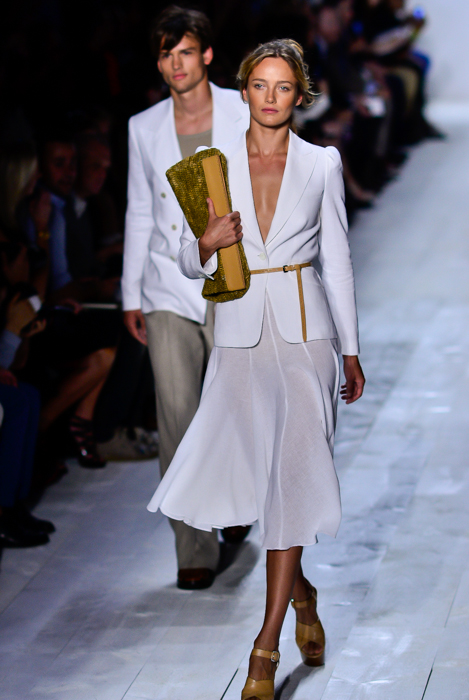
London Fashion Week opens on 17 September 2026 and runs to the 21st, with collections for spring and summer 2027. Read as an art calendar rather than a trade one, this season is unusually direct about a question the fashion industry normally leaves implicit: where does the work actually happen - on the body, in the room, or on the screen that carries it afterwards?
Two returns, and what a house name carries
McQueen comes back to the London schedule with Seán McGirr's first show for the house in the city, presenting menswear and womenswear. Mulberry returns under Christopher Kane, who presents his first collection for the label.
Both are inheritances rather than debuts. A designer who takes on McQueen inherits a visual vocabulary - tailoring as armour, romance staged as violence - that the audience knows better than it knows the current designer's own work. What makes the first London show interesting is not whether it pleases, but which parts of that vocabulary the new author keeps and which he refuses.
Around them stands the group that gives the week its recognisable surface: Burberry, Barbour, Erdem, Emilia Wickstead, Harris Reed, Richard Quinn, Roksanda and Simone Rocha. Quinn and Rocha in particular have spent a decade making garments that read as objects first and clothes second, which is why their shows are reviewed by people who otherwise write about sculpture.
When the show stops being a show
Three events this season abandon the catwalk as a format.
J.L-A.L stages an immersive presentation, followed by an afterparty with Puma. The label 5000, supported by the Paul Smith Foundation, unveils a new collection through a sound bath - the audience is placed inside a sustained field of sound rather than seated along a runway. And H&M works with Nick Knight and SHOWstudio on a special event, which brings the week back to the photographer who spent the 1990s and 2000s arguing that fashion's real medium was the image, not the garment.
These are not novelties bolted onto a trade event. They are three different answers to the same problem: a runway show lasts eight minutes and produces a sequence of frontal images, which is an efficient way to sell a collection and a poor way to make an audience feel anything. Replace the seated row with a room, or a sound, or a lens, and the collection becomes an installation with a duration.
The shop as exhibition space
The same shift shows up in retail. Dover Street Market hosts a jewellery showcase in store; Selfridges highlights an edit of British designers; eBay brings back Endless Runway, its pre-loved runway show, shoppable live and open from Thursday 17 September with daily streams from 180 Strand.
A department store that stages a show is doing what a Kunsthalle does: it selects, sequences and frames. The difference is that the visitor can buy the object off the wall - and in the case of Endless Runway, that the objects have histories, since they have already been worn by someone else.
What it means for the visual scene
Three things are worth holding on to after this week.
The first is that the most interesting fashion images this season will not come from the catwalk. They will come from rooms designed to be experienced rather than photographed, which paradoxically produces better photographs.
The second is that the audience for fashion as an object is no longer specialist. When a sound bath, a jewellery display and a second-hand runway all appear in the same five days, the boundary between an exhibition and a sales floor has become a curatorial choice rather than a fact.
The third is the inheritance question. Two historic British houses hand their visual language to new authors in the same week. Whatever those authors decide to keep will be the most consequential piece of art criticism written in London this September, and none of it will be written in words.
A format that has never been stable
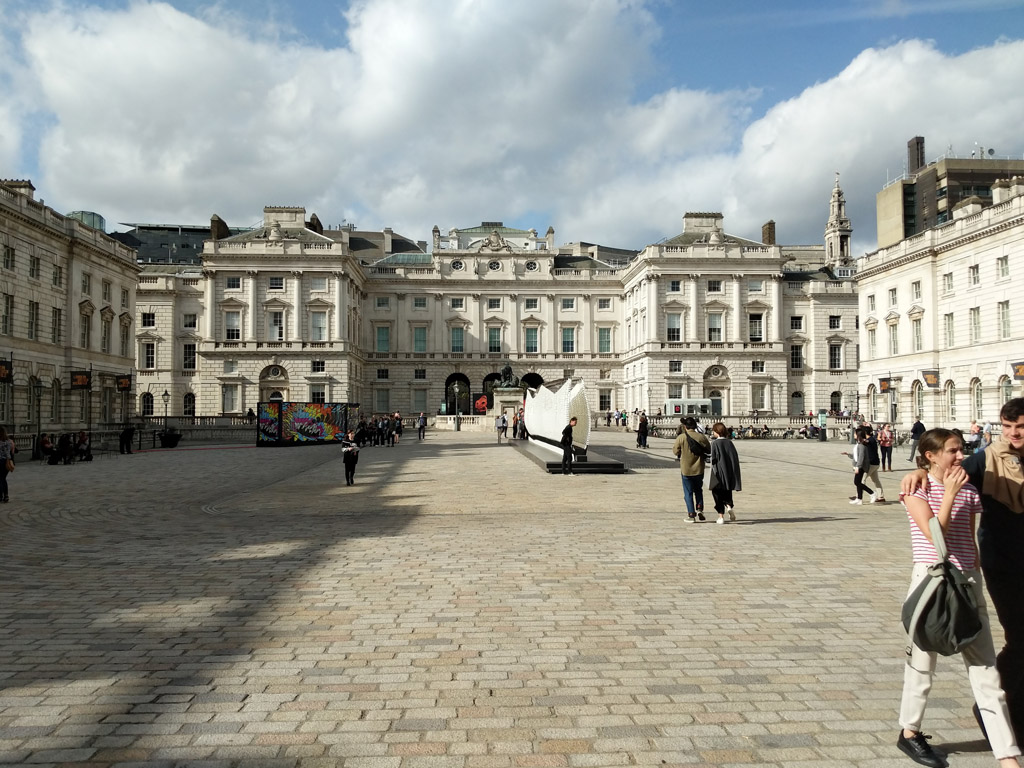
It helps to remember how recent all of this is. The British Fashion Council was founded in 1983, and the first London Fashion Week took place in 1984 in a car park at the Commonwealth Institute in Kensington, with fifteen shows including Vivienne Westwood, Ghost and Betty Jackson. The week moved to Somerset House between 2009 and 2015, then to 180 Strand from February 2017, and since February 2020 it has had no single central venue at all.
That is four homes in forty years, and the current answer is no home. For an art audience, this is the most interesting fact about fashion week as a form: unlike a biennale or a museum season, it has never settled into a building, and its architecture changes with the industry that pays for it.
One other change is worth recording. London Fashion Week has been fur-free since September 2018 - the first of the major fashion weeks to adopt the policy across its schedule. Material decisions of that kind alter what designers can make, and therefore what the work looks like, more directly than any trend.
What to look at this week
If the week is read as an exhibition, four things reward attention.
The first is silhouette under inheritance: how much of McQueen's established language survives into a new author's first London show, and how much of Mulberry's leather tradition survives Kane's.
The second is light. Immersive presentations and sound-led events are lit for the room rather than for the camera, which produces images that look unlike the rest of the season's output.
The third is the object shown without a body. A jewellery showcase at Dover Street Market, or an edit assembled at Selfridges, puts the work at eye level and lets the viewer approach it - the conditions of a gallery, applied to commerce.
The fourth is the second-hand garment. eBay's Endless Runway presents clothing that already has a history of wear. In art terms this is a provenance question, and it is being asked on a runway rather than in a catalogue.
None of these will be reviewed as art. All of them are.
Sources: the provisional London Fashion Week schedule published by the British Fashion Council (20 July 2026, subject to change), BFC announcements for the September 2026 season, and the guide to the week published by the London BGTC Society.