
By Anna Zhila
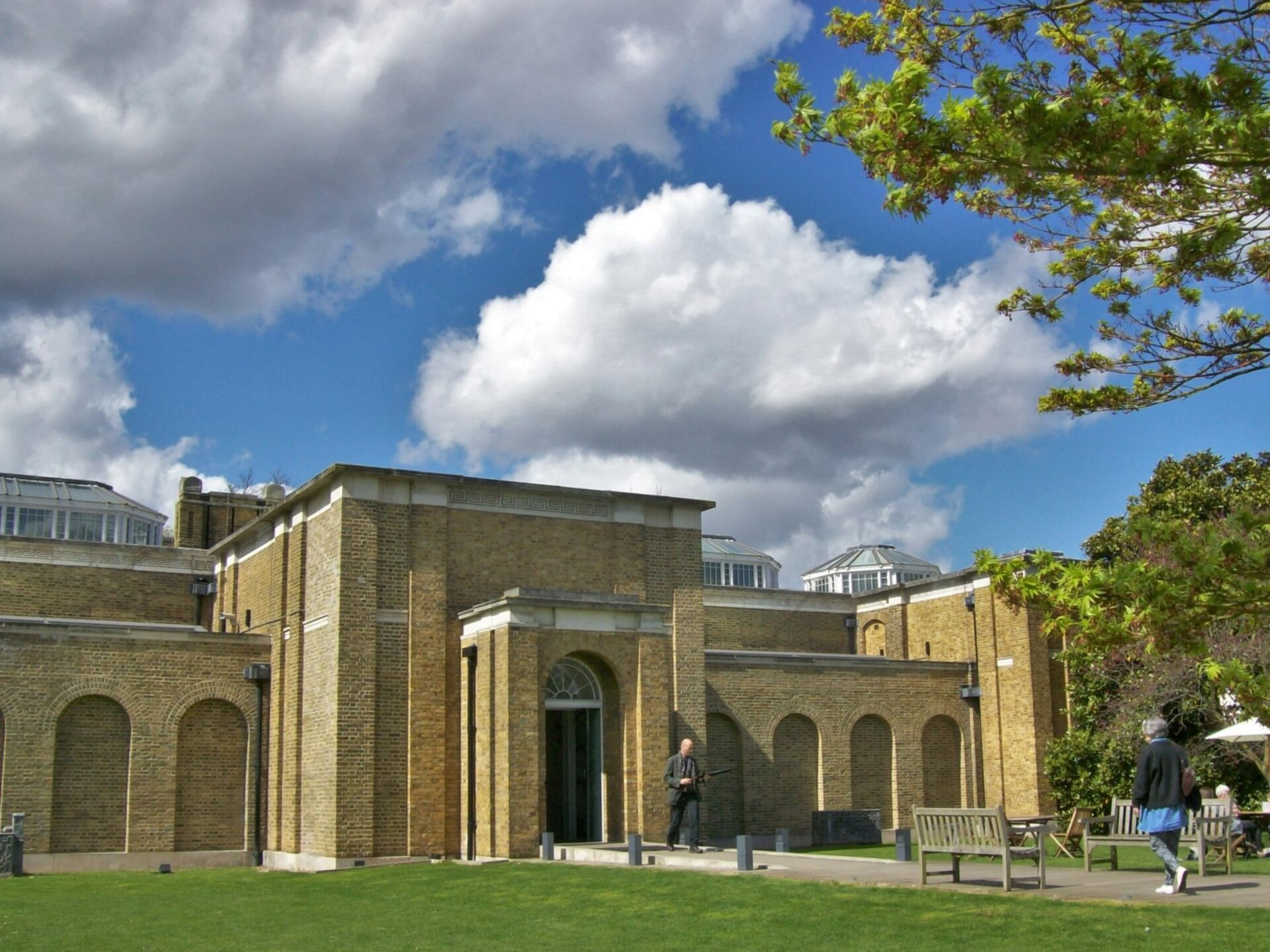
Before Dulwich, looking at great paintings in England usually required an introduction, a private appointment, or the luck of being born into the right family. Pictures lived in country houses and town mansions, hung for the pleasure of their owners and the flattery of guests. The notion that a building might exist for the sole purpose of showing art to anyone who cared to walk in was close to unheard of. That is what makes the low brick gallery in a quiet corner of south London so quietly revolutionary. Dulwich Picture Gallery, which opened in 1817, was the first building in the world designed from the ground up to be a public art gallery, and much of what followed, from the National Gallery to the museums of our own century, descends from it.
The distinction is worth pressing. Great public collections already existed by 1817, but they had been improvised into palaces and mansions. The Louvre had opened to the public in 1793 inside a former royal palace. The British Museum had received visitors since 1759 in a converted Bloomsbury house. Florence had let people into the Uffizi earlier still. What none of them had was a structure conceived, from the first line on the drawing board, around a single question: how do you show paintings well? Dulwich was built to answer it. Its architect, Sir John Soane, had to invent the solutions as he went, and those solutions are still with us.
A collection assembled for a king who lost his throne
The gallery exists because of a commission that collapsed. In 1790 two London-based art dealers, Noël Desenfans and Sir Francis Bourgeois, were asked by Stanisław August Poniatowski, the last king of Poland, to assemble a national collection of paintings for his country. They spent the next five years buying across Europe, gathering pictures with the taste and the budget of men furnishing a royal gallery.
Then history intervened. Poland was carved up by its neighbours in a sequence of partitions, the king abdicated in 1795, and the state the collection had been bought for ceased to exist. Desenfans and Bourgeois were left holding one of the finest private accumulations of Old Master painting in Europe and no buyer for it. They tried to sell, and Desenfans went so far as to propose that the British government take the pictures as the foundation of a national gallery, an idea that came to nothing. When Desenfans died in 1807 the collection passed to Bourgeois. On his own death in 1811 Bourgeois left it to Dulwich College, the charitable foundation established in 1619 by the Elizabethan actor Edward Alleyn, on the condition that it be shown to the public and to students. Money followed the pictures. Bourgeois left funds for a building, and Margaret Desenfans, Noël's widow, added substantially to them. A collection bought for a vanished kingdom became, by accident and bequest, a gift to Londoners.
Soane's problem, and how he solved it with light
Bourgeois named his friend Sir John Soane as architect. Soane, then deep into his long remaking of the Bank of England, faced a problem no one had solved before, because no one had posed it in quite this form. How do you light a room so that the paintings, and not the windows, are what the eye finds?
His answer was to bring the light down from above. Soane arranged a sequence of interconnected rooms in a single line, an enfilade, and roofed them with lanterns and skylights that drew daylight onto the walls without letting the viewer stare into a bright opening. The pictures were lit evenly and indirectly, the glare removed, the wall surface given over entirely to art. It reads as obvious now because every gallery built since has borrowed the idea. In 1817 it was a genuine invention, and it fixed the basic grammar of how we hang and light paintings.
The building itself is austere. Soane worked in yellow London brick with sparing stone dressings, laid out on an E-shaped plan in a stripped neo-Greek manner that refused ornament almost entirely. The original design even folded in a set of almshouses for poor women, later converted into further galleries in the nineteenth century. Set among the college buildings and the trees, it looks less like a temple to art than a well-mannered piece of institutional architecture, which is part of its charm. The drama is saved for the inside, and for one room in particular.
A tomb at the heart of the museum
At the centre of the building, on its main axis, Soane placed a mausoleum. This is the strangest and most affecting thing about Dulwich. The founders are not commemorated somewhere off to one side. They are buried in the middle of their own gallery, and visitors pass close to their tombs on the way to the pictures. Three sarcophagi hold Noël Desenfans, his wife Margaret, and Sir Francis Bourgeois, the three people whose thwarted commission and eventual generosity made the place possible.
Soane lit the mausoleum as carefully as he lit the galleries, but to the opposite effect. Where the picture rooms are calm and evenly bright, the mausoleum is bathed in a dim amber glow filtered through coloured glass, a deliberate sepulchral gloom that Soane cherished and returned to throughout his career. It is a small masterpiece of mood, and it anticipates the tomb-like atmosphere he would later build into his own house, now the Sir John Soane's Museum at Lincoln's Inn Fields. Very few museums ask you to walk past the graves of the people who founded them. At Dulwich, death and art share a roof by design.
What hangs on the walls
The collection Desenfans and Bourgeois gathered for a king turned out to be extraordinary, and it remains one of the finest holdings of Old Master painting in Britain. Its strengths are the Baroque schools of the seventeenth century and British portraiture of the Georgian age.
The most celebrated single picture is Rembrandt's A Girl at a Window of 1645, a young woman leaning on a sill, caught in a moment of frank and level attention that has held visitors for two centuries. It shares the walls with other Rembrandts, among them the small portrait of Jacob de Gheyn III that has become notorious for reasons of its own. It has been stolen from the gallery and recovered four times, which has earned it a reputation as the most frequently stolen artwork in the world.
Beyond the Rembrandts the depth is remarkable. There are biblical scenes and landscapes by Nicolas Poussin and the golden light of Claude Lorrain; a strong group of Rubens; portraits and religious works by Anthony van Dyck; the tender, artificial world of Watteau; and Spanish and Italian painting by Murillo, Guido Reni and Guercino. British visitors will find Gainsborough, Reynolds and Lawrence, the great portraitists of their day, alongside Venetian views by Canaletto. In all the gallery holds some six hundred paintings, a collection small enough to see properly in an afternoon and rich enough to reward a lifetime of returns.
Bombed, rebuilt, and still setting the pattern
Dulwich has not led a charmed life. In 1944 a German V1 flying bomb struck the building, wrecking the mausoleum and the western galleries. The paintings had been evacuated for safekeeping and survived. The structure was repaired and largely rebuilt in the years that followed, and the gallery reopened in 1953. In 1954 it was listed at Grade II*, the protection reserved for buildings of more than special interest, a formal acknowledgement that this modest brick box is one of the most important pieces of architecture of its age.
Soane's answers, meanwhile, became everyone's defaults. The top-lit room, the enfilade of connected spaces, the wall cleared for pictures and lit from above: these are now so standard that we forget they were ever designed by anyone. Stand in almost any gallery raised in the two centuries since, and you are standing inside a descendant of Dulwich, whether the architect knew it or not.
Why it still matters
It is easy to walk past Dulwich Picture Gallery. It sits away from the tourist circuit, a low building among trees in a suburb most visitors to London never reach. Yet it holds a claim that few buildings anywhere can make. It was the first of its kind, the prototype for an idea we now take entirely for granted, that art belongs in public and deserves a building of its own. The collection was gathered for a king who lost his kingdom and given instead to ordinary people. The architect solved a problem no one had thought to set and, in solving it, drew the template for two centuries of museums. And at the centre of it all, lit by amber glass, lie the three founders who meant to furnish a palace in Warsaw and ended up inventing the public art gallery in Dulwich. It remains one of the quietly essential places in British culture, and one of the most rewarding to seek out.





One response to “The Gallery That Invented the Gallery - Dulwich, John Soane and a King's Lost Collection”
[…] resolution. Readers who enjoy that kind of argument in built form may also like our piece on Dulwich Picture Gallery, a building that solved a very different problem in […]