By Yulia Tulegenova
Frieze Sculpture opened on 16 September 2026 and runs to 1 November in the English Gardens of The Regent's Park. Entry is free, the gates are the park gates, and the exhibition stays open for seven weeks, which makes it the longest part of the Frieze season and the only one open to everyone. The fairs arrive later: Frieze London and Frieze Masters run from 14 to 18 October in the same park, with 14 October reserved for invitations and public days from 15 October.
This is the 14th edition of the outdoor show and the fourth curated by Fatos Ustek. Eleven international artists take part, and the edition has a stated theme: hybridity. Ustek frames it as sculpture understood as a living and adaptive language, shaped by natural and urban ecologies at once. Her invitation to visitors is plain: step outside daily rhythms and let the works propose other ways of thinking and feeling.
The eleven names
The full list, confirmed in the July announcement: Ivana Basic, Carolina Aguirre, Matyas Chochola, Conrad Shawcross, Angel Otero, Douglas White, Elena Nemkova, Ozlem Gunyol and Mustafa Kunt, Ramesh Mario Nithiyendran, Tarini Sethi and Catriona Robertson. Galleries present new commissions alongside recent loans, including Hauser and Wirth, Victoria Miro, Albion Jeune, Jhaveri Contemporary with Sullivan and Strumpf, Leila Heller, Rajiv Menon Contemporary, Dirimart, Dom Art Gallery, Ruttkowski;68, The Chemistry Gallery and The Muse Gallery.
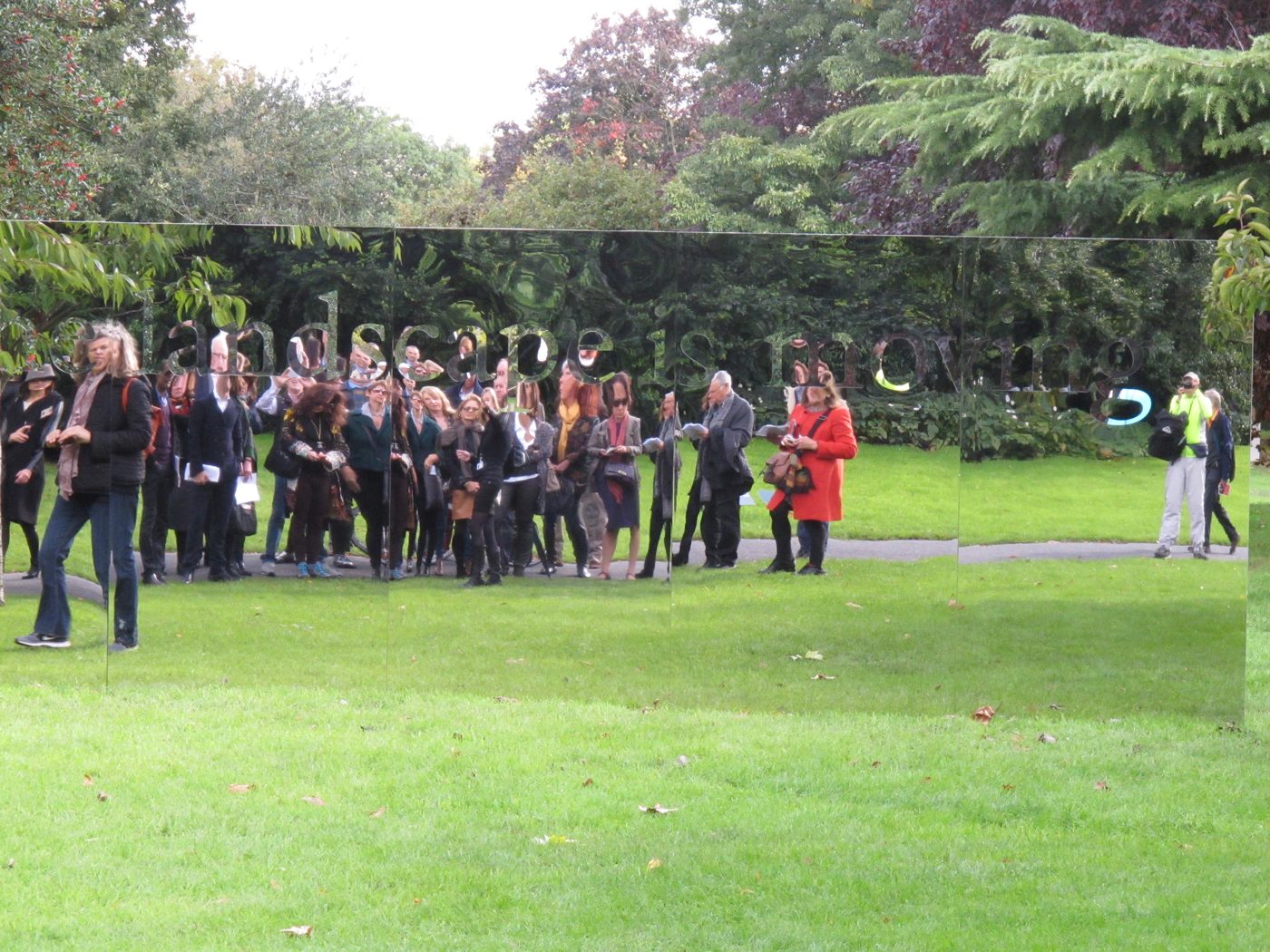
Four works give the fastest sense of the theme. Angel Otero shows Dreams and Salt, a threshold form that reads as a doorway leading below the surface of the lawn. Ivana Basic shows Metanoia, a brutalist monument first seen in 2025 with Albion Jeune. Tarini Sethi shows The Sun Bathes Its Friends and Neighbours, four interconnected stainless steel screens cut with imagined utopian scenes, with Rajiv Menon Contemporary. Ramesh Mario Nithiyendran shows Warrior Figure, a vivid dual faced idol, with Jhaveri Contemporary and Sullivan and Strumpf. Around them: Conrad Shawcross with Victoria Miro, Douglas White with Black Palm and Leila Heller, Carolina Aguirre with Held, Matyas Chochola with three works from 2024, Ozlem Gunyol and Mustafa Kunt with Possibilities for a Sculpture, and Elena Nemkova with Agony in the Garden, a new commission supported by the Mtec Bursary awarded this year to Dom Art Gallery.
The eleventh is the one that answers the theme most literally. Catriona Robertson shows WYRM with The Muse Gallery: gargantuan worm like forms that surface and burrow through the lawn, a speculative ecology in which nature takes back the built environment through the cracks in its own concrete. Robertson works with construction waste and cast fragments of the city, so the material is the argument.
How to see it
The works are sited through the English Gardens at the southern end of the Broadwalk, between the two fair sites. Free curator led tours start at the St Andrew's Gate entrance. The audio guide, narrated by Ustek, sits on the Bloomberg Connects app, which this year adds a dedicated Family Guide with an audio track built for children. No ticket, no time slot, no bag rule: the park conditions apply, not the fair conditions.
The exhibition is also part of London Sculpture Week, 19 to 27 September 2026, alongside the Fourth Plinth, East Bank, Sculpture in the City and The Line. Eva Langret, director of Frieze EMEA, called the outdoor show one of the most open and immediate ways to experience Frieze in London: for seven weeks it brings artists, galleries and audiences together in the park, extending the energy of the fairs into the public realm.
Why it matters before the fairs open
The fairs are commercial rooms by design. Frieze London gathers 172 galleries from 42 countries with a contemporary cutoff around 2000, plus curated strands for new commissions and young galleries: The Code Universe, curated by Carol Yinghua Lu with Ohtake, Kadan, Lazard and Selman; the fourth Artist to Artist selection with nominators including Shonibare, Nkanga, Baez, Gibson and Giovanelli; Focus for younger programmes; Editions for accessible prints. Frieze Masters, with nearly 140 galleries, works the longer range from antiquities to the twentieth century, with Spotlight under Singh and Gotti, Queering Modernism conceived by Kempkes, Reflections curated by Bangser, and the Masters Talks with dunhill under the title Breaking the Mould.
The park show reverses the logic. One audience pays for a timed ticket, enters through a bag check, and cannot re enter. The other walks in from the street and meets the same galleries' artists at full scale, in weather, among dogs and runners. For a viewer deciding where to spend attention, the free half is the better test of whether a work holds a site rather than a booth.
A short institutional memory
Frieze began as a magazine in 1991, founded by Amanda Sharp, Matthew Slotover and Tom Gidley. Frieze London followed in 2003, Frieze Masters and Frieze New York in 2012, the Mayfair room at No.9 Cork Street in 2021. The calendar now spans London, New York, Los Angeles, Seoul and Abu Dhabi. The outdoor edition has become the public face of that operation in London, and its hybridity brief fits the setting: a historic garden that already mixes planting, sport, traffic and wildlife before any art arrives.
What to look at
Start with thresholds. Otero's doorway, Basic's monument and Sethi's screens all stage a passage between one state and another, which rewards walking through and around rather than photographing from the front. Then look at surfaces: stainless steel, pigment, brutalist mass and woven detail behave differently in September light and October rain, and the same work changes across the seven weeks. Finish with scale against planting. The worm forms and the dual faced idol read as garden follies until their references land, which is the point where public sculpture either earns its site or becomes decoration.
Practically, the visit is governed by the park rather than by the art. Pedestrian gates open at 5am and close at dusk, and dusk moves earlier every week of the run: by the end of October the gardens go dark not long after half past four, so an afternoon in late October is a short afternoon. Regent's Park station is about five minutes away, Great Portland Street and Baker Street a little further, Camden Town the sensible approach from the north. There is no entrance, no bag rule and no cloakroom, and an hour is enough to see all eleven works without hurrying.
Frieze London and Frieze Masters open 14 October for invitations and 15 to 18 October for ticket holders, with combined tickets, a free shuttle between the two sites, and tickets sold online in advance for a set date and time. The park needs none of that. It is open now.
Sources: the Frieze Sculpture 2026 announcement on frieze.com (20 July 2026); Frieze visitor information, tickets and FAQs pages; the London BGTC Society guides to Frieze Sculpture 2026 and to Frieze London and Frieze Masters 2026 (updated 17 and 13 September 2026); FAD Magazine artist line up report (21 July 2026); ArtPlugged's full list of the eleven artists, works and galleries; The Royal Parks opening times for The Regent's Park. Dates and programmes may change; confirm on frieze.com before visiting.